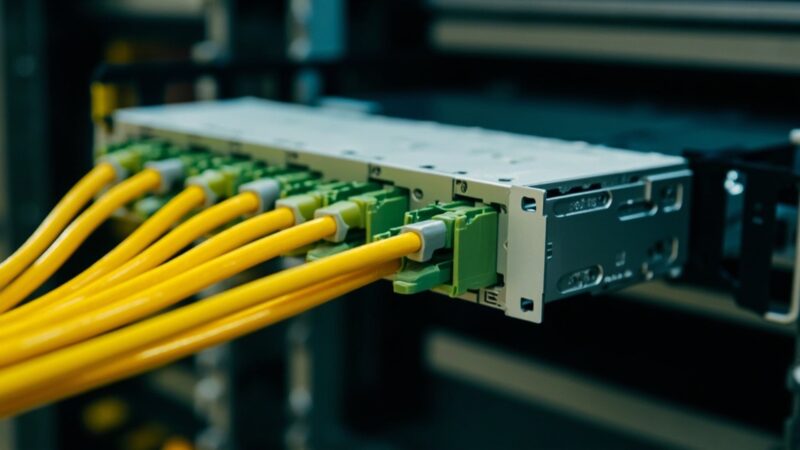
DAC vs AOC vs single-mode fiber: the cabling decision that defines your 5-year budget
Choosing between DAC (Direct Attach Copper), AOC (Active Optical Cable), and single-mode fiber optic is not an isolated technical decision: it defines the cost per switch port, the project’s cabling budget, and the ability to grow without replacing cable runs within five years. In medium-sized data centers in Mexico, a poor choice often translates into an over-investment of 30% to 40% in cabling infrastructure, or into operational bottlenecks when the rack demands more density than the cabling supports.
All three technologies solve the same physical problem: connecting a switch to a server, or two switches to each other, carrying 10G, 25G, 40G, 100G, or 400G over a physical medium. The difference lies in the conductor material, the integrated electronic-to-optical converter, and the maximum distance each one can cover without losing signal. Understanding those three axes is what allows designing a topology that survives the cluster’s growth without rewriting the budget.
What each technology solves and why the price diverges so much
All three connectors share the QSFP (Quad Small Form-factor Pluggable) or SFP (Small Form-factor Pluggable) form factor, which makes them interchangeable in the same switch port. What changes is what is inside the module:
- DAC (Direct Attach Copper): Twinaxial copper cable with the transceiver integrated at both ends. No active optical components, low latency, lower cost, but limited to short distances (typically up to 7 meters for 100G).
- AOC (Active Optical Cable): Multimode fiber optic with the transceiver integrated at both ends and the electrical-to-optical converter inside the connector. Covers medium distances (up to 30 meters at 100G, up to 100 meters at 25G) with lower weight and diameter than the equivalent DAC.
- Single-mode fiber optic: OS2 fiber patch cord with a separate SFP/QSFP transceiver at each end. Covers long distances (up to 10 km and beyond), but requires more expensive optical transceivers and clean splices to maintain the loss budget.
100G technical comparison: distance, latency, and cost per port
The following table compares the three media on a real-world case: ToR (Top of Rack) link between an aggregation switch and a server in the same rack or in neighboring racks, at 100G per port. Prices are typical market ranges for Latin America in 2025-2026 and may vary by volume and transceiver brand (FS, Cisco, Arista, NVIDIA/Mellanox).
| Characteristic | DAC 100G | AOC 100G | Single-mode fiber 100G |
|---|---|---|---|
| Maximum distance | ~5 m | ~30 m | up to 10 km |
| Typical latency | ~0.1 µs/m | ~0.5 µs/m | ~0.5 µs/m (limited by transceivers) |
| Approximate cost per port | USD $80-150 (approx. $1,400-2,625 MXN at 17.5 MXN/USD) | USD $200-350 (approx. $3,500-6,125 MXN at 17.5 MXN/USD) | USD $400-700 fiber + USD $300-500 transceiver (approx. $7,000-12,250 MXN + $5,250-8,750 MXN at 17.5 MXN/USD) |
| Power per port | ~1.5-2.5 W | ~1-2 W | ~2-3.5 W |
| Weight (3 m cable) | ~0.6 kg | ~0.2 kg | ~0.1 kg + transceiver |
| EMI emissions | High (copper) | Negligible | Negligible |
| Field replaceable transceiver | No (integrated) | No (integrated) | Yes |
When DAC makes sense in your top-of-rack
DAC remains the dominant option for links within the same rack or between adjacent racks. Its cost-performance ratio is hard to match when physical space allows: a 3-meter DAC cable for 100G costs a fraction of the optical equivalent and requires no separate transceivers.
The decision favors DAC when three conditions are met: the ToR-to-server distance is under 5 meters, the rack does not exceed 15 kW of power (because the DAC dissipates some additional heat), and the project prioritizes low CAPEX over future flexibility. For hyperscale sites with 40-50 kW racks, this last condition almost never holds.
When AOC makes sense for medium-distance connections
AOC covers the middle range: distances of 5 to 30 meters where DAC no longer reaches and single-mode fiber with a separate transceiver is expensive for point-to-point links. This is the typical case of ToR to leaf switch in different compartments of the same data center, or aggregation between rows.
Two concrete advantages over DAC: AOC does not generate electromagnetic interference, which lets it run alongside power cabling without special separation precautions, and its weight and diameter are significantly lower, which reduces the load on overhead cable trays. The drawback is that the integrated transceiver cannot be replaced: if the cable fails, the entire AOC is replaced.
When single-mode fiber optic makes sense
Single-mode fiber enters the equation when the distance exceeds 30 meters, when margin is needed for future rack relocations, or when the goal is to standardize the physical infrastructure so it serves 100G today and 400G tomorrow by only swapping the transceiver. In sites aiming for TIA-942-C (Telecommunications Infrastructure for Data Centers) certification, single-mode fiber is practically mandatory in the backbone.
The total cost of ownership tends to be lower than a tangle of AOC over long distances, because the transceiver can be reused and the fiber is cheap per meter. The penalty is operational complexity: every connection requires connector cleaning, OTDR testing (Optical Time Domain Reflectometer, an instrument that measures reflectivity and loss along the fiber), and a minimum stock of spare transceivers to avoid prolonged maintenance windows.
How to build a five-year cabling budget without coming up short
The most expensive mistake in cabling projects is sizing only for the current configuration. A good exercise is to project three variables over five years: rack density (kW and ports), target uplink speed (10G, 25G, 100G, 400G), and cluster growth rate. With that in hand, the decisions tend to clarify:
- If the speed is going to jump to 400G within three years: single-mode fiber from day one. DAC at 400G is on the market but its power draw and cost per meter make it prohibitive beyond 2 meters.
- If the cluster will stay at 25G-100G: AOC for 5-30 meters and DAC inside the rack. The single-mode fiber investment can be deferred without operational penalty.
- If the data center has relocation expectations: single-mode fiber or AOC at the maximum available length. Patch panel changes are much cheaper than replacing complete cable runs.
As a validation rule, a cabling audit at 12-18 months of operation should show less than 10% of links in failed or intermittent state. Higher percentages usually indicate undersizing of the medium type or poor transceiver quality. At hyperscale sites that threshold drops to 2-3%, because the metric maps directly to cluster availability.
Sources
[1] IEEE 802.3 Ethernet Working Group — https://www.ieee802.org/3/
[2] TIA-942-C — Telecommunications Infrastructure for Data Centers — https://tiaonline.org/product/tia-942-c/
[3] FS.com — DAC vs AOC: which to choose and why — https://www.fs.com/blog/dac-vs-aoc.html
[4] Wikipedia — QSFP (Quad Small Form-factor Pluggable) — https://en.wikipedia.org/wiki/QSFP
[5] Wikipedia — Fiber-optic cable — https://en.wikipedia.org/wiki/Fiber-optic_cable
Want to master this?
Noxtel Academy →