What is ToR vs EoR vs MoR: the 3 data center switch topologies that confuse 80% of operators

Qué es un ToR vs EoR vs MoR: las 3 topologías de switch en data center que confunden al 80% de los operadores

When a provider sells you “leaf-spine design with ToR”, they are selling you an architecture decision with a 5 to 10 year total cost of ownership, not a topology detail. The difference between Top of Rack, End of Row and Middle of Row in cabling cost, latency, port cost and ease of operation is the difference between a project that closes financially and one that doesn’t. And the decision is even harder when you’re sizing for an AI cluster where each GPU costs more than all the rack cabling.

This article breaks down the three topologies, the decision criteria, and the 3 errors I’ve seen in Mexican sites choosing the wrong topology by following switch provider marketing.

What each topology means (without marketing jargon).

The three topologies are defined by where you place the access switch (the one connecting the servers in the rack) and how you run copper or fiber cabling up to the aggregation or spine switch.

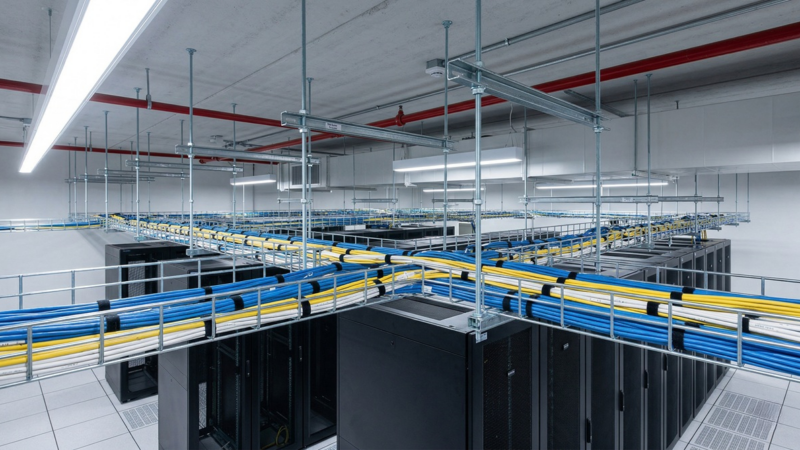
  1. Top of Rack (ToR): the access switch goes at the top of the rack. Each server connects to the ToR switch with a short patch cord of 1 to 3 meters (DAC or AOC for 10G/25G/100G, fiber for 400G/800G). From the ToR switch, long uplink cables (MPO/MTP fiber) go to spines or aggregation switches in the MDA. It is the dominant topology in hyperscale and most modern DCs.
  2. End of Row (EoR): the access switch is in a dedicated cabinet at the end of the row, not in the server rack. Each server connects with a long copper or fiber cable (between 5 and 25 meters depending on position in the row) to the EoR switch. Reduces the number of physical switches in the network (more density per switch) but multiplies horizontal cabling.
  3. Middle of Row (MoR): the access switch is placed in a cabinet in the center of the row. It’s a compromise between ToR and EoR: maximum server cable length is halved compared to EoR, and cabling management is more organized than ToR when racks are very close together. It’s rarely seen in new sites today, but still useful in modernizations where you already have horizontal cabling.

The 5 dimensions that matter for choosing.

The decision among the three is not only technical. There are five variables that weigh, and each pushes you in a different direction:.

  • Rack density: higher density (more kW and more servers per rack), ToR wins because short cabling reduces disorder and weight on the upper patch panel. Below 10 kW per rack, the difference is marginal.
  • Server type and speed: for 1G/10G servers with copper interfaces, ToR allows short and cheap patch cords. Also for 25G/100G with DAC. For 400G/800G with fiber, the difference between ToR and EoR dilutes because both need fiber, and fiber cost dominates over cable length cost.
  • Site size and number of racks: ToR scales better than EoR beyond 30-50 racks. Below 20 racks, EoR can be simpler to operate and cheaper because it consolidates switches.
  • Operations team: if your operations team is used to managing switches in dedicated cabinets (carrier operation), EoR will feel familiar. If they’re closer to hyperscale/cloud culture, ToR is the natural option.
  • 5-year total cost of ownership: in sites of 50 to 200 racks, ToR typically closes with TCO 8-15% lower than EoR due to reduced horizontal cabling, greater flexibility to add capacity rack by rack, and lower failure risk from long cable handling.
  • When ToR is the correct answer.

    ToR is the dominant choice in three scenarios:.

  • Hyperscale or cloud sites with 15 kW to 40 kW racks. Each rack is independent in compute and network, and operation benefits from dedicated switches per rack. Examples: an AI GPU cluster, a Kubernetes pod with 40 racks, a dense storage zone.
  • Sites that grow fast by individual racks. If the growth pattern is adding 1 or 2 racks per month, ToR lets you scale the network in parallel without touching the rest of the site. EoR forces you to re-size the row switch every time you add a rack.
  • Operation with short cables and high port density. ToR allows 1-3m patch cords that are cheap, easy to replace, and minimize damage risk from movement. In sites where cabling is touched several times per month (frequent provisioning), this translates to fewer incidents.
  • When EoR still wins.

    EoR is not a relic. There are three cases where it remains the best decision:.

  • Small or medium sites (under 20 racks) where consolidating switches reduces CAPEX. Buying 2 EoR switches of 48 ports is cheaper than buying 20 ToR switches.
  • Legacy or modernization sites where horizontal copper Category 6A or 6 cabling already exists, and replacing it would be throwing away the investment. EoR with existing cabling can be the right decision to extend useful life 3 to 5 more years.
  • Operation with facility staff closer to traditional IT than cloud. EoR keeps the access network in dedicated cabinets, outside compute racks, simplifying switch changes without touching servers.
  • When MoR makes sense (niche case).

    MoR is the least common topology today, but has a real niche:.

  • Long rows (more than 15 racks per row) where ToR generates long patch cords in extreme racks, and EoR cables too long in middle racks. MoR divides the row in half, limiting horizontal cabling to about 8-10 racks on each side.
  • Brownfield where existing cabling routes run through the center of the row, not overhead. Reusing central ducts and pathways is cheaper than building overhead.
  • The 3 most common errors when choosing switch topology.

  • Copying hyperscale provider topology without adjusting to context: Microsoft and Google use ToR at 40 kW per rack with DAC cables. If your DC is 8 kW per rack with general-purpose servers, copying the topology leaves you with inflated CAPEX and marginal benefit. Adapt, don’t copy.
  • Ignoring cabling total cost of ownership: Category 6A copper cable at 25 meters costs 8 times more than the same cable at 3 meters, and occupies 8 times more pathway space. In large sites, ToR closes TCO better precisely because it minimizes linear meters of horizontal cable.
  • Not planning the transition between topologies: if you start with EoR and in 3 years migrate to ToR (because density increased and you need switches per rack), horizontal copper cabling becomes scrap. Some topology decisions are made thinking about the site at 7 years, not 3. Consider whether density will rise before choosing the initial topology.
  • The verdict.

    For most new data centers in Mexico with more than 30 racks and densities of 10 kW and up, ToR is the correct answer. Initial investment is slightly higher, but 5-year TCO closes better, operation is simpler, and flexibility to add capacity rack by rack is worth it. EoR remains the correct decision for small sites, brownfield, or where network operation is centralized. MoR is a niche case that applies only in long rows or existing physical constraints. The decision is not made looking at the switch provider brochure; it’s made looking at your current density, your growth pattern, and your operations team composition.

    Sources

    TIA-942-B-2023 — Telecommunications Infrastructure Standard for Data Centers (Cabling topologies) —.https://www.tia.org/standards.

    Cisco — Data Center Spine-Leaf Architecture Design Guide —.https://www.cisco.com/c/en/us/products/collateral/switches/nexus-9000-series-switches/white-paper-spine-leaf-architecture.html.

    IEEE 802.3 — Ethernet Standard (10G/25G/100G/400G/800G PHY specifications) —.https://standards.ieee.org/ieee/802.3/6228/.

    Uptime Institute — Data Center Site Infrastructure Tier Standard (Tier Classification System) —.https://uptimeinstitute.com/resources/asset/tier-classification-system.

    ANSI/TIA-568.2-D — Balanced Twisted-Pair Telecommunications Cabling —.https://www.tia.org/standards.

    Want to master this?

    Noxtel Academy →
    Also in Fiber Optic Cabling

    ← Back to categories