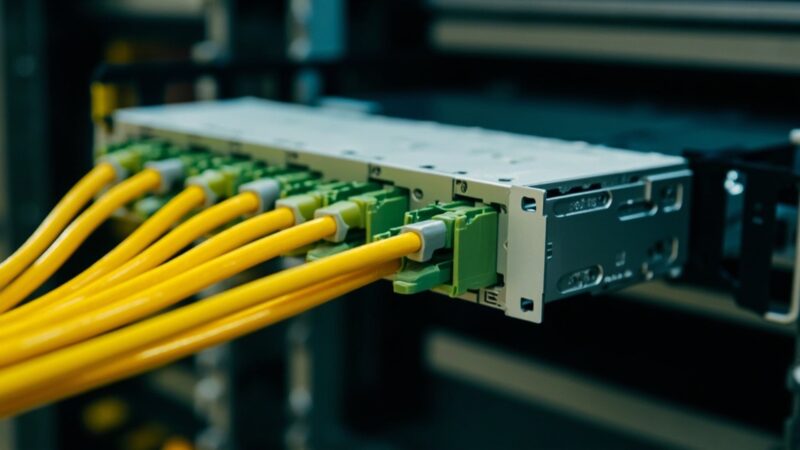
What is an SFP vs QSFP vs OSFP transceiver and why it matters for 800G migration in 2027
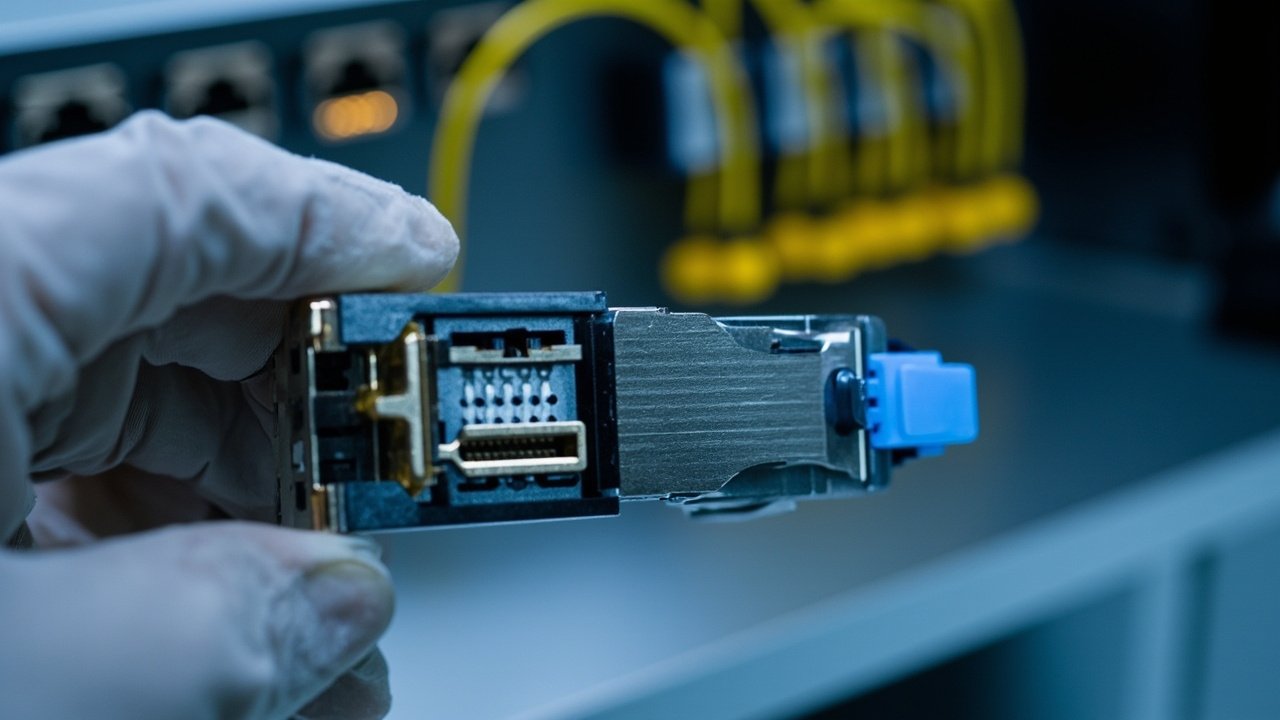
The transceiver is not the cable — and the difference decides your migration project
When a client asks you for an 800G link next year, what they are asking for is not “more fiber”. It is an optical transceiver with a specific form factor that has to fit the port of your current switch — or force you to change the switch. The choice between SFP, QSFP and OSFP is not a technical preference. It is a migration path.
If you are going to deploy 800G in 2027 — the date hyperscalers are consolidating their data center Ethernet roadmap — you need to understand why OSFP has already won the AI race and why QSFP-DD is in its last production generation at that speed [Source: LINK-PP 1.6T Optical Transceiver Roadmap, l-p.com, 2026].
What a transceiver is and why the form factor matters
An optical transceiver is the module that plugs into a network port and converts the equipment’s electrical signals into light pulses that travel over optical fiber. The form factor is the module’s mechanical and electrical shape — its size, its connector, how it seats in the port, its maximum power draw and its thermal design.
Three families have dominated the market since 2001:
| Form factor | Channels | Per-channel speed | Typical total speed | Typical power draw |
|—|—|—|—|—|
| SFP / SFP+ / SFP28 / SFP56 | 1 | 1 G / 10 G / 25 G / 50 G | up to 50 G | < 1.5 W |
| QSFP / QSFP+ / QSFP28 / QSFP-DD / QSFP-DD800 | 4 / 8 | 25 G / 50 G / 100 G / 200 G | 40 G → 800 G | 3.5 W → 12-14 W |
| OSFP / OSFP1600 / OSFP-XD | 8 / 16 | 100 G / 200 G | 800 G → 1.6 T → 3.2 T | 12-25 W → 33 W |
[Source: NADDOD, The Evolution of 400G, 800G, and 1.6T Optical Modules, naddod.com, 2026]
SFP (Small Form-Factor Pluggable) is the original part, with a single lane. What you have in your SFP28 port today is probably a 25 G link. QSFP (Quad Small Form-Factor Pluggable) doubles the number of lanes in roughly the same mechanical size — four fiber lanes instead of one. OSFP (Octal Small Form-Factor Pluggable) doubles it again: eight lanes, larger in physical footprint but with more thermal headroom.
Why OSFP wins the transition to 800G and 1.6T
QSFP-DD800 — the QSFP-DD version that supports 800G — is at its thermal limit. Module power in QSFP-DD800 runs around 12 to 14 W, manageable in mature switch designs. But the jump to 1.6T demands modules of 25 to 33.5 W to maintain reach over single-mode fiber and support higher-order PAM4 modulation [Source: Ascent Optics OSFP 1.6T Technical Guide, ascentoptics.com; FiberMall 1600G Roadmap, fibermall.com, 2026].
QSFP-DD cannot dissipate that power with its current heatsink design. The OSFP-XD (eXtended Density) extends the original OSFP footprint to accommodate up to 33 W per module with larger-surface heat sinks, and leaves a migration path to 3.2 T without hardware change [Source: Ascent Optics OSFP 1.6T Technical Guide].
The leading hyperscale switch manufacturers (Arista, Cisco, NVIDIA/Mellanox, Juniper) already offer OSFP as the default option in their 800G/1.6T-ready lines. QSFP-DD800 remains as an option in legacy switches and in the server segment where the upgrade is more conservative.
When to migrate to 800G — and when not
Migrate to 800G when:
- You have GPU/NIC clusters that demand ≥ 400 G per server (NVIDIA ConnectX-7/8, BlueField-3) and the aggregation of racks exceeds the headroom of your current 400G uplinks.
- You are deploying fat-tree or rail-optimized architectures for AI fabric where uniform speed between nodes reduces training fragmentation.
- Your current switch is already at the end of its support life and the migration to OSFP is unavoidable with the new generation.
Stay at 400G when:
- The main workload is north-south traffic (client → server) rather than east-west (server ↔ server).
- Your OS2 fiber cabling budget is limited and you want to maximize the number of links per fiber pair (QSFP-DD breakouts of 4×100G or 4×200G remain the most cost-efficient pattern per Gbps for this segment).
- The timeline for the migration to 1.6T is > 3 years for your specific site.
The cost per Gbps difference — a concrete number for a CFO
2026 prices on the open market for 800G modules:
- OSFP 800G SR8 (100 m OM4 reach): $700 – $1,200 USD per module.
- QSFP-DD800 SR8 (same application): $650 – $1,100 USD.
- OSFP 800G DR8 (500 m OS2 reach): $1,000 – $1,800 USD.
- QSFP-DD800 DR8: $950 – $1,700 USD.
[Source: average 2026 wholesale market ranges, Mar-Tech Optical, qsfptek.com, FS.com]
The difference between OSFP and QSFP-DD is marginal at module level. What costs money is the switch: a 64-port OSFP 800G chassis is at $35,000 – $60,000 USD; a 32-port QSFP-DD800, $18,000 – $30,000 USD. The architecture decision is not made at transceiver level, but at switching platform level.
What you need to be clear about BEFORE requesting your RFP
1. Current port footprint. Does your switch have QSFP-DD or OSFP bays? If mixed (some modern switches accept both via adapters), confirm with the manufacturer which optics they recommend.
2. Required fiber reach. < 100 m → SR8 (multimode OM4/OM5). 100 m – 500 m → DR8/FR4 (single-mode OS2). 2 km – 10 km → coherent (LR4/ZR). Each one has its own optics and cost.
3. Port cooling. OSFP dissipates more heat. If your switch is in a 42U rack with 1.6 kW thermal budget per U, OSFP can force density reduction.
4. Manufacturer’s roadmap. Ask your vendor: will the next 1.6T generation of your platform support QSFP-DD or only OSFP? The answer decides your 2-year upgrade path.
5. Compatibility with your current NIC. Do your servers have ConnectX-7 (QSFP-DD) or BlueField-3 (OSFP)? Mixing server and switch platforms with different form factors requires breakout cables that cost between $200 and $800 USD per link.
800G in 2027 — what to expect
Hyperscalers (AWS, Google, Meta, Microsoft) already deployed > 100,000 800G ports in production during 2025-2026, mostly OSFP. The ecosystem expectation is that 2027 will be the year of 800G consolidation (the technology becomes mainstream in the enterprise segment) and 2028-2029 will be the migration to 1.6T. OSFP1600 and OSFP-XD are the canonical form factors for that migration [Source: LINK-PP 1.6T Optical Transceiver Roadmap, 2026].
QSFP-DD does not die — it remains the option for 400G/800G in existing switches. But the QSFP-DD production line beyond 800G is no longer guaranteed. If your 3-year capacity plan demands 1.6T, buy OSFP today even if you only use 400G/800G — the upgrade path is direct. If your plan stays at 800G, QSFP-DD800 remains defensible until the end of its useful life.
Sources
- LINK-PP — 1.6T Optical Transceiver Roadmap for Future Data Centers, l-p.com
- Ascent Optics — OSFP 1.6T Optical Transceiver Complete Technical Guide, ascentoptics.com
- NADDOD — The Evolution of 400G, 800G, and 1.6T Optical Modules, naddod.com
- FiberMall — 1.6T Optical Module Roadmap, fibermall.com
- QSFPTEK — OSFP vs OSFP-XD Which Delivers Better 1.6T Transceiver Performance, qsfptek.com
Want to master this?
Noxtel Academy →