Power chain in a data center: emergency plant + UPS + distribution (how to size resilience)
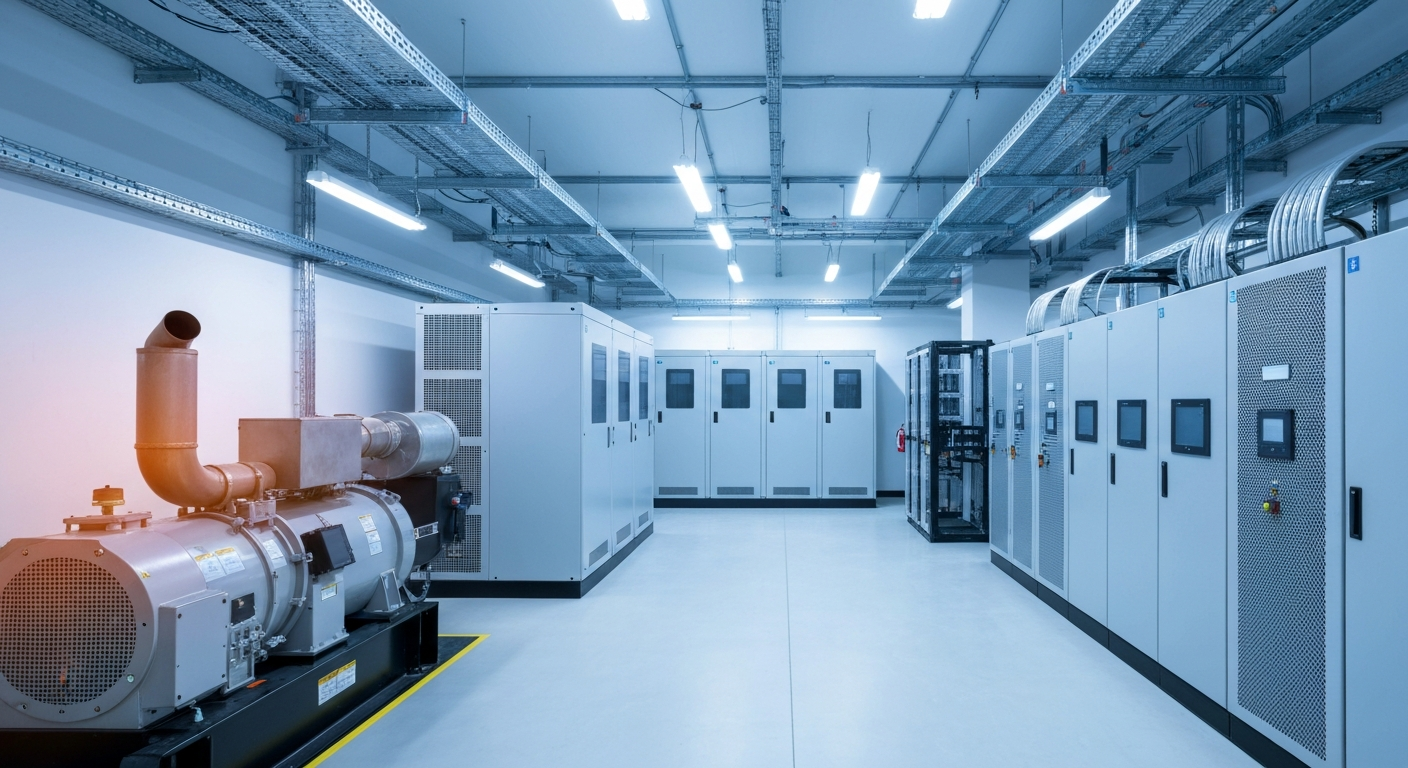
The electrical continuity of a data center is not sustained by a single piece of equipment: it is sustained by three links that must operate in coordination during grid failures, voltage sags, transients, and scheduled maintenance. When one of the three links fails, the other two mask the problem for a limited time, and the site goes down.
This article describes the complete electrical chain of a data center — from the utility service entrance to the final contact at the rack — and why each link has its own criticality, its own sizing logic, and its own test protocol.
The three links of the electrical chain
A robust data center electrical chain has three main components in series, each with a distinct function:
- Emergency plant: Diesel or natural gas generator that starts when the utility grid fails. It delivers mechanical power converted to electrical power to keep the site running during the grid outage, until the grid returns or fuel runs out.
- UPS (Uninterruptible Power Supply): Battery-backed system that bridges the time between the grid failure and the emergency plant reaching stable operation. It also filters transients from the grid during normal operation.
- Distribution: PDUs (Power Distribution Units), isolation transformers, transfer switchboards, and final cabling that carry power from the UPS to each rack.
Each link covers a different time window and a different failure mode. The chain works because the three complement each other.
Emergency plant: the first and most critical link
The emergency plant (typically a 1-5 MW diesel generator for medium-sized data centers) kicks in when the utility grid fails. The IEEE 446 standard (Recommended Practice for Emergency and Standby Power Systems) and the NFPA 110 and NFPA 70 (US National Electrical Code) standards define the sizing and testing criteria.
The criticality of the emergency plant sits in three variables:
- Startup time: A diesel generator takes between 10 and 30 seconds to reach stable voltage and frequency. The UPS must cover that window without interruption.
- Continuous vs transient capacity: The generator must be sized to sustain the site load continuously, not just the startup peaks of the equipment.
- Fuel reserve: For extended autonomy (8-24 hours or more), a properly sized tank and planned refueling are required.
A poorly maintained or undersized emergency plant is the most catastrophic failure mode in the data center: when the grid fails, the generator does not start, the UPS runs out, and the site goes down.
UPS: the bridge between failure and recovery
The UPS serves two distinct functions, not always explicitly recognized:
- Transient continuity: During normal operation, the UPS filters spikes, brief sags, and harmonic distortion from the grid. The load never sees those events directly.
- Grid failure continuity: When the grid drops, the UPS batteries keep the load running until the emergency plant starts. The typical window is 30 seconds to 5 minutes, depending on sizing.
The UPS is not a generator: its autonomy is limited by battery capacity. A VRLA battery with 5 years of use may have lost 30-40% of its original capacity, which reduces effective autonomy without the operator noticing until the first real failure.
Distribution: the link most people undersize
Electrical distribution is the link that connects the UPS to each rack. It is made up of PDUs, isolation transformers, transfer switchboards, breakers, and cabling. It is the link most often undersized in sites that get built quickly, because each individual decision looks small until it fails.
The five most common sub-sizing issues in data center distribution are:
- Single-source PDU: A PDU without redundancy or automatic transfer turns any upstream maintenance into rack downtime.
- Unlabeled cabling: Cables without clear labeling that complicate troubleshooting during incidents.
- Unmonitored switchboards: No way to know what load each circuit is drawing without manual intervention.
- Overloaded transformers: Sites that grow in consumption without resizing the downstream transformer.
- Lack of selectivity in protections: Poorly coordinated breakers that, on a fault, trip the main breaker instead of the local one.
Testing: what separates an audited electrical chain from one that only looks real
An electrical chain with three correctly sized links but no periodic testing is operationally a chain that only looks real. The probability of failure accumulates silently until an incident occurs.
The minimum tests recommended by Uptime Institute and the IEEE/NFPA standards are:
- Monthly emergency plant test: No-load startup running 15-30 minutes to verify basic operation.
- Annual loaded test: The plant must operate under at least 30% of nominal load for a minimum of 4 hours to detect degradation that does not show at no-load.
- Quarterly UPS test: Real autonomy verification under partial load, battery parameter reading, and transfer test.
- Annual transfer system test: Verify the ATS (Automatic Transfer Switch) operates within the correct time and that the commutation between sources is clean.
- Annual thermography: Analysis of electrical connections under load to detect hot spots from poor torque or degradation.
The chain is only as strong as its weakest link
A data center’s availability metric depends on the entire chain, not the most robust link. A premium UPS with a mediocre generator delivers lower availability than a chain where all three links are correctly sized and tested.
For the operations team, the operational implication is clear: the investment in scheduled testing, preventive maintenance, and periodic thermography pays off more than oversizing a single link. Resilience is built across the whole chain, not in a single component.
Sources
[1] Wikipedia — Uninterruptible power supply: https://en.wikipedia.org/wiki/Uninterruptible_power_supply
[2] Wikipedia — Diesel generator: https://en.wikipedia.org/wiki/Diesel_generator
[3] Wikipedia — Automatic transfer switch: https://en.wikipedia.org/wiki/Automatic_transfer_switch
[4] Wikipedia — Power distribution unit: https://en.wikipedia.org/wiki/Power_distribution_unit
[5] Wikipedia — Switchgear: https://en.wikipedia.org/wiki/Switchgear
[6] Uptime Institute — Data Center Resources: https://uptimeinstitute.com/resources
[7] Uptime Institute — Blog: https://uptimeinstitute.com/blog
[8] IEEE Std 446 (Recommended Practice for Emergency Power): https://standards.ieee.org/ieee/446/7228/
[9] NFPA — Codes and Standards: https://www.nfpa.org/codes-and-standards
Want to master this?
Noxtel Academy →