Cat6 vs Cat6A Structured Cabling: Guide for Companies in Mexico
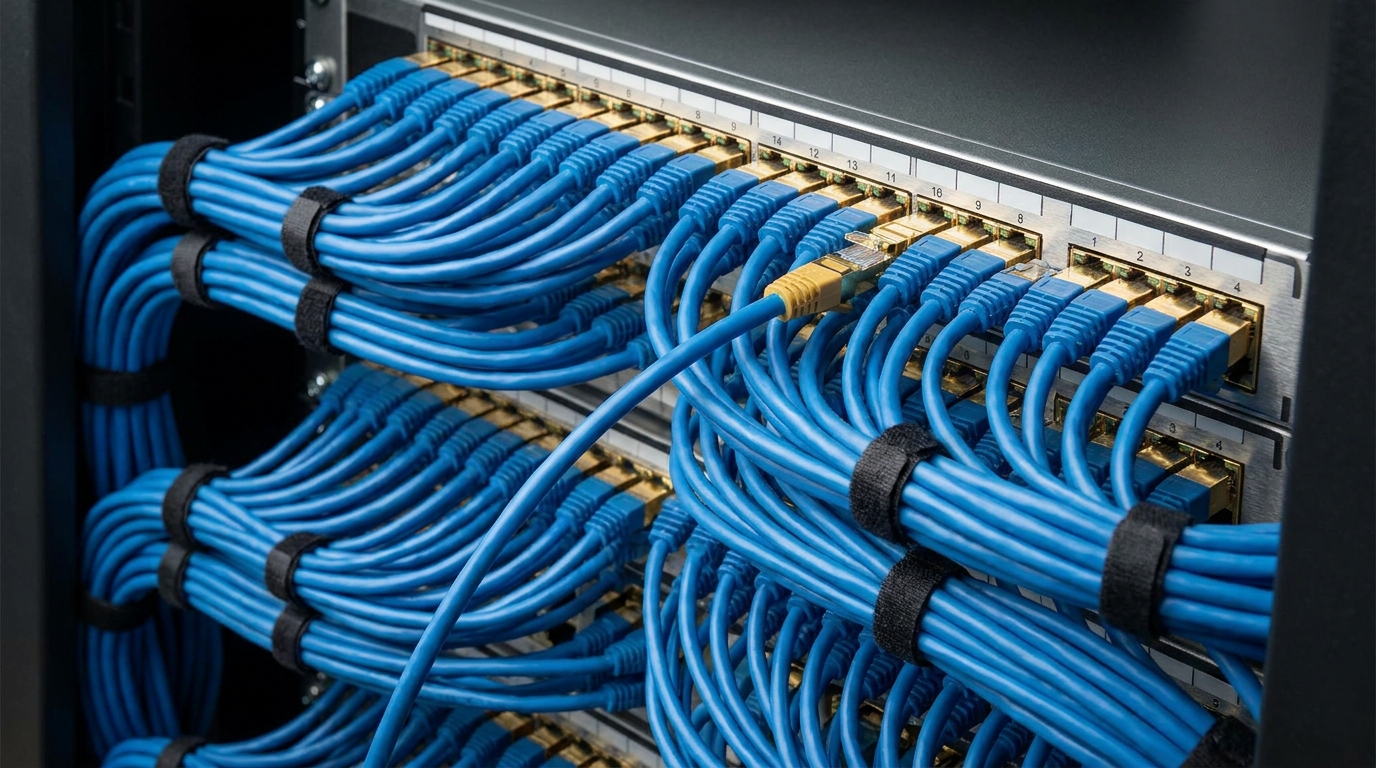
Choosing the wrong cable does not show today. It shows 2 years later, when your network cannot keep up with growth. Structured cabling is the system of cables, connectors, and pathways that forms the backbone of your company network. It is not just cables in the ceiling. It is infrastructure designed with standards (TIA/EIA-568, ISO/IEC 11801) to support voice, data, video, and security systems over a single platform.
A well-designed cabling lasts 15 to 20 years. A poorly designed one forces you to rebuild walls.
Cat6 vs Cat6A: the differences that matter
Max speed — Cat6 10 Gbps, Cat6A 10 Gbps. Distance at 10 Gbps — Cat6 55 meters, Cat6A 100 meters. Bandwidth — Cat6 250 MHz, Cat6A 500 MHz. Shielding — Cat6 unshielded (UTP), Cat6A enhanced shielding. Crosstalk — Cat6 moderate, Cat6A very low. Cost per box (305 m) — Cat6 USD $140 to $200 (approx. $2,500 to $3,500 MXN at 17.5 MXN/USD), Cat6A USD $230 to $345 (approx. $4,000 to $6,000 MXN). Estimated useful life — Cat6 10 to 15 years, Cat6A 15 to 20 years.
When to use Cat6
Cat6 is sufficient for: small offices (fewer than 50 users), networks that do not exceed 55 meters per run, 1 Gbps applications (the majority of SMBs today), and tight budgets with 5-year upgrade plans. The reality is that many SMBs in Mexico still operate on 100 Mbps over Cat5e. For them, Cat6 is already a huge leap.
When to use Cat6A
Cat6A is the right choice when: your building has cable runs greater than 55 meters, you plan to implement Wi-Fi 6E or Wi-Fi 7 (which require a 10G backbone), you handle 4K video, mass VoIP, or high-demand applications, you want an installation that lasts 15+ years without replacement, and you must comply with regulated industry standards (finance, healthcare, government).
The cost difference is 40 to 60%, but the cost of re-cabling later is 5 to 10x higher.
The most common mistake in Mexico
Installing Cat6 to save money and discovering 3 years later that runs exceed 55 meters (and drop to 1 Gbps), that Wi-Fi 6 does not perform because the backbone is the bottleneck, that high-resolution IP cameras saturate the switches, and that you cannot support PoE++ (802.3bt) for high-consumption devices.
Cabling is the most expensive infrastructure to replace. It is inside walls, floors, and ceilings. Do it right the first time.
Cat6A and the future
With the arrival of Wi-Fi 7 (802.11be) at up to 46 Gbps theoretical, industrial IoT with thousands of connected devices, 8K video and augmented reality requiring massive bandwidth, and edge computing needing fast distributed networks, Cat6A is not overkill. It is the minimum baseline for the next 15 years.
What cabling does your company need?
There is no universal answer. It depends on: building size (linear cable meters per run), number of users (active connection density), critical applications (what happens if the network saturates), budget (upfront investment vs. replacement cost), and growth plans (how many more users in 3 to 5 years).
Sources
[1] TIA — ANSI/TIA-568 (Commercial Building Telecommunications Cabling Standard) — https://tiaonline.org/
[2] ISO/IEC 11801 — Information technology — Cabling for customer premises — https://www.iso.org/standard/66182.html
[3] CommScope — Cat6 vs Cat6A structured cabling — https://www.commscope.com/
[4] Wikipedia — Category 6 cable (background reference) — https://en.wikipedia.org/wiki/Category_6_cable
Want to master this?
Noxtel Academy →