Fiber inspection without dropping the network: what changed in IEC 61300-3-35
Your rack is full and you need to inspect a fiber connector before opening a maintenance window. The procedure you learned says: disconnect the assembly, look at the connector end face under the microscope, clean, reconnect. In a high-density data center, that “disconnect and look” is not a formality: it is an avoidable service outage inside a window that is already tight. And there is a second problem, quieter than the first: the standard that defines that procedure changed in 2022, and most of the certification reports you have on paper were issued under the previous criterion.
In this article we break down exactly what changed, why contamination on the connector end face is a continuity problem and not a minor maintenance one, and which five questions to demand in your fiber maintenance contract. Also the angle that applies to Mexico: carrier consolidation, and who owns the fiber connecting your data center.
Contamination is the first cause, and your contract treats it as the last
The starting data point is not a marketing opinion: it is a survey. In an NTT-Advanced Technology study cited by Fluke Networks, 96% of installers and 80% of network operators reported problems related to contamination on the connector end face. In other words: practically everyone who installs or maintains sees the problem, and most of them report it.
And the multifiber connector makes it worse by design. A single-fiber connector end face is a contact point. A rectangular ferrule end face is a surface with 8, 12, 16 or more fibers, and any loose particle on it can migrate towards the individual fibers and create air gaps that raise insertion loss and return loss. Connector density goes up, and with it the difficulty of inspecting and maintaining.
The detail almost nobody quotes: contamination does not degrade the link progressively. It produces intermittent failures. And an intermittent failure is the worst kind of failure for an operator, because it cannot be triaged remotely at the same speed.
The four zones of the standard and what changed in each
The standard that governs this procedure is IEC 61300-3-35, published by the International Electrotechnical Commission under technical committee TC 86/SC 86B. The current edition is the third: IEC 61300-3-35:2022, published on September 16, 2022, a technical revision of the second edition from 2015.
The zones are the structure of the standard: A is the core, B the cladding, C the adhesive and D the contact zone where the two fibers meet.
| Zone | What it is | Edition 2 (2015) | Edition 3 (2022) |
|---|---|---|---|
| A — Core | Signal pass-through zone | Strict criteria for defects and scratches | Relaxed and better-defined criteria; a defect partially in the core is judged only by the part that is inside the core |
| B — Cladding | Cladding zone | Separate limits for defects and for scratches | Smaller zone B (outer edge from 115 µm to 110 µm) and relaxed defect limit |
| C — Adhesive | Adhesive zone | No pass or fail criteria | **Eliminated from the pass and fail criteria** |
| D — Contact | Contact zone | 10 µm limit on defects | **Eliminated from the pass and fail criteria** |
Two changes in that table deserve two raised eyebrows from the team doing the certification.
Operational translation: a certification report issued in 2015, or under the 2015 criterion, could declare a connector “not fit” over a scratch that is admissible today, and that can also work in reverse. The difference is not cosmetic, it is about what can be rejected and what can be demanded. The standard says so in its own technical sheet: visual inspection does not replace the measurement of performance parameters such as attenuation and return loss.
The 2022 edition also requires specific measurement equipment: for the full rectangular ferrule, a microscope with a wide field of view of at least 6.4 × 2.5 mm and the ability to detect 10 µm particles; for the core and the cladding, a reduced field of view of at least 250 µm, with detection of 2 µm defects and 3 µm-wide scratches. If your contractor arrives with a microscope that does not meet those specifications, they are not running the current procedure.
Inspecting from the front of the rack: the MMCE tip
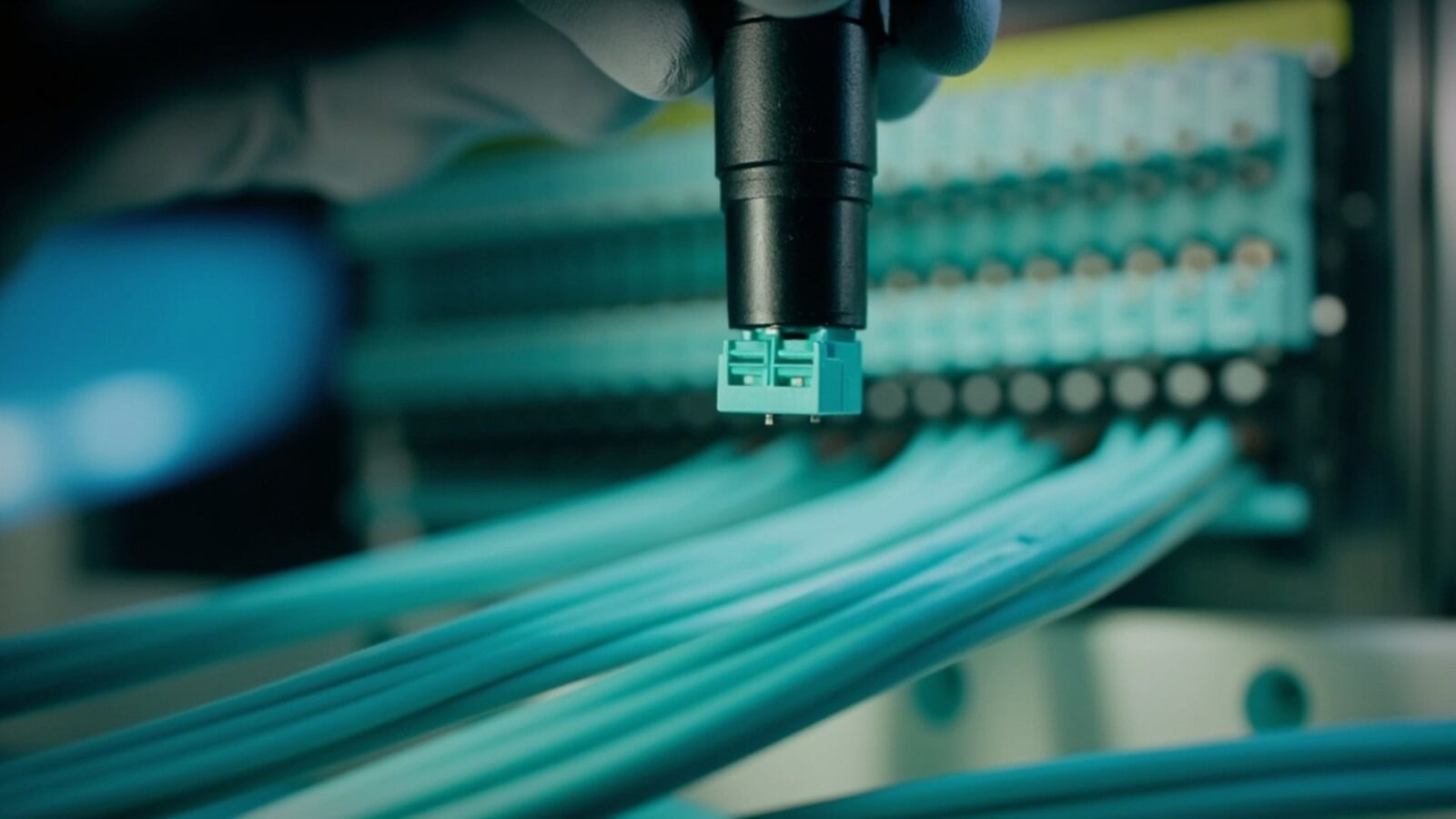
On October 22, 2026, Fluke Networks announced two extended-reach MMCE inspection tips for the FI-3000 FiberInspector Pro, in keyed and keyless versions. What they solve is concrete: they allow access to multifiber connectors and patch panel ports from the front of the rack, without disconnecting active infrastructure and without dismantling fiber assemblies.
The operational impact is in what you no longer have to do. In a row of cabinets at maximum density, the real practice of many is to disconnect in order to measure. That is an avoidable service outage in a maintenance window that is already tight. Fluke sums it up in the note by Mark Mullins, the company’s global product director: technicians should not have to interrupt installed infrastructure just to inspect a fiber connection; by removing that commitment, the customer recovers resolution time and the network stays online.
The equipment that does this belongs to Versiv, Fluke’s cabling certification platform, which also covers twisted pair and both single-fiber and multifiber connections. Results are documented in LinkWare, with close to 40,000 downloads and 200 million stored results; Fluke declares more than 10,000 technicians certified through its training program.
The connector base decides whether any of this is useful to you
Inspecting a connector better only pays off if the cabling architecture you installed is the right one. There is a decision taken once that then defines the cost of every inspection, every expansion and every migration.
SENKO, a connector manufacturer, documents the three most widespread configurations: MPO-8, MPO-12 and MPO-16, with MPO-24 and MPO-36 introduced to raise the fiber count in the same physical space. The critical detail: MPO-12 in 8-fiber applications leaves four central fibers unused, and MPO-16 carries a displaced key that prevents mis-mating against keyed MPO-8 and center-keyed MPO-12 optics or adapters.
The difference between Base-8 and Base-12 is paid for at every patch. A Base-8 channel offers three MPO connectors and supports up to three parallel optics over the same trunk cable; a Base-12 channel supports two. Base-12 can work for low-bandwidth dual optics, but with the adoption of parallel optics — where 400GBASE-SR8 requires 16 fibers across an MPO-16 interface — legacy infrastructure falls short. To migrate an existing facility, the MPO/MTP cabling guide for data centers covers exactly that decision, and the budget impact of 800G and 1.6T is developed in what your cabling needs before 2027.
The angle that changes in Mexico
On October 13, 2026, AT&T announced an agreement to sell AT&T Mexico to Grupo Televisa and Fintech Holdings for 2,000 million dollars in cash at closing, with closing expected in the first quarter of 2027 and subject to the required regulatory approvals in Mexico. The reason stated by AT&T is to concentrate its capital on building the strongest fiber and 5G network in the United States. John Stankey, AT&T Chairman and CEO, framed it in infrastructure terms: “the future of artificial intelligence will run over converged networks with high-density fiber infrastructure”.
The reading for a data center operator in Mexico is fiber concentration and, with it, reduced carrier diversification. If your continuity depends on routes from two different operators, the universe of auditable combinations shrinks. And there is a less visible effect: the fiber plant inside your data center — the one you do own, cable and maintain — comes to represent a larger share of the risk you can actually control. The Guadalajara fiber gap deep-dive documents what happens when that fiber does not arrive as planned.
The five questions you must demand in writing
All of the above comes down to five questions with verifiable answers. Ask them in writing, citing the standard.
The Noxtel point: the quality of your fiber is not defined on the day you install it, it is defined on the day you can certify it without dropping the network. A maintenance contract that requires disconnecting in order to inspect is paying for a service outage on every connector it checks, and that is exactly the cost that separated an installer from an integrator. We quote connector contamination audits and fiber plant certification with equipment that meets the current edition of the standard, and we deliver the traceable report.
Sources
Want to master this?
Noxtel Academy →