400G and 800G Ethernet: what changes in your data center cabling
Why the bottleneck is no longer in the servers
The speed of traffic between servers, between racks, and between rows stopped doubling every 18 months and started doubling every 9. What for a decade was a project of gradual adoption — moving from 10G to 25G, from 40G to 100G — became in 2024-2026 a platform decision: the IEEE 802.3 standard has already published 802.3bs for 200G/400G and 802.3df for 200/400/800G, and the leading switch and optics manufacturers already have commercial products in production. For the operator of a data center in Mexico, the question is no longer whether 400G arrives at the site, but rather when it arrives and what changes in the cabling, the racks, and the internal plant budget when that happens.
This article describes what changes physically when moving from 100G to 400G/800G, what remains the same, and what design decisions are worth making before the first optical card of the new standard touches the rack.
Why 400G and 800G are inevitable in 2026
The three drivers of the change are well known: training of artificial intelligence models with inter-GPU connections demanding per-link bandwidth on the order of 400G or 800G; hyperscale operators running generative AI workloads that require east-west traffic (between servers in the same data center) far above traditional north-south traffic; and the progressive replacement of 100G network cards with higher-speed optics in compute and storage clusters. The operational consequence is that a site operating at 100G in 2026 is on the descending curve of its technical lifetime, while one operating at 400G is where the industry will be for the next five to seven years. The decision of when to migrate depends less on technical desire than on the switch refresh cycle and the roadmap of the selected manufacturer.
What changes in cabling: single-mode and multimode fiber
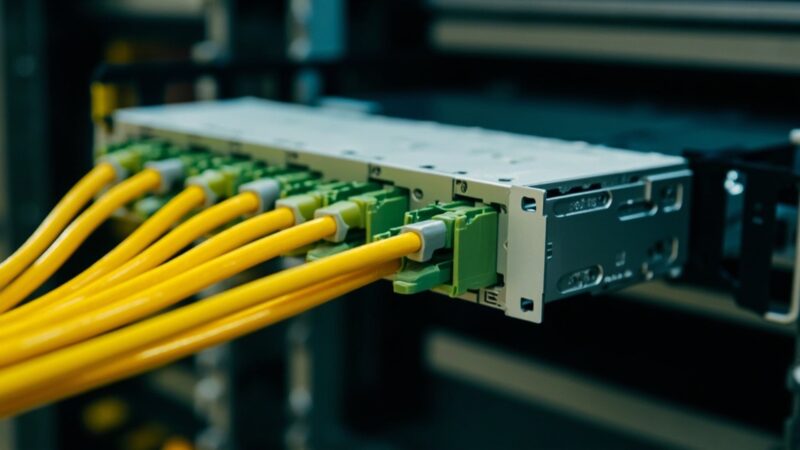
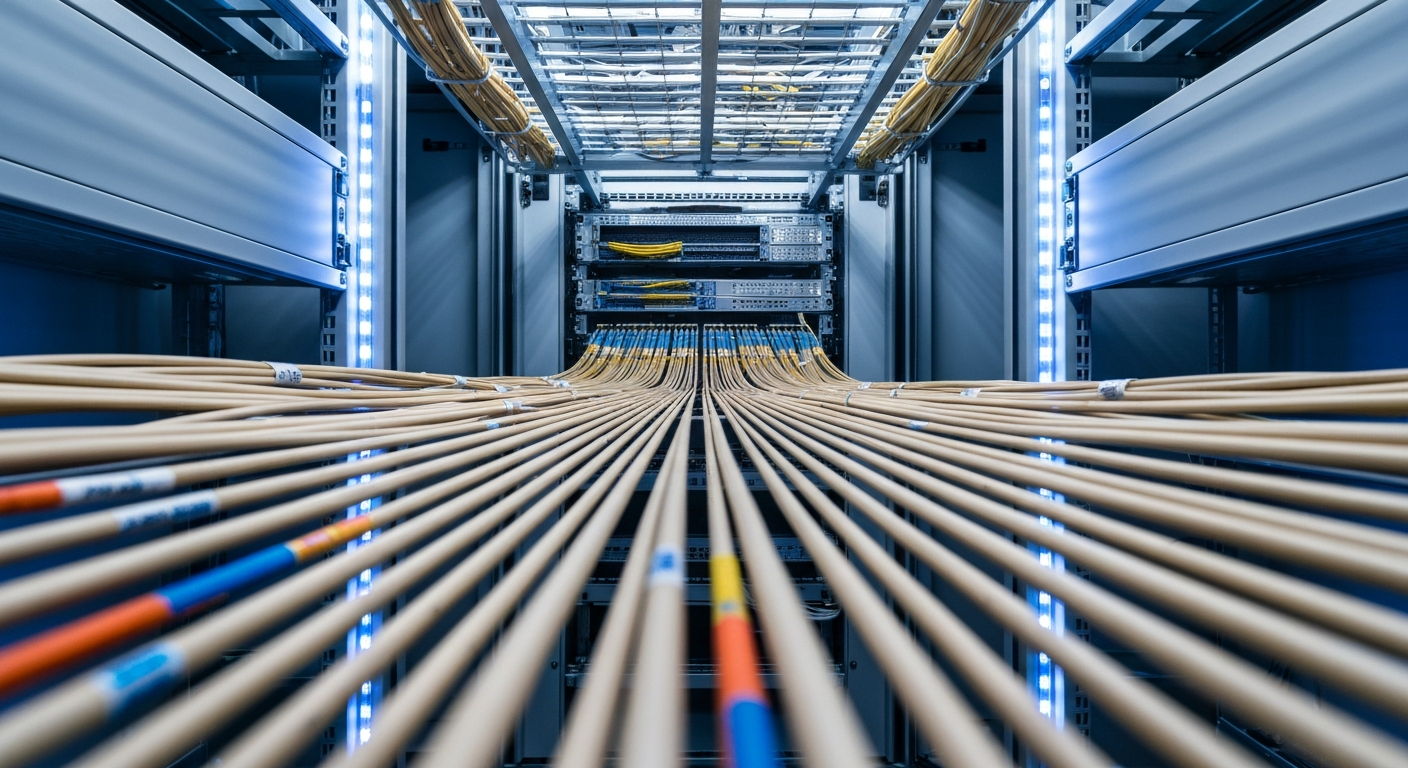
At 100G and below, OM3 and OM4 multimode fiber was the dominant option for short distances, and OS2 single-mode fiber for long links. At 400G and 800G, this division is reversed: the dominant standard for short-distance applications within the data center is single-mode fiber, mainly in PSM4 (Parallel Single Mode 4 lanes) and DR4 (Datacenter Reach 4 lanes) variants that use 1310 nm lasers over single-mode fibers with MPO/MTP connectors. OM4 multimode fiber is still used at 400G for very short links (VR4, up to 50 meters), but it loses appeal against single-mode because bending tolerance, modal bandwidth, and cable lifetime are better in single-mode. Operationally this means that a data center that in 2018 wired with OM3/OM4 looking at a 10-year horizon faces a decision: does the existing cabling move to 400G with multimode (limited to short links and using more expensive SR4.2 BiDi optics), or does it re-fiber with single-mode and take advantage of the broader standard?
Three variables that decide the investment
The decision to migrate to 400G/800G comes down to three concrete variables:
- Port density per rack. A rack with two 32-port 400G switches delivers 12.8 Tbps per rack unit. If the aggregate demand per rack exceeds 6-8 Tbps, 400G is the natural choice; if it stays below, 100G with 400G uplinks remains the most cost-efficient architecture.
- Link distance. PSM4 covers up to 500 m on single-mode and DR4 covers up to 2 km. If the links are internal to the data center and under 100 m, DR4 or FR4 single-mode are the right choice. If they are inter-building links or to a meet-me room, FR4 or LR4 extend the reach without amplifiers.
- Available CAPEX and adoption pace. 400G and 800G optics cost between 3x and 8x what an equivalent 100G optic costs in aggregate speed, according to data published by the Ethernet Alliance. That gap is closing gradually as manufacturing volume rises, but the cost per gigabit still favors 100G in operations where aggregate demand does not require 400G.
Checklist for migrating without rebuilding the site
If the decision is to migrate, the five points that most impact the cost and speed of the project are:
- Audit of the current cabling. How many single-mode vs multimode fiber strands exist on each route? Are the patch panels MPO/MTP-ready or LC/SC legacy? The answer defines whether the cabling is reused or re-fibered.
- Switch manufacturer’s roadmap. What is the next generation announced? What is the end-of-life (EOL) cycle of the current hardware? Migrating two years before EOL avoids forced patches.
- Optics compatibility. 400G DR4/FR4 optics are not compatible with 100G switches on the other end of the link without a breakout cable. Defining the full topology before purchasing avoids accumulating adapters.
- Internal plant budget. Migration implies new ducting, new patch panels, and often new distribution racks. The cost of the physical migration is usually greater than that of the optics themselves.
- Coexistence plan. The site will operate with 100G and 400G switches simultaneously during the transition. Defining VLANs (virtual local networks), routing segments, and traffic policies for that coexistence avoids operational incidents.
Conclusion: The moment to prepare the network
400G and 800G are not the future of data center cabling — they are already the present for sites with AI, hyperscale, or high-density storage workloads. The operational decision is when to migrate, and it depends less on the IEEE standard than on three site variables: target density per rack, link distance, and available CAPEX for external plant. The good news is that the commercial product ecosystem is mature, and the Ethernet Alliance publishes updated roadmaps that serve as a reference for aligning the decision with market supply.
Sources
[1] IEEE 802.3 Ethernet Working Group: https://www.ieee802.org/3/
[2] IEEE 802.3bs 200G/400G Standard: https://standards.ieee.org/ieee/802.3bs/7024/
[3] IEEE 802.3df 200G/400G/800G Project: https://standards.ieee.org/project/802_3df.html
[4] Ethernet Alliance: https://ethernetalliance.org/
[5] Ethernet Alliance Blog (800G posts): https://ethernetalliance.org/blog/
[6] Wikipedia — Ethernet: https://en.wikipedia.org/wiki/Ethernet
[7] Wikipedia — 100 Gigabit Ethernet: https://en.wikipedia.org/wiki/100_Gigabit_Ethernet
[8] Wikipedia — 400 Gigabit Ethernet: https://en.wikipedia.org/wiki/400_Gigabit_Ethernet
[9] Wikipedia — QSFP: https://en.wikipedia.org/wiki/QSFP
[10] Wikipedia — Optical fiber: https://en.wikipedia.org/wiki/Optical_fiber
[11] Wikipedia — Data center: https://en.wikipedia.org/wiki/Data_center
[12] TIA — TIA-942 Telecommunications Infrastructure: https://tiaonline.org/product/tia-942-c/
Want to master this?
Noxtel Academy →