Stulz CyberAir: how direct expansion precision cooling works
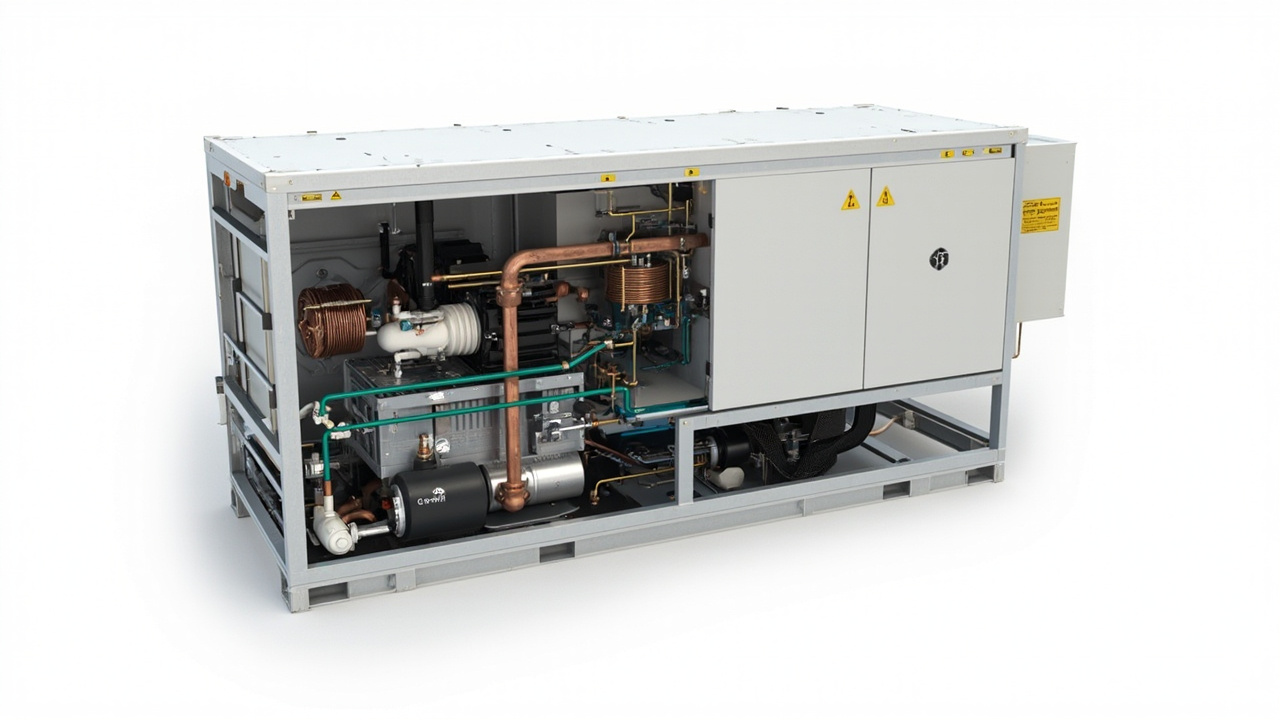
The Stulz CyberAir series is probably the most widely installed precision air conditioning unit in mid-sized data centers in Europe, and over the last five years it has gained significant ground in Mexico. The direct expansion (DX) version is the most common for sites of 20-150 kW per unit, and understanding how it works helps size redundancy and free cooling correctly.
This guide explains the operating principle, the main components, the operating modes, and the criteria for specifying CyberAir DX in a new project or a modernization.
Operating principle: direct expansion with refrigerant
CyberAir DX operates under the classic vapor compression refrigeration principle. The refrigerant (typically R-410A or R-32 depending on model) circulates through a closed loop that includes:
- Compressor: compresses the refrigerant, raising its pressure and temperature. CyberAir uses inverter compressors in recent models, which modulate capacity between 30% and 100% depending on demand.
- Condenser: dissipates the refrigerant’s heat to the environment. It can be air-cooled (remote condenser) or water-cooled (plate condenser).
- Expansion valve: controls the refrigerant flow toward the evaporator. CyberAir uses electronic expansion valves for fine modulation.
- Evaporator: absorbs heat from the room air. This is where the refrigerant changes from liquid to gas, cooling the air that flows through the coil.
- Fans: move air through the evaporator and return it to the room at controlled temperature.
The hot air from the room enters the unit, passes through the evaporator (where it is cooled and dehumidified), and returns to the room. The refrigerant, now in gaseous state, returns to the compressor to repeat the cycle.
Main components of CyberAir DX
Indoor unit:
- Double-wall cabinet with thermal and acoustic insulation.
- Inverter compressor(s) mounted on an anti-vibration base.
- Copper-tube evaporator with aluminum fins, sized for the required capacity.
- EC (electronically commutated) high-efficiency fans.
- Electronic expansion valve with PID control.
- Stulz E² controller with touch screen and network connectivity.
- G4 + F7 (optional) air filters for dusty environments.
Outdoor unit (condenser):
- Air condenser with variable-speed axial fans.
- Variable frequency drives for fan modulation.
- Electrical and pressure protections.
- Possibility of integrated free cooling (dry cooler mode) in some configurations.
Operating modes
CyberAir DX can operate in several modes, automatically controlled by the Stulz E² controller:
- Compression mode: standard operation with active compressor. EER efficiency of 3.0-3.5 depending on outside temperature.
- True thermal free cooling mode: available only in configurations with dual fluid/glycol (such as the CyberAir GE line) connected to an outdoor dry cooler. In this mode the compressor shuts off and heat is dissipated directly outdoors through the water/glycol-to-air heat exchanger, without going through the compression cycle. Effective efficiency can exceed 10 (kW of heat dissipated per kW of electricity consumed). In pure DX units without dual fluid, the compressor stays active to maintain refrigerant pressure, so the thermal free cooling efficiencies do not apply.
- Mixed mode: combination of compression and free cooling when the outside temperature is in an intermediate range.
- Dehumidification mode: activates the compressor and reduces airflow to control humidity without overcooling.
- Redundant mode: when operating N+1, standby units start automatically on failure of the active unit.
When to specify CyberAir DX
The decision between DX and other technologies (chilled water, indirect free cooling, immersion) depends on:
- Low to medium load per rack (5-15 kW): DX is efficient and economical. For 20-50 kW per rack, DX is still viable with larger units.
- Site with little outdoor space: DX does not require a chilled water plant or chillers, only a remote condenser.
- Temperate to cold climate: in CDMX, Guadalajara, Monterrey, and most of central and northern Mexico, free cooling can operate more than 6 months a year.
- Tight initial budget: DX is generally cheaper to install than chilled water.
- Operation with HVAC-trained technical staff: DX uses standard mechanical components, easier to maintain than chilled water.
When NOT to specify DX
There are scenarios where DX is not the best choice:
- Loads consistently above 20 kW per rack: DX loses efficiency vs chilled water or rear-door heat exchangers.
- Site with extreme warm climate: in coastal zones with outside temperatures above 40°C (104°F) for many months, DX can struggle without free cooling.
- Need for residual heat reuse: DX produces low-temperature heat, hard to reuse. For heat reuse, chilled water or heat pumps are better.
- Fully sealed operation: if the data center has no outside ventilation, DX has nowhere to dissipate heat.
Maintenance and service life
CyberAir DX is designed for a service life of 15-20 years with proper maintenance. The main components have defined service intervals:
- Compressor: annual inspection, preventive replacement every 8-10 years.
- Air filters: quarterly inspection, replacement based on differential pressure.
- EC fans: service life above 50,000 hours, replacement at 10-12 years.
- Refrigerant: annual leak check, recharge every 5-7 years depending on conditions.
- Electrical panel and controller: annual inspection, periodic firmware updates.
Need help with Stulz solutions?
At Noxtel we specialize in the design, supply, installation, and preventive maintenance of critical infrastructure for Data Centers. If you are comparing equipment, need to size a project, or require certified technical support for Stulz solutions, our engineering team is ready to help.
? Contact us today and schedule a consultation with the Noxtel team.
Sources
[1] Stulz — CyberAir product page: https://www.stulz.com/en/products/precision-air-conditioning/cyberair
[2] Stulz — CyberAir technical documentation: https://www.stulz.com/en/products/precision-air-conditioning/cyberair/cyberair-3
[3] ASHRAE TC 9.9 — Thermal Guidelines: https://www.ashrae.org/technical-resources/bookstore/thermal-guidelines-for-data-processing-environments
[4] Wikipedia — Stulz: https://en.wikipedia.org/wiki/Stulz
Want to master this?
Noxtel Academy →