Cold plate vs immersion vs spray: how to choose by density and budget
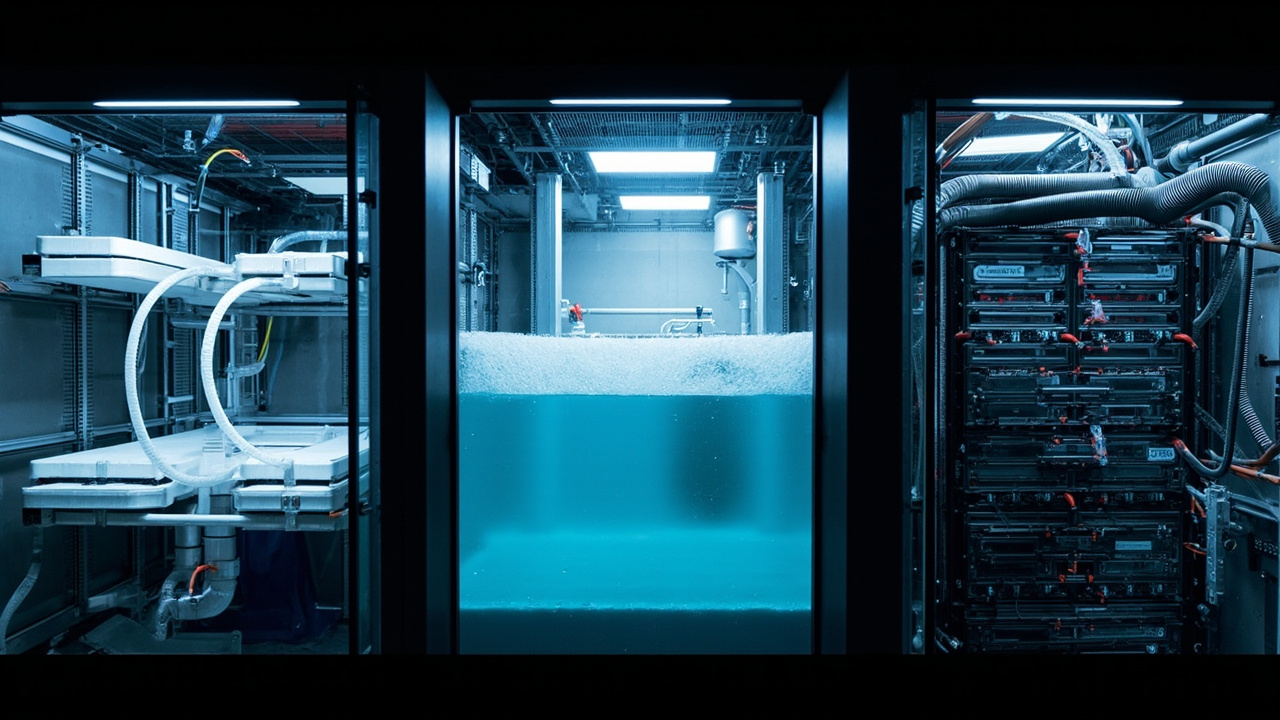
When rack density exceeds 30-40 kW, air cooling is no longer enough. The industry has already adopted three main paths for liquid cooling, each with its own trade-offs in cost, complexity, and maintenance.
Here is an honest comparison between direct cold plate, immersion, and spray cooling, to help you pick based on your density, budget, and AI roadmap.
The three architectures
- Direct-to-chip cold plate (DLC). Cold plates bolted to the processors, with a coolant loop running to a CDU (Coolant Distribution Unit) in the row. Preserves the traditional rack format.
- Immersion. The entire server is submerged in a dielectric fluid inside a tank. Air is fully removed from the rack. A deep operational change.
- Spray cooling (two-phase immersion). A variant that sprays the fluid onto the components. More efficient than passive immersion, but requires fine fluid control.
When to pick each one
- Cold plate. Densities of 30-80 kW per rack. When you want to keep standard racks and operators with experience in traditional facility management. Best initial balance and reasonable adoption curve.
- Immersion. Densities above 80-100 kW. When maximum density and energy efficiency are the priority, and you can absorb operational changes (there is no such thing as an “open rack”).
- Spray cooling. High densities with better volumetric density than pure cold plate. Specialized equipment; ecosystem still limited.
Real decision variables
- Target density. Below 30 kW/rack, air is still valid (with containment). Above that, liquid becomes competitive.
- Initial CAPEX. Cold plate is the option with the least disruption to a standard rack. Immersion requires near-total replacement of the metal rack with tanks.
- OPEX. Immersion has the lowest PUE of the three, because it eliminates air. Cold plate reduces OPEX vs air, but less so.
- Maintenance. Cold plate requires managing manifolds, filters, and pumps. Immersion simplifies some components but complicates server replacement.
- Operational risk. Immersion still has a track record under construction. Cold plate has longer operating history in hyperscalers.
Practical summary
For data centers that are planning a gradual transition from air to liquid, the reasonable path is to start with cold plate in the highest-density racks. It lets you keep the rest of the operation unchanged. If the roadmap structurally pushes to 100+ kW per rack, immersion becomes competitive as the definitive solution.
An ideal application scenario for a company running mixed workloads would be to deploy cold plate in the AI racks and keep air with containment in general-purpose IT racks. It is the combination with the best cost-benefit ratio in 2026.
Sources
[1] ASHRAE — TC 9.9 Datacom Equipment Power Trends (thermal guidelines): https://www.ashrae.org/technical-resources/bookstore/datacom-series
[2] Vertiv — Liquid Cooling Portfolio (vendor technical reference): https://www.vertiv.com/en-us/solutions/liquid-cooling/
[3] Schneider Electric — Liquid Cooling Solutions (vendor reference): https://www.se.com/ww/en/solutions/data-center-cooling/
[4] Asetek — Cold Plate and Liquid Cooling Technology (vendor reference): https://www.asetek.com/
[5] Wikipedia — Liquid Cooling (data center reference): https://en.wikipedia.org/wiki/Computer_fluid_cooling
Want to master this?
Noxtel Academy →