NOC vs SOC: real differences and why your data center needs both
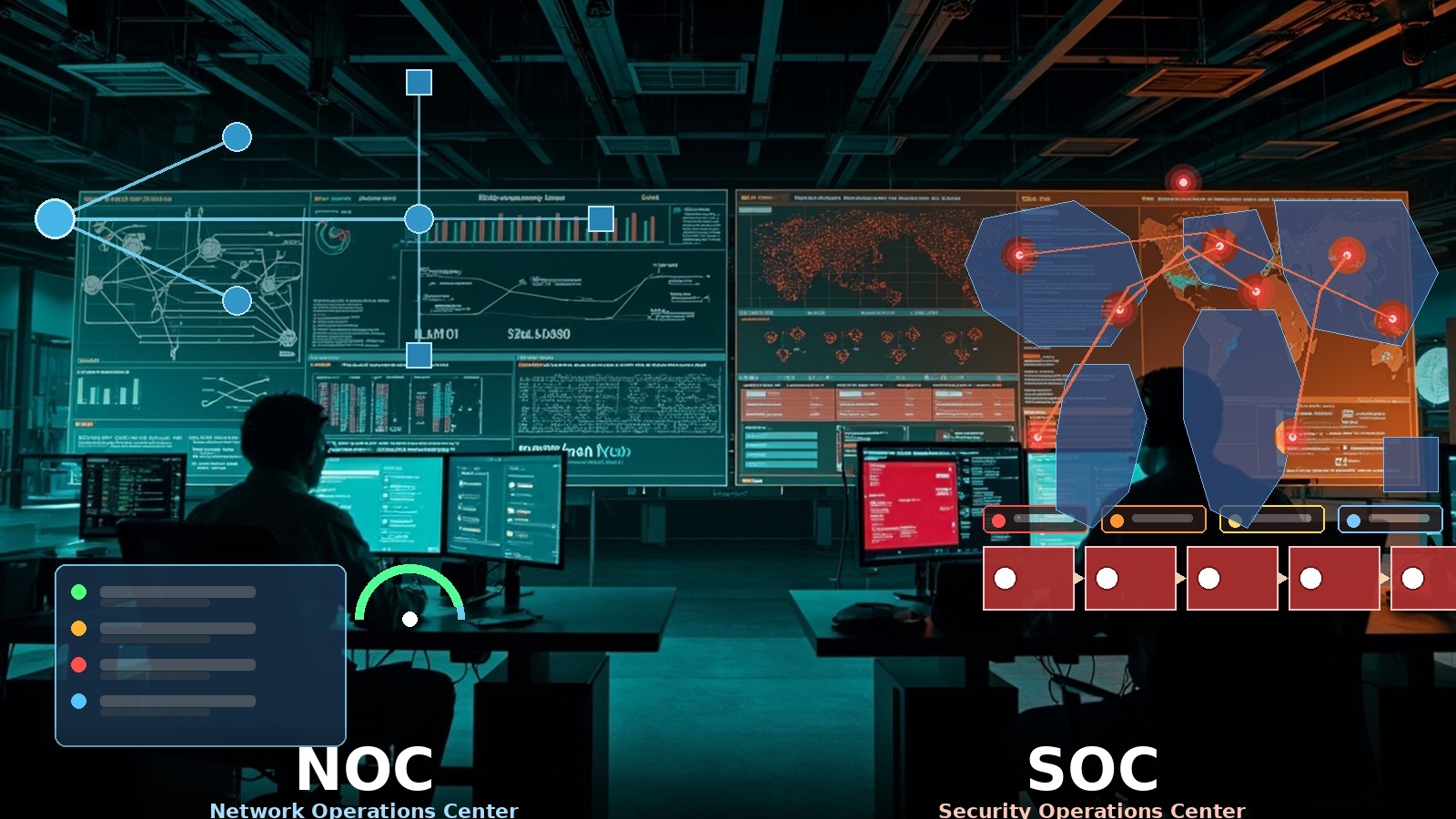
NOC (Network Operations Center) and SOC (Security Operations Center) are often confused as the same team of people staring at screens all day, but they perform distinct and complementary functions. A data center that only has a NOC reacts late to security incidents; one that only has a SOC does not detect infrastructure failures until the client calls. The correct answer is to operate both, coordinated but not merged.
This article describes what each team does, how they differ in tools, staff, and KPIs, why a data center needs both, and how to integrate them without duplicating costs or creating a third team that ends up managing itself.
What a NOC does and what a SOC does
The NOC focuses on infrastructure availability and performance: network, compute, storage, power, and cooling. Its tools are SNMP (Simple Network Management Protocol) monitors, DCIM (Data Center Infrastructure Management, infrastructure monitoring platform) dashboards, capacity alerts, and performance thresholds. The team works on tickets that reflect operational incidents: loss of connectivity, server down, temperature out of range, UPS on battery.
The SOC focuses on detection and response to security incidents: intrusion, malware, data exfiltration, credential abuse, behavioral anomalies. Its tools are SIEM (Security Information and Event Management, a platform that correlates security events), EDR (Endpoint Detection and Response, advanced endpoint protection), threat intelligence, and forensic analysis. The team works on alerts that require context: an external IP scanning ports may be an attacker or a legitimate provider doing inventory.
Operational differences between NOC and SOC
Although both operate 24/7, watch screens, and escalate incidents, the two teams have different incentives and metrics. The table summarizes the practical differences that matter when designing the operation.
| Aspect | NOC | SOC |
|---|---|---|
| Primary focus | Infrastructure availability and performance | Security incident detection and response |
| Key metrics | Uptime, MTTR (mean time to recover), per-service availability | MTTD (mean time to detect), containment time, false positives |
| Data monitored | SNMP, system logs, performance metrics | Security logs, authentication events, network traffic |
| Typical severity | Operational: affects service or client | Compliance and reputational: can escalate to regulatory |
| Escalation when in doubt | Notifies the client’s operations team | Notifies the CISO (Chief Information Security Officer) or equivalent |
Why a data center needs both
A NOC without SOC detects that a server is down, but does not detect that the server is exfiltrating data to a third party. A SOC without NOC detects the exfiltration, but does not know that the rack lost power and the uplink is down. Coverage of serious incidents requires both: the SOC sees the threat, the NOC sees the operational context, and together they decide whether to isolate the server or leave it online to avoid disrupting other services.
In multi-tenant data centers, the separation is mandatory by contract and by regulation. The enterprise client demands evidence that their data is protected against intrusion (SOC), but also that their service is available (NOC). If a provider only offers one of the two, they lose contracts or face failed audits.
How to integrate NOC and SOC without duplicating costs
The common mistake when integrating the two teams is merging them into a single structure. The result is usually a hybrid team that ends up responding only to operational incidents (which are more visible) and neglecting security ones (which require deeper investigation). The correct integration keeps the roles separate but shares three elements: communication tools (chat and tickets), cross-escalation procedures, and shared KPIs for serious incidents.
Three proven industry integration patterns: the first is a Fusion Center where NOC and SOC share a physical floor and synchronize on compound incidents; the second is integration by tickets where both teams use the same ticketing system and can see each other’s status in real time; the third is strict separation with a dedicated communication channel for critical incidents. The choice depends on the data center’s size and number of clients.
Common mistakes when implementing NOC and SOC
Four mistakes account for most NOC/SOC implementations that fragment within the first 18 months. Recognizing them before hiring the team or buying the tools reduces the risk of failure.
- Hiring the same provider for both without verifying role separation: some providers offer NOC and SOC but share the same team of analysts. If a NOC analyst sees a security alert, he must escalate it to a real SOC, not investigate it himself.
- Defining KPIs that reward closing tickets instead of resolving incidents: a team that closes tickets fast without documenting the root cause ends up seeing the same incident three times a month. The correct metric is time to resolution, not time to close.
- Underestimating alert volume: a poorly configured SIEM tool can generate thousands of alerts per day. Without a triage process and rule tuning, the team ends up ignoring legitimate alerts due to fatigue. Initial tuning takes months.
- Not documenting cross-escalation procedures: if NOC and SOC do not have a written agreement on what to do when an incident is both operational and security, each team assumes the other is handling it. The result is an incident that no one manages for hours.
Sources
[1] NIST Cybersecurity Framework — https://www.nist.gov/cyberframework
[2] ISO/IEC 27001 — Information security management — https://www.iso.org/standard/27001
[3] SANS Institute — Reading Room (security operations resources) — https://www.sans.org/reading-room/
[4] Wikipedia — Network operations center (background reference) — https://en.wikipedia.org/wiki/Network_operations_center
[5] Wikipedia — Security operations center (background reference) — https://en.wikipedia.org/wiki/Security_operations_center
Want to master this?
Noxtel Academy →