Brownfield vs greenfield: how to plan a data center expansion without downtime
Planning a data center expansion is not a theoretical exercise: every square meter of floor space, every kilowatt of utility feed, and every centimeter of clear height has operational consequences for the next ten years. The decision between expanding within an existing structure (brownfield) or building from scratch (greenfield) defines CAPEX, delivery timeline, and, most importantly, the level of operational risk the organization is willing to tolerate during construction. This article describes the real constraints of each approach, the five variables that tip the decision, and the most common mistakes when presenting the case to the investment committee. It is not a universal guide: every data center has local conditions (building structure, available electrical capacity, maintenance windows) that weigh differently.
This article describes the real constraints of each approach, the five variables that tip the decision, and the most common mistakes when presenting the case to the investment committee.
What brownfield and greenfield mean in a data center
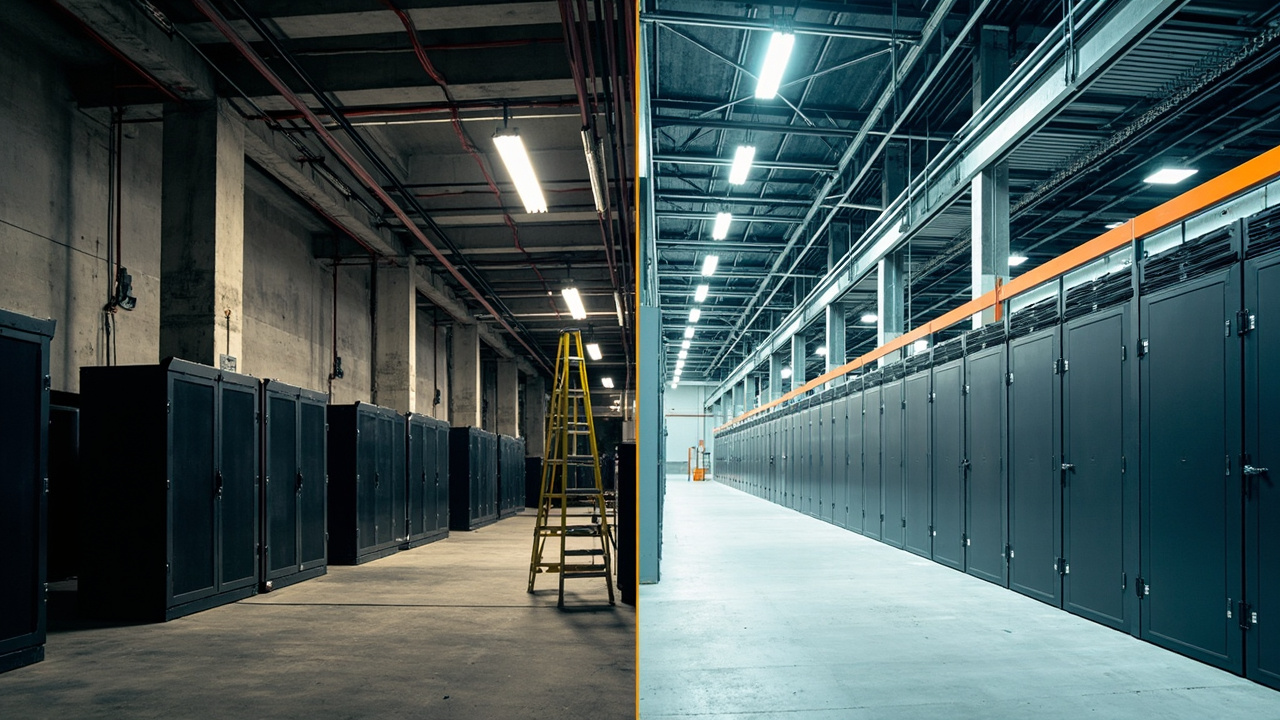
In operational practice, the two terms describe opposite starting points. A brownfield project starts from an existing structure, an occupied floor, a limited utility feed, a structure that already supports certain loads. The designer works with constraints he did not choose. A greenfield project starts from empty land or a previously unoccupied area, where the designer defines the utility feed, the clear height, the cooling system, and the rack layout from scratch. The difference is not semantic: it conditions schedule, cost, and risk. A brownfield is typically between 20% and 40% cheaper in initial CAPEX because it reuses structure, utility feed, and existing cable routes, but it demands maintenance windows that can affect operations. A greenfield is more expensive in CAPEX but allows operation without interruptions during construction and full design optimization.
Brownfield: constraints you must accept before starting
Expanding within an existing structure means inheriting three constraints the designer cannot change without major civil works. The first is the electrical capacity of the utility feed: if the data center already consumes between 80% and 90% of its contracted capacity, the expansion requires enlarging it with CFE (Comisión Federal de Electricidad), a process that can take between six and twelve months in Mexico. The second is the clear height between the finished floor and the false ceiling: if the existing cable trays are at 80% occupancy, taller or denser racks may require re-engineering of the routes. The third is the structural load of the floor: high-density racks weigh more than traditional racks, and the original structural calculation may not support the new layout without reinforcement. Each constraint demands a decision before the project starts. Some are solved with incremental CAPEX (reinforce the floor, expand the utility feed); others force rethinking the scope (reduce density, split the expansion into phases). In brownfield projects in Mexico, the typical maintenance window is four to eight hours per weekend, enough to move racks but not to rewrite infrastructure.
Greenfield: advantages and the price they pay
A greenfield project offers three advantages that brownfield cannot match. The first is full design optimization: utility feed sized for the expected growth, clear height calibrated to the target density, cooling system selected without inherited constraints. The second is operation without interruptions: construction takes place in a separate space, and migration to the new data center happens in a short, controlled window. The third is flexibility for emerging technologies: liquid cooling, hot containment, non-blocking network topology can be sized from the start without costly adaptations. The price is high and in more dimensions than CAPEX. A greenfield requires construction permits, civil works supervision, equipment delivery times (large chillers and UPS have 12–20 week lead times), and a commissioning process that validates each subsystem before energizing. A typical mid-site greenfield takes between 12 and 18 months from the start of civil works to the first energized rack.
Five variables that tip the decision
The choice between brownfield and greenfield is not binary: it depends on five variables that the infrastructure team must evaluate before presenting the case. The table summarizes the operational questions each variable forces you to answer.
| Variable | Question to answer | Favors brownfield if… | Favors greenfield if… |
|---|---|---|---|
| Electrical capacity | Is there headroom in the utility feed for the expansion? | There is headroom ≥ 30% over current consumption | The feed is at ≥ 90% and the expansion would push it to ≥ 100% |
| Maintenance window | How long can equipment be taken out of operation? | Weekends are available without affecting SLA | Any window affects the SLA of active clients |
| Expected growth over 5 years | How much will the load grow? | Growth fits within the existing footprint | Expected growth exceeds the building’s physical capacity |
| Target rack density | What kW/rack is the target? | Stays between 8 and 12 kW/rack | Requires between 25 and 40 kW/rack for AI or high-performance computing |
| Useful life of the current building | How many more years is operation planned here? | More than 7 years | Less than 5 years or the building has operational constraints |
Five common mistakes when planning an expansion
Five mistakes account for most brownfield and greenfield projects that run late or exceed budget. Recognizing them before starting reduces the probability of falling into them.
- Underestimating permit timelines: in Mexico, construction permits from local authorities and CFE processes for utility feed expansion can take longer than the civil works themselves. Planning the schedule without accounting for this is the most common cause of late-delivery projects.
- Ignoring the floor’s structural load: racks at 25–40 kW weigh more than traditional racks at 5–8 kW. Reinforcing the floor after racks are installed means moving all equipment, multiplying the cost by five or more.
- Undersizing the cooling system: sizing the cooling system to today’s target density, without margin for future growth, leads to a cooling system expansion within two or three years, when there is no physical space left to add units.
- Postponing commissioning: skipping integration testing of the electrical and mechanical systems, or running it with insufficient time, is the leading cause of operational failures in the first six months of the new data center.
- Not involving the operations team from design: a data center designed without the participation of the team that will operate it ends up with details that hinder daily maintenance: doors that open the wrong way, racks without space for side PDUs, cable trays without access for inspection.
How to present the case to the investment committee
The investment committee usually approves projects based on initial CAPEX, not on TCO (total cost of ownership) over five or ten years. A brownfield with lower CAPEX may end up more expensive at five years if operational constraints generate incidents; a greenfield with higher CAPEX may end up cheaper at five years if uninterrupted operation avoids revenue loss per client.
The way the case is presented matters: a table with CAPEX, annual OPEX, and estimated operational risk in local currency for each alternative allows comparing apples to apples. The committee decides better when it sees the three numbers side by side, not when it receives a project disguised as a technical obvious choice.
Sources
[1] TIA-942-C — Telecommunications Infrastructure for Data Centers — https://tiaonline.org/product/tia-942-c/
[2] Uptime Institute — Research and reports — https://uptimeinstitute.com/resources/research-and-reports/
[3] ASHRAE — Technical Resources (TC 9.9 data center guidance) — https://www.ashrae.org/technical-resources
[4] ISO/IEC 30134 — Data centre key performance indicators — https://www.iso.org/standard/45611.html
[5] Wikipedia — Data center (background reference) — https://en.wikipedia.org/wiki/Data_center
Want to master this?
Noxtel Academy →