WUE: why water consumption in your data center can sink your ESG
Water consumption in a data center has gone from being a secondary technical data point to a first-line ESG (Environmental, Social and Governance, a corporate sustainability framework) risk. In areas where water is scarce or expensive — central and northern Mexico among them — the WUE (Water Usage Effectiveness, the efficiency of water use) metric can sink a sustainability report even when the PUE (Power Usage Effectiveness, energy-use efficiency) is impeccable. And unlike PUE, WUE is still little known outside the circle of facility managers.
This article describes what WUE measures, why it matters more than PUE in certain sites, what hyperscale operators are doing to reduce it, and what a mid-sized data center in Mexico can do without falling into greenwashing (misleading advertising that exaggerates a company’s environmental achievements). The goal is to give the reader an operational, comparable, and defensible metric when facing a sustainability committee or an enterprise client.
What WUE is and how it is calculated
WUE is a metric defined by The Green Grid, the same organization that popularized PUE, and later formalized in the ISO/IEC 30134 series. The formula is straightforward:
WUE = Annual liters of water consumed by the data center / Annual kWh of energy delivered to IT equipment.
The numerator includes all water entering the site: what evaporates in the cooling towers, what is used in humidification, what is lost through boiler blowdown, and what is consumed in general services (restrooms, kitchen, cleaning). The denominator is the energy that reaches the servers, not the data center’s total energy.
The typical unit is liters per kWh. A WUE of 1.0 L/kWh is excellent for a site that uses cooling towers; a WUE of 0.2 L/kWh is typical of a site that uses adiabatic cooling (which cools air through controlled evaporation) or direct outside air (air-side economizer). Hyperscale sites at the public clouds report WUE between 0.18 and 0.30 L/kWh in their 2024-2025 sustainability reports.
Why water matters more than energy in some sites
PUE has been at the center of the energy-efficiency conversation for 15 years. WUE is still peripheral, but three conditions make it critical:
Water is scarce or expensive. In central and northern Mexico, where water availability is under pressure from agricultural and urban use, the cost of water and the regulatory restrictions on drawing it have become a real operational factor. A data center with cooling towers can consume between 1 and 3 million liters per month on a 2 MW site. That competes with the consumption of a small town.
The enterprise client demands ESG reporting. Contracts with financial, retail, and global-manufacturing clients typically require Scope 1, 2, and 3 (direct, electricity-indirect, and supply-chain emissions) to be reported cleanly. Water falls under Scope 3 when the data center is operated by a third party. A poorly reported WUE exposes the client to ESG penalties.
The site uses cooling towers with high evaporation. Each evaporative tower consumes between 1.5 and 2.5 L per kWh of heat dissipated. In dry climates, this evaporation can represent more than 80% of the site’s total water use. Reducing this component is the obligatory first step before any offsetting.
Real cases: what hyperscale operators are doing and the net positive water trend
Hyperscale operators have an edge because their scale justifies investments in water efficiency that a mid-sized site cannot afford. Three concrete trends set the direction of the sector:
Commitment to net positive water by 2030. Microsoft, Google, and selected operators have committed to replenishing more water than they consume, through replenishment projects in local watersheds. The model is financeable for hyperscale, but it is hard to replicate at a mid-sized data center in Mexico without subsidies or public-private partnerships.
Migration to adiabatic cooling and outside air. More and more sites in temperate or cold climates are replacing cooling towers with adiabatic cooling (a combination of outside air and controlled evaporation) or free cooling (the direct use of outside air when temperature and humidity allow). The leap in WUE is from 1.0 L/kWh to 0.2 L/kWh or less, depending on the climate.
Reuse of condensed and rainwater. Sites in temperate climates collect rainwater and condensate from the air-conditioning units themselves to feed the towers, reducing demand for fresh water by up to 40%. In dry climates such as northern Mexico, the potential is limited but not zero.
What a mid-sized data center in Mexico can do
The mid-sized data center cannot bet on rainwater reuse in Hermosillo or on net positive water commitments in Querétaro. But there are five concrete actions that lower WUE between 20% and 60% without major CAPEX:
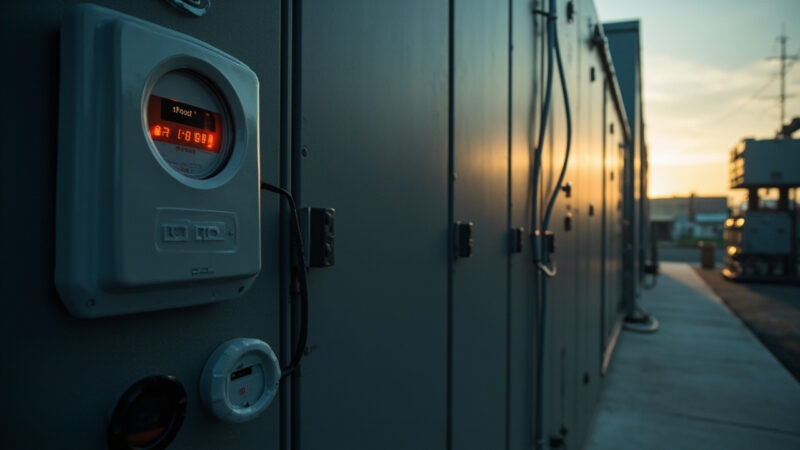
- Measure your WUE today: if you don’t have a water meter at the data center’s main supply and separately for the towers and general services, you cannot improve what you don’t measure. Basic installation: 2-3 meters, cost <$500 USD (approx. $8,750 MXN at 17.5 MXN/USD, verify Banxico FIX on publication day), monthly reading.
- Optimize tower blowdown: continuous blowdown of the cooling towers wastes water if conductivity stays below the operating threshold. Conductivity-based blowdown control systems reduce consumption by 15-30% without additional operational intervention.
- Evaluate the switch to adiabatic or outside air: in cities like Toluca, Puebla, or Saltillo, adiabatic cooling or free cooling cover between 4,000 and 6,000 hours per year. The CAPEX pays for itself in 3-5 years on water savings alone, before counting energy savings.
- Separate data center water from building water: if the data center shares a building with offices, restrooms and the kitchen must not be counted in the data center’s WUE. Separate metering = a defensible report.
- Document WUE in a comparable format: report WUE in L/kWh following the ISO/IEC 30134 formula, not in gallons per month or in cubic meters per year without context. A comparable number is an auditable number.
How to report WUE without falling into greenwashing
Four rules separate a defensible ESG report from one that falls into greenwashing under scrutiny:
Use the ISO/IEC 30134 formula, not a proprietary version. The standard exists precisely to make the figure comparable across operators.
Report the numerator and the denominator separately. Any WUE reported without the ability to verify both components individually is a figure that cannot be audited.
Clarify the scope. Data center water includes towers, humidification, blowdown, and general services. If you exclude anything, state what and why.
Compare against the previous year, not against an external benchmark. Your own trend is what shows real improvement; external benchmarks typically mix methodologies.
Sources
[1] The Green Grid — Water Usage Effectiveness (WUE) definition — https://www.thegreengrid.org/
[2] Wikipedia — Water Usage Effectiveness (WUE) — https://en.wikipedia.org/wiki/Water_usage_effectiveness
[3] IEA — Data Centres and Data Transmission Networks — https://www.iea.org/energy-system/digitalisation/data-centres-and-data-transmission-networks
[4] Microsoft — Corporate Responsibility: Water sustainability — https://www.microsoft.com/en-us/corporate-responsibility/sustainability/water
[5] United Nations — Sustainable Development Goal 6 (Clean Water and Sanitation) — https://sdgs.un.org/goals/goal6
Want to master this?
Noxtel Academy →