What is ToR vs EoR vs MoR: the 3 data center switch topologies that confuse 80% of operators

When a provider sells you “leaf-spine design with ToR”, they are selling you an architecture decision with a 5 to 10 year total cost of ownership, not a topology detail. The difference between Top of Rack, End of Row and Middle of Row in cabling cost, latency, port cost and ease of operation is the difference between a project that closes financially and one that doesn’t. And the decision is even harder when you’re sizing for an AI cluster where each GPU costs more than all the rack cabling.
This article breaks down the three topologies, the decision criteria, and the 3 errors I’ve seen in Mexican sites choosing the wrong topology by following switch provider marketing.
What each topology means (without marketing jargon).
The three topologies are defined by where you place the access switch (the one connecting the servers in the rack) and how you run copper or fiber cabling up to the aggregation or spine switch.
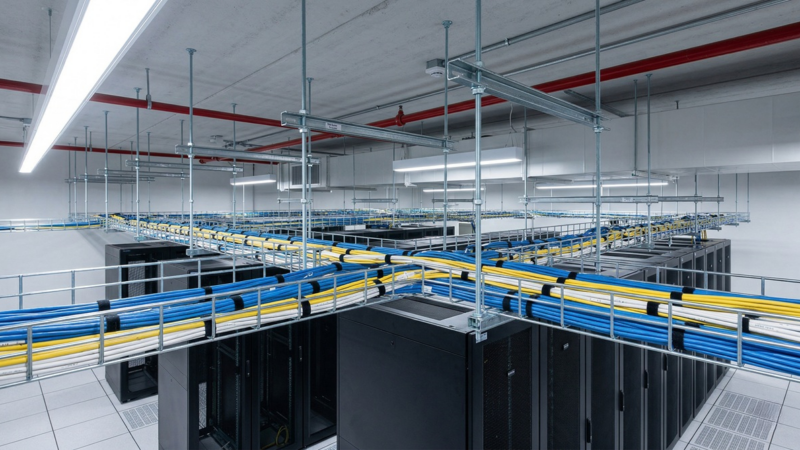
- Top of Rack (ToR): the access switch goes at the top of the rack. Each server connects to the ToR switch with a short patch cord of 1 to 3 meters (DAC or AOC for 10G/25G/100G, fiber for 400G/800G). From the ToR switch, long uplink cables (MPO/MTP fiber) go to spines or aggregation switches in the MDA. It is the dominant topology in hyperscale and most modern DCs.
- End of Row (EoR): the access switch is in a dedicated cabinet at the end of the row, not in the server rack. Each server connects with a long copper or fiber cable (between 5 and 25 meters depending on position in the row) to the EoR switch. Reduces the number of physical switches in the network (more density per switch) but multiplies horizontal cabling.
- Middle of Row (MoR): the access switch is placed in a cabinet in the center of the row. It’s a compromise between ToR and EoR: maximum server cable length is halved compared to EoR, and cabling management is more organized than ToR when racks are very close together. It’s rarely seen in new sites today, but still useful in modernizations where you already have horizontal cabling.
The 5 dimensions that matter for choosing.
The decision among the three is not only technical. There are five variables that weigh, and each pushes you in a different direction:.
When ToR is the correct answer.
ToR is the dominant choice in three scenarios:.
When EoR still wins.
EoR is not a relic. There are three cases where it remains the best decision:.
When MoR makes sense (niche case).
MoR is the least common topology today, but has a real niche:.
The 3 most common errors when choosing switch topology.
The verdict.
For most new data centers in Mexico with more than 30 racks and densities of 10 kW and up, ToR is the correct answer. Initial investment is slightly higher, but 5-year TCO closes better, operation is simpler, and flexibility to add capacity rack by rack is worth it. EoR remains the correct decision for small sites, brownfield, or where network operation is centralized. MoR is a niche case that applies only in long rows or existing physical constraints. The decision is not made looking at the switch provider brochure; it’s made looking at your current density, your growth pattern, and your operations team composition.
Sources
TIA-942-B-2023 — Telecommunications Infrastructure Standard for Data Centers (Cabling topologies) —.https://www.tia.org/standards.
Cisco — Data Center Spine-Leaf Architecture Design Guide —.https://www.cisco.com/c/en/us/products/collateral/switches/nexus-9000-series-switches/white-paper-spine-leaf-architecture.html.
IEEE 802.3 — Ethernet Standard (10G/25G/100G/400G/800G PHY specifications) —.https://standards.ieee.org/ieee/802.3/6228/.
Uptime Institute — Data Center Site Infrastructure Tier Standard (Tier Classification System) —.https://uptimeinstitute.com/resources/asset/tier-classification-system.
ANSI/TIA-568.2-D — Balanced Twisted-Pair Telecommunications Cabling —.https://www.tia.org/standards.
Want to master this?
Noxtel Academy →