What is a data center and why yours is not doing what you think it does

A data center is a specialized facility where compute, storage, and communications equipment are concentrated, together with the electrical, cooling, and connectivity infrastructure that keeps them operational. What distinguishes a data center from a conventional server room is the level of redundancy, environmental control, physical security, and connectivity availability that are designed from the start. An improvised technical room in an office does not qualify as a data center, even if it hosts servers; a modular prefabricated data center of 50 kW in a container does qualify, even if it is the size of a parking lot. The definition is operational, not by size.
This article describes what a data center does in operational terms, what subsystems compose it, what metrics define its quality, and why most existing facilities in Mexico operate far below their potential. The goal is that the reader ends with an operational map of what a data center is and where the typical improvement points are in real operations.
What a data center does and why it exists as a category
A data center exists because running enterprise compute at scale demands conditions that an office cannot offer: clean and redundant electrical supply, controlled cooling 24/7, high-capacity network connectivity with multiple carriers, physical security with audited access control, and operational redundancy so that an electrical or mechanical failure does not stop the service. When many servers are concentrated in a single installation optimized for those conditions, the unit cost per server drops and the aggregate availability rises.
The category has existed as such since the 1960s, when mainframe operations demanded special conditions. What has changed in the last 20 years is scale: what was once a corporate compute center with 50 servers is now a hyperscale with hundreds of thousands of servers distributed across multiple regions. The modern data center is the operational unit that makes contemporary digital infrastructure possible: public cloud, financial transactions, search, streaming, AI, and any service that demands continuous availability.
The five subsystems of a data center
A data center, regardless of its size, integrates five subsystems that together define its capacity and availability. Each subsystem has its own redundancy, its own sizing, and its own failure points, and all must operate in coordination for the whole to function.
- Electrical subsystem: composed of medium or high voltage service entrance, transformers, UPS, backup electrical generators, distribution panels, and PDU (Power Distribution Unit) per rack. Typical redundancy is N+1 for UPS and generators, and 2N for Tier IV operations. The quality of this subsystem determines the availability of the entire data center.
- Cooling subsystem: composed of CRAC, CRAH or liquid cooling units, plus chilled water network (when applicable), chimneys, hot or cold aisle containment, and environmental sensors. Typical redundancy is N+1 per subsystem, and the operating temperature is maintained within the ASHRAE A1 range (18 to 27°C / 64 to 81°F) for standard equipment classes.
- Connectivity subsystem: composed of fiber entrances from multiple carriers, Meet-Me Rooms (carrier interconnection rooms), core switches, patch panels, and structured cabling. Redundancy is 2N at carrier and active equipment level, with diversity of physical routes.
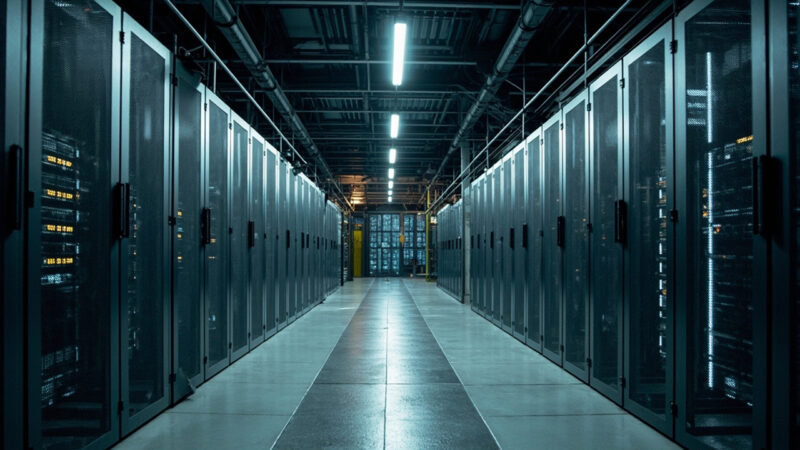
- Racks and cabinets subsystem: where the compute equipment resides. Standard 19-inch and 42U (rack units, each U = 4.45 cm / 1.75 in) racks are the norm, with depths of 1000 mm or 1200 mm (39.4 to 47.2 in) depending on density. Cable organization and load distribution within the rack are critical operational decisions.
- Security and monitoring subsystem: composed of physical access control, video surveillance, fire detection and suppression, environmental monitoring (temperature, humidity, smoke, water), and DCIM (Data Center Infrastructure Management) platforms that aggregate telemetry from all the previous subsystems.
The three metrics that define the quality of a data center
Three objective metrics separate a well-operated data center from one that only has the physical infrastructure. All three are independently auditable.
The first is PUE (Power Usage Effectiveness, overall energy efficiency). It is calculated as total energy consumed by the data center divided by energy delivered to IT equipment. A PUE of 1.0 is theoretical perfection (all energy reaches IT); a PUE of 1.5 is excellent in operation, 1.8 is typical, 2.5 or higher signals serious operational inefficiency. The metric is reported annually in mature operations.
The second is availability (uptime) measured on the actual service availability. Tier IV (the highest in the Uptime Institute standard) demands 99.995% annual availability, which allows approximately 26 minutes of planned and unplanned downtime per year. Tier III demands 99.982% (approximately 1.6 hours). The actual operational metric tends to be worse than the design nominal, because human failures and maintenance jobs consume the margin.
The third is WUE (Water Usage Effectiveness), particularly relevant in zones with water stress like central and northern Mexico. It is calculated as liters of water consumed by the data center divided by energy delivered to IT. A WUE of 1.0 L/kWh is excellent for sites with cooling towers; 0.2 L/kWh is typical of sites with adiabatic cooling or free cooling. This metric is less known than PUE but equally relevant for evaluating the environmental footprint of the data center.
Why most data centers in Mexico operate far below their potential
Three patterns concentrate the majority of operational problems in Mexican data centers that we see in operation. Recognizing them is the first step to solving them.
The first is initial electrical sizing without growth margin. Many data centers were designed for the original project load and ran out of margin at 3 years, which forces the electrical system to operate near its limit. This degrades operational efficiency and triggers the risk of failure. A well-designed data center maintains between 25% and 35% of free electrical margin after the first year of operation.
The second is cooling sized for the initial density, not for the target density. Racks have moved from 5 kW to 25 kW average in AI operations, but cooling systems remain sized for the original density. This generates recurring hotspots that the system cannot resolve, and ends up forcing equipment shutdown or rack density reduction. Cooling planning must consider the target density at 5 years, not the initial density.
The third is the lack of operational measurement. Most data centers in Mexico do not measure PUE, WUE, or uptime systematically, which prevents detecting trends and justifying investments. Without measurement, operational improvements are based on intuition, not data. The investment in a basic DCIM system pays off in data centers over 100 kW for the return in informed operational decisions.
How to start if you are evaluating a data center for the first time
Four steps cover the case of an organization that is evaluating building or leasing a data center for the first time. They are not the only possible ones, but they are the minimum to make a documented decision.
- Calculate the expected IT load at 3 and 5 years: sum the actual power (not the nameplate) of the equipment that will be operated, project organic growth, and validate the expansion margin. Without this base figure, everything else is speculation.
- Decide between on-prem, colocation (housing in a shared data center), and cloud: own on-prem is justified with stable loads above 500 kW and a horizon above 7 years; colocation fits mid-range loads with OPEX preference; cloud fits variable loads without CAPEX preference. Most operations end up hybrid.
- Define the target Tier before requesting quotes: Tier III (99.982% uptime) is the reasonable operational standard for enterprise operations; Tier IV (99.995%) is for operations with strict financial, regulatory, or continuity demands. Quoting without defining Tier leads to over-sizing or under-sizing.
- Validate connectivity before signing the site contract: a data center without carrier diversity and without diverse physical routes ends up with a single network provider, which is a single point of failure. Pre-site validation includes verifying entrances, available carriers, and fiber routes to the site.
Sources
[1] Wikipedia — Data center (background reference) — https://en.wikipedia.org/wiki/Data_center
[2] TIA-942-C — Telecommunications Infrastructure for Data Centers — https://tiaonline.org/product/tia-942-c/
[3] Uptime Institute — Data center industry resources — https://uptimeinstitute.com/
[4] ASHRAE — Technical Resources (thermal management guidance) — https://www.ashrae.org/technical-resources
[5] The Green Grid — Data center efficiency industry resources — https://www.thegreengrid.org/
Want to master this?
Noxtel Academy →