Stulz CyberAir 3: the German perimeter unit that costs more, lasts longer, and breaks less
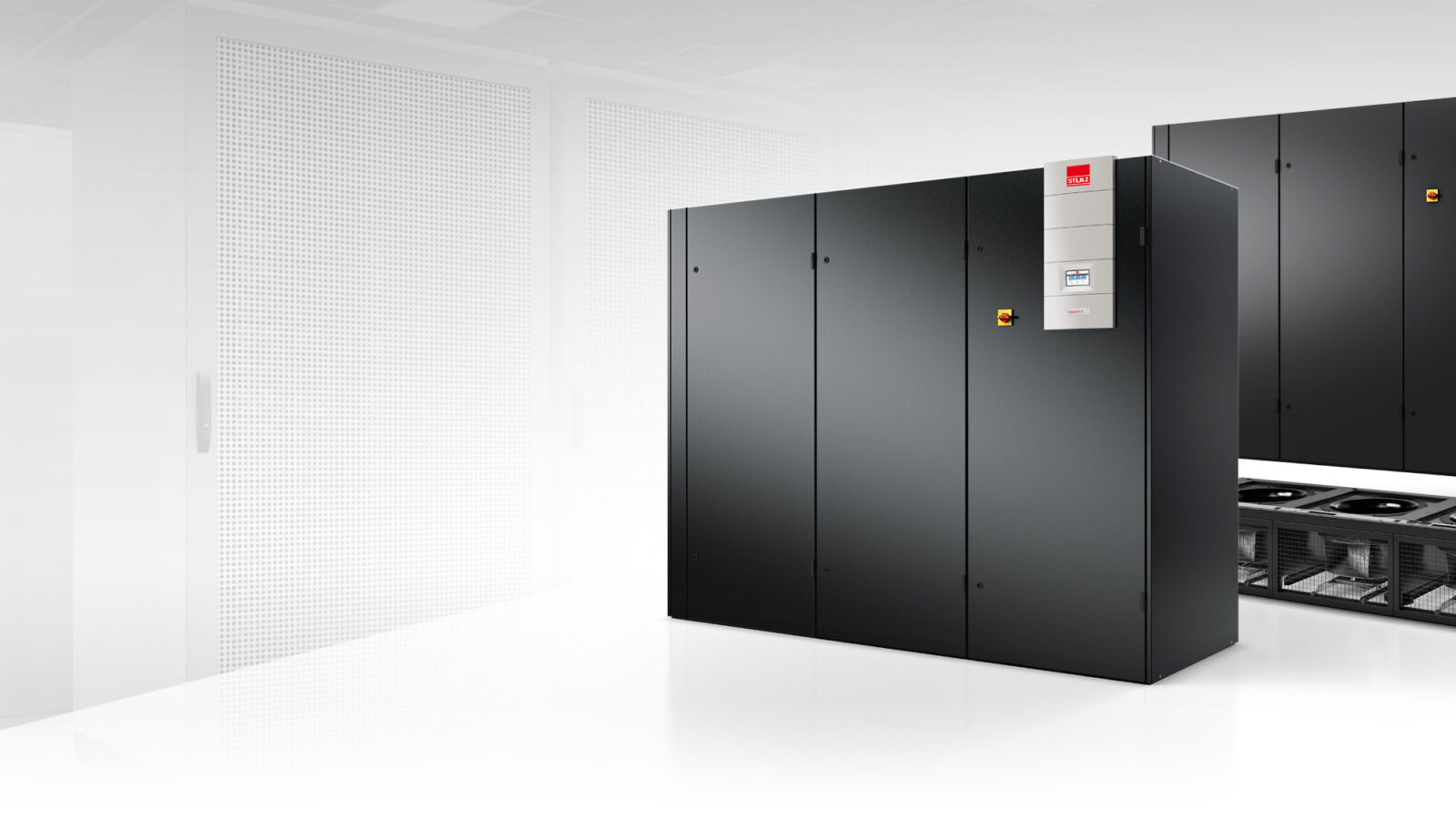
Stulz is the German manufacturer of precision air equipment for data centers with the highest recognition in enterprise and government operation in Europe and Latin America. Its CyberAir 3 line is the brand’s family of perimeter units with the highest capacity, present in operations that prioritize energy efficiency, redundancy, and service life above initial price. The question for a data center under evaluation is not whether Stulz is good, but whether the additional cost versus alternatives is justified with numbers—or is brand without substance.
This article describes what the CyberAir 3 family is, what variants make up the line, what differentiates it from competitors like Vertiv and Schneider Electric, in what cases its cost is justified, and when it makes sense to evaluate alternatives. The goal is that the reader ends with a technical-economic criterion to decide, not a brand preference.
The CyberAir 3 family: five variants for five cases
CyberAir 3 is not a single model; it is a family of five variants that share a platform and differ in the cooling mode. Each variant responds to a different way to reject heat, and the choice depends on the site climate, the existing infrastructure, and the load profile.
- Variant A (Air): Direct expansion (DX) with remote condenser cooled by outside air.
- Variant G (Glycol): Direct expansion (DX) with internal plate condenser cooled by water/glycol to a dry cooler.
- Variant W (Water): Direct expansion (DX) with internal condenser cooled by cooling tower water.
- Variant CW (Chilled Water): Chilled water unit without internal compressor that connects to an external chiller plant.
- Variant Dual / DFC: Hybrid system that combines chilled water and direct expansion to maximize free cooling hours.
The choice among the five variants depends on three site variables: climate (how many hours per year allow free cooling with outside air), existing infrastructure (whether there is a chiller, chilled water, or tower), and load profile (stable or variable). A data center in Mexico City, with its temperate climate that allows thermal use hours, is heavily favored by Free Cooling or Dual variants; while sites in hot and extreme climates in the north of the country tend to favor G or W variants with chiller support.
Comparison with Vertiv and Schneider Electric
Three manufacturers dominate the perimeter precision air market for data centers in Latin American operation: Stulz, Vertiv (which absorbed the former Liebert), and Schneider Electric. All three lines offer equivalent functional coverage: control precision, N+1 redundancy, remote monitoring, BMS/DCIM integration. What differentiates them is the internal engineering, the measured energy efficiency, and the documented service life.
Stulz tends to stand out in energy efficiency at partial loads thanks to its inverter compressors (with continuous speed variation instead of traditional on/off) and to integrated free cooling management. The EER (Energy Efficiency Ratio, ratio of thermal kW dissipated to electrical kW consumed) in nominal regime is comparable across the three brands; the real difference is in how they behave between 30% and 70% of load, which is where most data centers operate most of the time.
Vertiv has the largest installed base in Latin America, with many operations running 10 or 15 years with the same unit. The advantage is the availability of spare parts and technical service in Latin America; the disadvantage is that some models have years without platform updates. Schneider Electric (with the Uniflair line) has growing presence and good integration with its management ecosystem.
Comparison of the three brands in Latin American operation
The following table summarizes the most relevant operational differences for a data center operating in Mexico, considering local technical service availability and measured energy efficiency.
| Characteristic | Stulz CyberAir 3 | Vertiv Liebert | Schneider Uniflair |
|---|---|---|---|
| Full-load efficiency (EER) | 3.2 to 3.8 | 3.0 to 3.5 | 3.1 to 3.6 |
| 50% load efficiency (EER) | 4.5 to 5.2 | 3.5 to 4.0 | 3.8 to 4.4 |
| Compressor modulation | inverter (continuous) | traditional on/off or inverter depending on model | inverter on newer models |
| Technical service availability in Mexico | medium (representation + partners) | high (own offices) | medium (representation + partners) |
| Documented service life | 15 to 20 years | 12 to 18 years | 12 to 18 years |
| Relative initial price | high | medium | medium |
When Stulz CyberAir 3 makes sense
CyberAir 3 is justified in four specific scenarios. The first is when electrical OPEX (operational expense) weighs more than initial CAPEX: higher efficiency at partial loads reduces annual consumption between 10% and 25% versus standard-efficiency alternatives, which over 7 to 10 years amortizes the initial price premium.
The second is when the load is variable or scalable: the inverter modulation of the compressor allows operating the unit between 20% and 100% of load without on/off cycles that degrade efficiency and increase mechanical wear. For data centers with organic growth or phased load, this preserves service life.
The third is when the data center operates in a climate where free cooling is viable during part of the year: CyberAir 3’s integrated free cooling management maximizes hours of operation with free refrigeration, which in temperate climates can save between 30% and 50% of the cooling system’s annual consumption.
The fourth is when the target service life is 15 years or more: the construction of the unit and the components (compressor, EC fans, coils) are sized for that service life without major overhaul. For operations that target 15-year depreciation, the TCO (total cost of ownership) of CyberAir 3 may be lower than alternatives with mid-life replacements.
When Stulz CyberAir 3 does NOT make sense
Three scenarios make CyberAir 3 not the best option. The first is the small data center with limited budget: the price premium versus standard alternatives does not amortize in operations below 500 kW where the annual electrical OPEX is modest.
The second is the project with a very short return horizon: if the operator needs to recover the investment in 3 years or less, the efficiency savings do not add up. CyberAir 3 is for horizons of 7 years and beyond.
The third is operation without reliable local technical service: if the data center is far from an authorized Stulz service center, failure response time lengthens and effective availability drops. In that case, Vertiv with its broader service network in Latin America may be the best technical-economic option.
Five common errors when choosing precision air equipment
Five errors concentrate the majority of purchase decisions that are reviewed at three years. Recognizing them before buying avoids costly rework.
- Buying by brand without comparing measured efficiency: the catalog states one EER, the real operation measures another. Request efficiency curves at 25%, 50%, 75%, and 100% of load, certified by an independent laboratory, before deciding.
- Undersizing redundancy: a single unit per room is a single point of failure. N+1 (one extra unit for every N in operation) is the minimum; 2N (double capacity, with each subsystem duplicated) is the next level for Tier III/IV operations.
- Ignoring the site climate in variant selection: choosing A in hot climate degrades the condenser and triggers compressor consumption. Choosing W when there is no chiller leaves the operation without redundancy. The correct variant depends on the climate and on existing infrastructure.
- Underestimating technical service cost: the cheapest unit with expensive technical service ends up being more expensive in TCO. Compare the total cost of ownership including maintenance contract and spare parts availability over 15 years.
- Buying the largest unit to grow: sizing should be based on the load expected at 3 years, not the theoretical maximum capacity. Buying 2.5 times more capacity makes the project more expensive and operates the unit at 25% load with degraded efficiency.
Do you need help with Stulz solutions?
Stulz?
At Noxtel we specialize in the design, supply, installation, and preventive maintenance of critical infrastructure for data centers. If you are comparing equipment, need to size a project, or require certified technical support for Stulz solutions, our engineering team is ready to help.
Stulz, our engineering team is ready to help.
? Contact us today and schedule a consultation with the Noxtel team
[1] Stulz — Products (manufacturer reference) — https://www.stulz.de/en/products/
[2] ASHRAE — Technical Resources (thermal management guidance) — https://www.ashrae.org/technical-resources
[3] TIA-942-C — Telecommunications Infrastructure for Data Centers — https://tiaonline.org/product/tia-942-c/
[4] Uptime Institute — Data center industry resources — https://uptimeinstitute.com/
[5] Wikipedia — HVAC (background reference) — https://en.wikipedia.org/wiki/Heating,_ventilation,_and_air_conditioning
Want to master this?
Noxtel Academy →