What Are Remote Hands: Definition, What It Includes and What It Does Not (2026)
A disk failed at 2:40 in the morning in a hall with no staff of its own. Monitoring turns red and your only recourse is a phone number.
Who walks into the hall and swaps the disk at three in the morning? That answer is exactly what you contract as remote hands.
If you came looking for the term, this is the piece to walk away understanding it whole: what it is, what the person who executes it does, how they get into your hall and where the service ends.
The definition, in one sentence
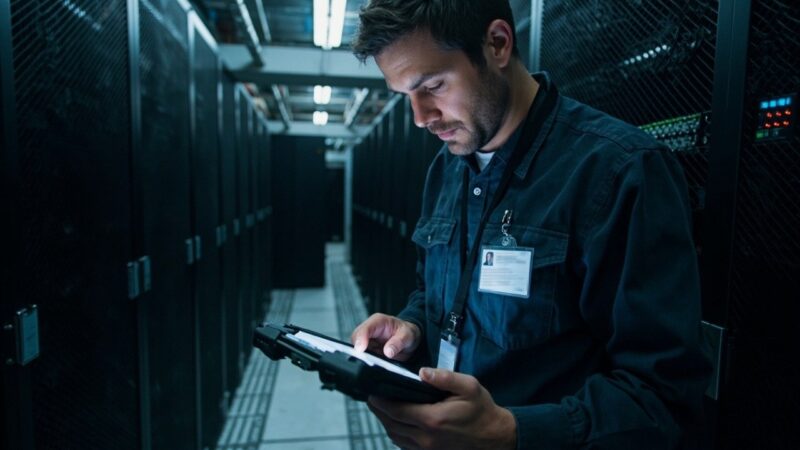
“Remote hands” is the short name for technicians who work physically inside your data center, on your equipment and under your contract. It is not software, it is not a robot and it is not a self-service portal: it is a person who walks to the rack, opens the lid and uses their hands.
The service exists for an arithmetic reason: your hall runs 168 hours a week and almost no midsize company can pay a facility employee for that. What you contract is human presence at the moments that matter, not a full payroll on shift.
The term comes from the colocation world: when someone rented square meters inside a data center, the provider rarely included staff. The hands were the client’s, or they were bought separately. “Remote” describes where the technician comes from, not the place where they work.
What a remote hands technician does, concretely
The technician performs physical work following instructions. They open a ticket, reach the identified rack, do the task, leave a record and withdraw. That is what sets it apart from diagnosis: if monitoring says a power module failed, the technician replaces it; the root cause is defined by someone else, remotely or from your office.
Day to day, the scope usually looks like this:
What it does not do is decide why your platform failed, nor reconfigure your network, nor design the growth of the site. That boundary separates this service from an IT support desk, and it is worth having it clear from the first contract.
How access works: two layers
Access has two layers and it is worth not confusing them. The first is physical: the technician enters the hall with identification, badge and logbook record, and in many contracts site staff accompany them or they announce by radio before opening each rack.
The second is remote. While the technician is in the hall, someone can see the equipment console through a shared screen or a restricted remote access, with a recorded session and logbook. The remote layer is for seeing the LED, the serial or the alarm; the physical layer is for changing the part.
Neither layer is magic: both are people and procedures. Remote does not replace physical, because an image on a screen does not tighten a connector or seat a disk.
The four types of work contracted this way
One practical difference: preventive work is scheduled, corrective work is triggered. That is why almost all contracts include a block of scheduled hours per month, so the part that can be planned does not compete with the part that arrives as an emergency.
How it is billed
The common thing is one of three models: per closed ticket, per hour of work or through a monthly retainer with hours included. Hybrid models also exist, with a fixed block plus variable consumption.
The structure matters more than the number, because it defines who assumes the risk of the month being quiet or being a month of three emergencies. Pricing and billing models are reviewed in depth in another piece of this series.
The honest limits
It is not a service for everything, and it is worth knowing that before signing. There is work a remote hands provider cannot accept: manufacturer authorization is the first, when the manufacturer does not allow third parties to intervene on its equipment and only admits its own technician or one certified by it.
There is also work that is refused for risk. An energized electrical panel, work at height without a certified harness or the interior of a fire suppression system is not remote hands work; it requires a specialized crew with safe work permits and lockout/tagout (LOTO) protocols.
And there is a fundamental limitation: the service executes, it does not reason. If your problem is a network design, a broken dependency or an architecture that no longer holds, more hands do not solve it.
Finally, if your site already has its own staff that can do the work during business hours, the service adds little.
Knowing this from the start does not take value away from the model. It takes waste away: a well-scoped contract solves what your hall really needs, and leaves out what nobody was going to charge for.
Sources
Want to master this?
Noxtel Academy →