Remote hands and evidence traceability: the photo, video and time-stamping system your audit will demand

The technician entered at 02:14, replaced the power supply of a rack and left at 03:02. Three months later the auditor arrives and nobody can prove that the equipment was not out of service before the intervention.
The SLA tells you how long you took; the evidence tells you what happened. They are two different things, and confusing them is the most common mistake when an audit of infrastructure providers arrives.
The evidence system: four components per intervention
Remote hands traceability is not solved with an Excel log nor with an email saying “it’s already done”. It is solved with a record that anyone can review three years later and understand without asking.
That record has four components, and each one answers a different question from the auditor. If one is missing, the evidence chain breaks exactly where the auditor starts asking.
The photo pair that anchors the change
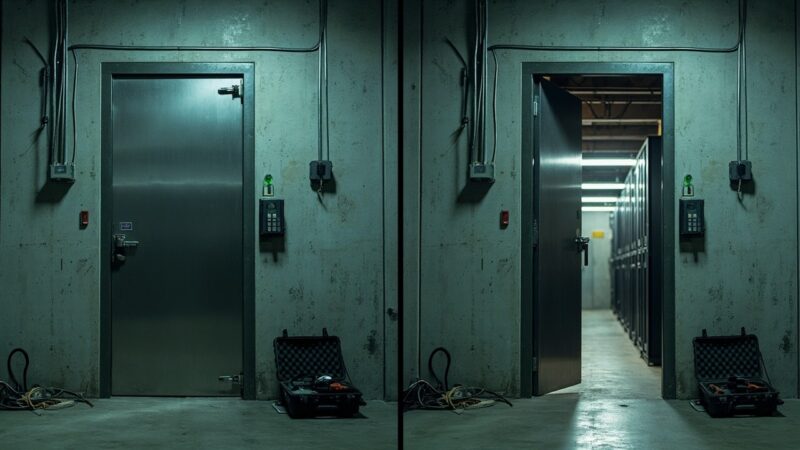
The before photo is not decorative documentation: it is the baseline of the asset. Without it, any later difference becomes disputable. Frame the complete equipment, the legible labels, the power indicators and the immediate surroundings.
The after photo must repeat the same angle and the same distance. Only that way is the comparison direct; a different framing forces the auditor to rely on your description.
If there was a change of hardware, cabling or location, the value of that photo pair goes up, because it proves the work happened where it should. That is the reason the two framings are repeated, not the habit of documenting for the sake of documenting.
Date and time go in the file metadata and also in the log. A photo that cannot be placed in time stops being evidence and becomes an image without context.
Video or screenshot when the intervention warrants it
The video answers what a photo cannot prove: the sequence. It is used when there is data migration, service restart, critical component replacement, firmware update or removal of equipment that is offline.
The screenshot covers the other case: when the work happens in a console, admin panel or terminal, because it shows the command, the result and the system time.
When the task does not warrant a video, that decision is also written down: “no video because there is no impact on service”. That line prevents the auditor’s uncomfortable question about why there is no record.
The traceability log: the component that is skipped the most
The minimum record per intervention carries the work order identifier, the name of the technician, the unique identifier of the credential used, entry and exit time with time zone, reason for the access, terminal and source address.
The credential must be nominal and non-transferable, with minimum privilege for the task and with rotation or expiration. A credential shared among several technicians does not prove who did the work; and if that credential appears at another time, it works against you.
The authorized work order is what turns an access into a legitimate intervention. Without an order, the access is documented anyway, but as a security event and not as maintenance.
Formats and tools so the evidence is unalterable
Two criteria govern the format: integrity and recoverability. The evidence is written once and is no longer edited; it is only added to.
As for the format: JPEG or PNG for photos, MP4 for video, and the complete record as a signed PDF/A. The log lives in the ticketing system as CSV or JSON. The evidence must remain legible in five years without depending on the equipment that generated it.
Which regulatory framework requires each piece of evidence
Each framework asks for something different, and that is why it is worth mapping each component to its standard before defining the format.
The pattern repeats: the standard does not ask you to send photos, it asks you to demonstrate control over who enters, with what permissions and under what authorization. The photo, the video and the log are the verifiable support for that demonstration.
Sources
1. ISO. «ISO/IEC 27001:2022 — Information security, cybersecurity and privacy protection» — https://www.iso.org/standard/27001
2. PCI Security Standards Council. «Payment Card Industry Data Security Standard (PCI DSS v4.0.1)» — https://www.pcisecuritystandards.org/document_library/
3. PeopleCert / AXELOS. «ITIL 4: Incident, change and service evidence management» — https://www.peoplecert.org/browse-certifications/it-governance-and-service-management/ITIL-1
4. NIST. «SP 800-53 Rev. 5: Security and Privacy Controls for Information Systems and Organizations» — https://csrc.nist.gov/pubs/sp/800/53/r5/upd1/final
Want to master this?
Noxtel Academy →