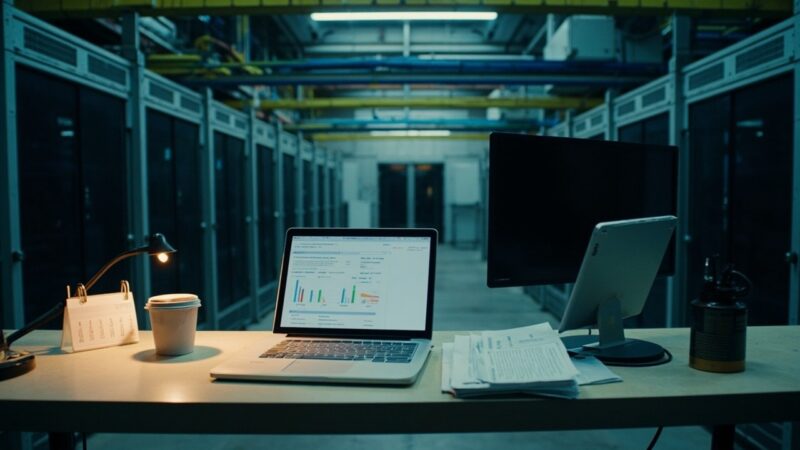
Remote hands for GPUs and AI workloads: the 3 specific tasks (InfiniBand cabling, H100 swap, liquid cooling management) only a specialist does
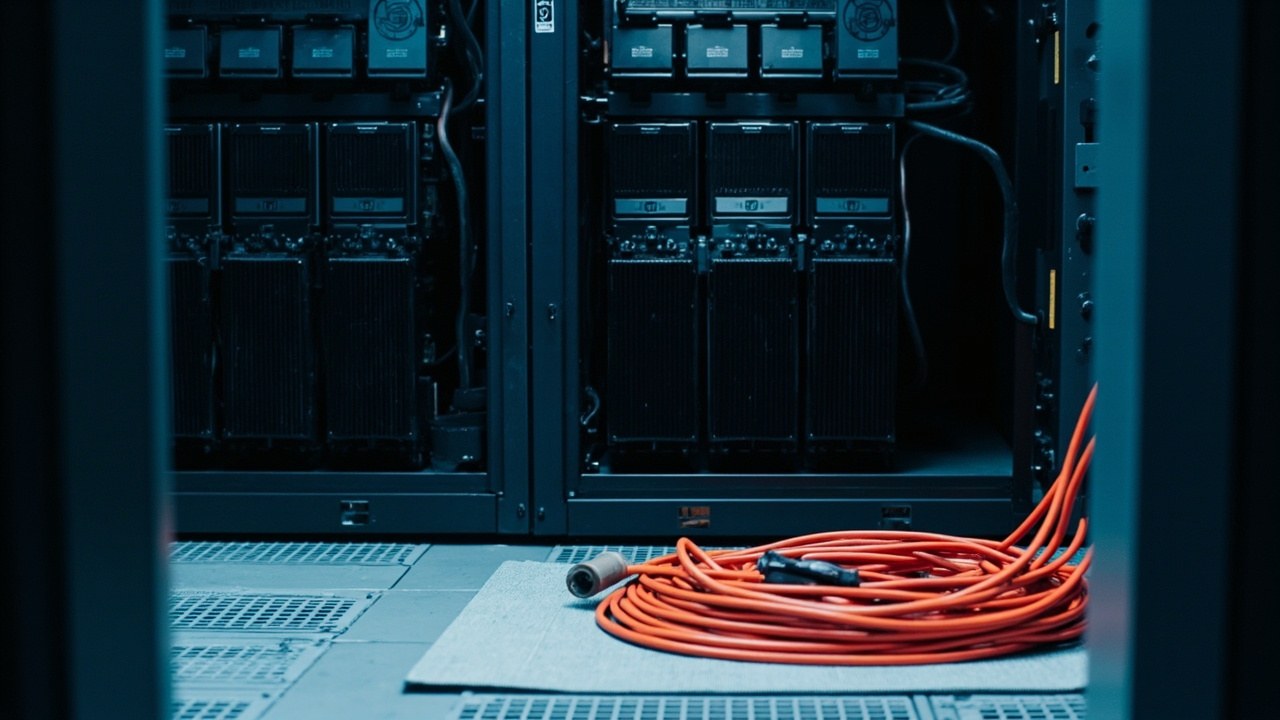
Your remote hands budget is calculated for conventional server racks: same technician, same rate, same hour. A technician with splicing enters, changes a power supply and leaves in 40 minutes.
As soon as that same rack hosts GPUs and AI workloads, the calculation no longer applies. Three tasks change in nature: interconnection, replacement of a high-consumption card, and immersion cooling management.
Why GPUs change the nature of the work
A general server receives two redundant power supplies and one network card. An acceleration node adds several GPUs per rack, high consumption on the 48-volt bus and links that do not tolerate improvised cabling.
Maintenance space is also reduced, and with it the margin to work without improvising.
It is a change in the type of work, not in the number of parts. A facility technician knows how to insert a cable into a patch panel. He does not always know what topology the equipment to connect expects, nor how to verify it is correct.
Task 1: InfiniBand cabling
The network connecting the nodes of an AI cluster does not behave like an office network. When the cluster distributes work across several GPUs, performance depends on each cable landing in the correct port.
- Understand cluster topology, because connection order defines which nodes see each other and at what latency cost.
- Respect cable classification, because a short-range transceiver does not replace a long-range one even though both connect.
- Validate with bandwidth and latency tests, not just with the green link light shown by the board.
A topology error does not pull the cable: it degrades it. The cluster keeps responding, the link appears active and performance drops, usually gradually.
When the symptom appears weeks later you no longer know which cable causes it, and the investigation starts from zero. That is where your data center account gets unbalanced.
Task 2: GPU replacement in a dense rack
Removing an H100 card from a high-density rack is a coordination job, not a strength job. The procedure requires respecting the system’s complete power-up sequence and how load is distributed when energizing.
- Power down in the order defined by the manufacturer, not in the fastest one.
- Restore the equipment respecting the power-on sequence, which is not the inverse of power-down.
- Handle the module with the electrostatic care a piece of that value requires, and verify temperature and consumption after startup.
A misapplied procedure leaves an unrecognized module, triggers power alerts or permanently degrades the card. The cost is not the part: it is the lost day of computing.
Add the customer waiting for their delivery and the risk over an asset measured in thousands of dollars. Neither appears on the technician’s invoice.
Task 3: immersion cooling management
When heat is dissipated with dielectric fluid instead of air, the procedure no longer resembles a conventional rack. The fluid turns the rack into an active part of the system.
- Recognize which materials and components are approved for direct contact with that fluid.
- Respect the module extraction and insertion procedure to avoid introducing contamination or bubbles into the chamber.
- Use the protection and extraction equipment defined for that installation, not the generic protocol.
Here a technician without specific training not only exposes himself: he can contaminate the fluid and force the entire rack into corrective maintenance. The cost of that poorly invested hour multiplies by the number of nodes.
And that outage is not absorbed by the support hours you already hired. A local incident becomes a contract problem.
What a general provider does resolve well
Not everything in a data center with AI needs a specialist, and that distinction matters for your budget. No operations director should pay specialist rates for a rack without acceleration.
A good general remote hands provider covers well the conventional part of the contract:
- Rack delivery, physical placement and labeling according to standard.
- Disk, power supply, network module and memory replacement in non-acceleration equipment.
- Raceway, conventional copper cabling and routine preventive maintenance.
- Documentation of each intervention and status report.
The boundary fits in one contract line: if the task does not touch acceleration topology, immersion fluid or GPU module replacement, it falls under the general provider.
That cut avoids paying specialist rates for work a good general technician resolves in one visit, and leaves clear the zone where the cost difference is worth paying.
Why this work is not bought by the hour
The expensive mistake is not hiring the cheapest technician for a poorly defined task. It is discovering the difference weeks later, when a training cluster performs below expectations.
Or when a module does not start after a maintenance nobody documented. In both cases the cost already fell on the data center account, and next year’s budget absorbs it.
Remote hands for AI is quoted based on demonstrated competence in that type of installation, not on an hourly rate. One hour well done in an acceleration node is worth more than ten hours billed to a technician who follows instructions to the letter.
When the contract distinguishes which tasks are specialist and which are not, both sides know what to expect and you can defend the budget with arguments, not intuition.
Sources
- InfiniBand Trade Association — https://www.infinibandta.org/
- NVIDIA DGX H100 User Guide — https://docs.nvidia.com/dgx/dgxh100-user-guide/introduction-to-dgxh100.html
- NVIDIA InfiniBand networking — https://www.nvidia.com/en-us/networking/products/infiniband/
- Open Compute Project — https://www.opencompute.org/projects
Want to master this?
Noxtel Academy →