Refrigerant R-1234ze vs R-1234yf vs R-134a: the future of low-GWP refrigerants in data centers beyond R-454B
Why R-454B is not the end of the road
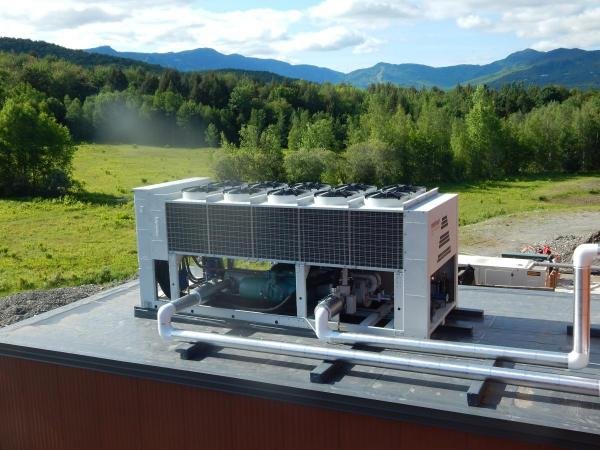
R-454B is the industry’s answer to the R-410A phase-down in commercial air conditioning, and that correctly positions it as the direct replacement for the previous generation. What R-454B does not resolve is the next question: what comes after R-134a for the large-capacity centrifugal chillers in the installed base, and for the direct-expansion systems that are already migrating away from R-410A for regulatory or energy-efficiency reasons? The short answer is that three very-low-GWP refrigerants are competing for that next generation, and the choice between them depends on the type of equipment, the applicable regulatory framework, and the remaining useful life of the installed system.
The map of the three candidates
R-1234ze(E) is a pure HFO (hydrofluoroolefin) with a GWP of 7 per the IPCC 4th Assessment Report and 1.37 per the 6th Assessment Report. The 4th Assessment figure (GWP 7) is the one that dominates in current regulation; the 6th Assessment is more recent but has not yet been fully adopted by regulatory frameworks. ASHRAE safety classification A2L (mildly flammable, low toxicity). It is the refrigerant of choice for new centrifugal chillers designed from the ground up for HFO.
R-1234yf is another HFO with GWP under 1 (0.501 per AR6). Also A2L. Historically it has been positioned in automotive air conditioning and light commercial applications. In data centers its primary use is in small chillers and high-efficiency direct refrigeration systems.
R-134a remains the reference refrigerant for medium and large centrifugal chillers, with a GWP of 1,430. It is the installed base that is being migrated, not a new-construction candidate. Its distribution price has multiplied by 9.5 since 2014, according to data prepared for the European Commission in Q4 2025, reflecting both regulatory pressure and the operational persistence of the installed stock.
The technical difference that matters for your site
The three refrigerants have distinct thermodynamic behavior, and that directly affects what type of equipment can use each one.
R-1234ze(E) has a volumetric capacity 25 to 30% lower than R-134a. That means that, to deliver the same cooling capacity, a compressor with greater displacement is required. In practice, R-1234ze(E) requires equipment designed from the outset for that refrigerant — a retrofit is not practical. The benefit is an efficiency improvement of roughly 27% versus R-134a in certain configurations with an internal heat exchanger, according to laboratory tests reported by Climalife.
R-1234yf has thermodynamic behavior similar to R-134a but with A2L classification. Its use in data centers is more limited than R-1234ze(E) because its application window is narrower.
R-134a remains the installed base. The cost of migration depends on what is done with the existing equipment: a retrofit with R-513A (another refrigerant, a blend with R-1234yf, GWP 631) costs between €5,000 and €10,000 per 200 kW chiller — far less than a full replacement.
The design pressures you need to consider
The three refrigerants have different operating pressures, and that impacts equipment cost and complexity:
- R-513A and R-1234yf operate at 325–350 psig, similar to R-134a systems.
- R-1234ze(E) and R-515B operate at 250–275 psig, moderately lower.
- R-1233zd(E) and R-1336mzz(Z) operate at 70–80 psig, much lower.
Lower pressures allow thinner, cheaper components on the liquid side, but they require return-vapor piping 3 to 6 times larger than R-134a-class options. For a data center where mechanical-room floor space is expensive, that is an important design variable.
R-1233zd(E) and R-1336mzz(Z) deserve a separate mention. They have a GWP of 1–2, A1 classification (non-flammable), and represent 97–99% reductions versus traditional refrigerants. They are the candidates for new installations where fire safety is the priority. Their adoption in data centers is growing, but the catalog of commercial chillers offering them is still narrower than for R-1234ze(E).
The economic calculation for your next refresh
For a data-center operator evaluating the replacement today of a 200 kW chiller running on R-134a, the options are:
- Retrofit to R-513A (GWP 631). Cost €5,000–€10,000 all-in, maintains R-134a operating pressure, no compressor replacement required, fast implementation. Reduces GWP by 56% versus R-134a. Limitation: R-513A still has a significant GWP; it is not “ultra-low.”
- Full replacement with an R-1234ze(E) chiller (GWP 7). Higher capital cost (a new chiller specific to HFO), but a 99.5% GWP reduction. Estimated operational electrical savings of 27% versus R-134a under favorable conditions. Design life 20+ years.
- Wait until the end of the current chiller’s service life. If the R-134a equipment has less than 5 years remaining, perform an immediate retrofit with R-513A and plan the replacement to R-1234ze(E) for the next cycle. If it has more than 5 years left, evaluate direct replacement.
- For new builds, specify R-1234ze(E) or R-1233zd(E) from the design stage. This eliminates the pressure of having to migrate later and aligns the site with the strictest regulatory frameworks already in force in some jurisdictions.
The regulatory context that is coming
Mexican regulation specific to refrigerants in data centers is not yet as detailed as the U.S. or European one. What applies today:
- SEMARNAT has general energy-efficiency guidelines for commercial refrigeration systems.
- The General Law on Climate Change establishes the national framework for GHG-reduction commitments.
- International commitments under the Paris Agreement set a ceiling on the country’s aggregate emissions.
What is coming:
- The Regulation of the General Law on Circular Economy (published January 2026) may include guidelines for industrial refrigeration equipment aligned with the global phase-down.
- The international trend is toward GWP below 150 for new equipment in data centers. R-454B (GWP 466) covers that frontier for small DX systems, but for large chillers the frontier keeps moving.
For a site that operates with R-410A today and is migrating to R-454B, the next natural replacement cycle will likely be to R-1234ze(E) or R-1233zd(E), depending on fire-safety priorities and the availability of equipment in the Mexican market.
The environmental caveat that few mention
HFOs such as R-1234ze(E) have a far lower operational carbon footprint than HFCs. But their atmospheric breakdown produces trifluoroacetic acid (TFA), a persistent compound that has been detected in drinking water, human blood, urine, and beer according to an analysis by the German Environment Agency. TFA is not removed by conventional drinking-water treatment plants.
That means the calculation “R-1234ze(E) = better for the environment” has two dimensions: operational GWP reduction (clearly favorable) versus TFA pollution (concerning at a global scale). The science on TFA is still evolving. For a Mexican data center today, the practical decision is that HFOs are the best available alternative to R-134a and R-410A, but the conversation around TFA will intensify in the next 3 to 5 years.
What your next RFP should ask
For a new data-center project or a refrigeration-system refresh, the technical questions that document the right decision:
- What is the GWP of the refrigerant in the proposed equipment, and under which IPCC standard (AR4 or AR6) is it calculated?
- Is the equipment new or a retrofit? Is it compatible with the refrigerant by design, or is it a retrofit?
- What is the ASHRAE safety classification of the refrigerant (A1 or A2L), and what changes in handling, ventilation, and leak detection does it require?
- What is the operating pressure, and how does it compare with the existing infrastructure?
- What is the refrigerant cost per kg, and what is the projected availability at 5 and 10 years?
- What is the expected energy efficiency (kW/ton) at part-load and full-load conditions?
The answers to those six questions tell you where on the GWP-migration ladder the proposed equipment sits, and what it costs operationally versus the alternative.
Sources
- https://refrigerationstore.eu/gas/alternatives-r134a-r513a-r1234ze-industrial-retrofit-2026
- https://bisresearch.com/insights/how-data-center-refrigerants-transformed-by-the-end-of-2025-with-major-shifts-and-innovations
- https://dataintelo.com/report/rze-high-efficiency-chiller-market
- https://ccacoalition.org/sites/default/files/resources/files/Germany_Experience%20in%20Data%20centre%20emissions.pdf
- https://hvac-eng.com/direct-to-chip-liquid-cooling-the-future-of-high-density-data-center-thermal-management/
Want to master this?
Noxtel Academy →