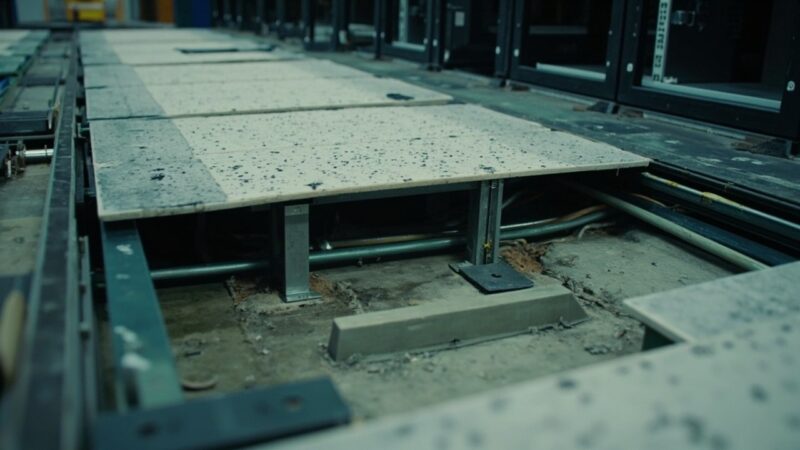
Raised floor vs slab on grade: when to design on raised floor and when concrete slab is the smarter (and cheaper) choice
Raised floor or slab on grade is one of the earliest and hardest decisions to reverse in data center design. Once built, switching from one to the other is practically demolition and reconstruction. That is why the decision must be made with concrete information: rack density, total budget, operational flexibility you need over the next 10-15 years, and the type of cooling system you will use. This article covers the objective criteria for each case, the real costs in Mexico for 2025-2026, and the most common mistakes when choosing.
If your data center is under 100 kW of IT load and fewer than 10 racks, this decision was probably already made for you: a concrete slab with surface raceway is the sensible choice. If it is over 500 kW or more than 30 racks, the cost-benefit analysis becomes critical. Between 100 and 500 kW, there is a gray zone that requires case-by-case analysis.
When raised floor makes sense
Raised floor has operational sense when you need some combination of:
- High cable density under the floor. If you are going to route more than 500 network cables and 200 power cables in the room, raised floor lets you organize trays below without saturating the surface.
- Air flow underneath (cold-air plenum). If your cooling system is CRAC/CRAH with floor discharge (cold aisle containment with perforated tiles), you need raised floor — no alternative. Without it, the cold-aisle containment model does not work.
- Flexibility to reconfigure rack layout. If your operation is going to grow or reorganize every 2-3 years, raised floor lets you move racks without cutting trenches or running new cables on the surface.
- Need for chilled water under the floor. If you are going to use CRAH with chilled water piping, you need the raised floor plenum to run the piping without cluttering the surface.
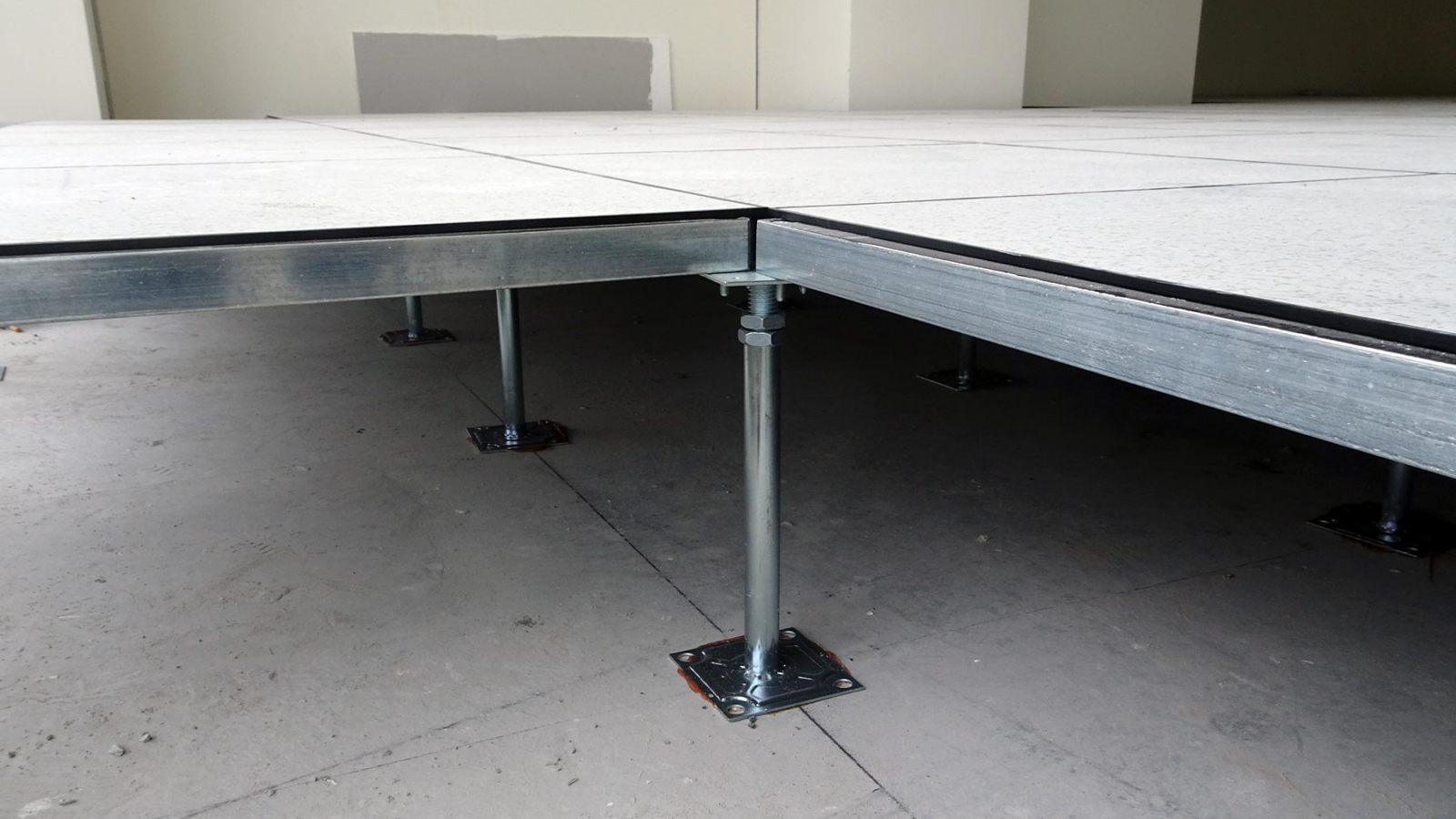
Cost ranges in Mexico for 2025-2026: raised floor with steel pedestals + calcium sulfate tiles with conductive finish, installed, in 30-45 cm plenum height: MXN $2,800 to $4,200 per m². If you need perforated tiles (cold aisle), cost rises MXN $1,500 to $2,500 extra per m² perforated.
When slab on grade makes sense
Slab on grade has operational sense when:
- Low cable density. If your room has fewer than 8 racks and cabling is manageable over surface raceway or overhead tray, you do not need the plenum.
- Overhead air cooling system (ducted overhead). If your CRAC/CRAH discharges through overhead ducts (cold aisle containment with ductwork), the air does not go below and raised floor loses its plenum function.
- Limited CAPEX budget. Slab on grade is 60-70% cheaper than raised floor up front. If you have strong CAPEX pressure, slab frees up that margin to invest in UPS or generator.
- Stable operation without reconfigurations. If your data center is in an industry with little technological change (government, certain manufacturing industries), you can design the rack layout once and forget about it for 10 years. Slab on grade is ideal for that.
Costs in Mexico: the reinforced concrete slab with polished finish and dust-sealed surface comes with the building’s civil construction. What adds cost on slab vs raised floor is surface raceways for cables (aluminum or PVC, MXN $400-900 per linear meter installed) and overhead ducts for air (galvanized sheet, MXN $1,200-2,800 per linear meter).
The 10-year cost-benefit analysis
The most common trap: comparing only initial CAPEX. Raised floor always loses there. The real comparison is CAPEX + OPEX + operational flexibility over 10-15 years. For a typical 200 m² DC:
- CAPEX raised floor (200 m², 45 cm plenum, 30% perforated tiles): MXN $840,000 initial. CAPEX slab (same area, raceway + overhead ducts): MXN $380,000 initial. Initial difference: MXN $460,000 in favor of slab.
- OPEX raised floor (seals, adjustments, replacement of damaged tiles, plenum management): ~MXN $80,000-120,000 annually. OPEX slab (overhead duct cleaning, raceway adjustment): ~MXN $40,000-60,000 annually. Annual difference: ~MXN $50,000 in favor of slab.
- Cost of change: if you design with slab and in 5 years you need raised floor, the retrofit cost is MXN $1,500,000-2,500,000 (demolition of finishes, pedestal system installation, etc.). If you design with raised floor and in 5 years you realize it was unnecessary, the demolition cost is MXN $400,000-600,000 but it is not mandatory, you can leave it.
Conclusion of the analysis: if your operational plan contemplates more than 2 layout reconfigurations over 10 years, or if your IT load will grow more than 30% in 5 years, raised floor wins at 10 years despite the higher initial CAPEX. If your operation is stable and IT load is predictable, slab wins on TCO.
Common mistakes when choosing
The 4 mistakes that cost the most in operation:
- Choosing raised floor because ‘that is how data centers look’. Fashion drives inflated CAPEX without real operational need. If your operation does not require the 4 advantages from the first section, you do not need it.
- Choosing slab and then wanting to install outside-air free cooling. Free cooling saves 20-40% of cooling OPEX, but requires large cross-section ducts (60-90 cm diameter) that do not fit on slab without affecting structural capacity. If you consider free cooling, design with raised floor from the start.
- Designing raised floor at 30 cm and then wanting chilled water. Chilled water piping needs 15-20 cm of free space between the floor and the bottom of the lowest pipe. If your plenum is 30 cm, the piping takes 2/3 of the plenum and blocks airflow. Minimum 45 cm if you consider chilled water.
- Designing slab and then discovering that rack heat does not dissipate. If your rack density rises to 15-20 kW per rack (typical in AI clusters), overhead air cooling needs large cross-section ducts that are difficult to install on slab without affecting ceiling clearance. Plan the maximum expected density at 10 years, not just day-1 density.
When raised floor is not an option
There are 3 contexts where raised floor is NOT viable, regardless of the advantages:
- Buildings on upper floors (second floor and above) without structural reinforcement. Raised floor + IT equipment + racks can add 800-1,500 kg/m² to the building’s structural slab. If the building was not designed for that load, you cannot install full raised floor. Option: partial raised floor only in the rack zone, slab for the rest.
- Modular (containerized) data centers. Containers come with integrated slab and there is no height to add a plenum above. If your DC is modular, it is slab — period.
- Sites with high seismic risk (CDMX, Oaxaca, Chiapas zones) without specific seismic design. Raised floor in seismic zones requires pedestal reinforcement with anchoring and dissipators. If your provider does not have seismic experience, better to use slab with overhead ducts anchored to the building.
Recommendation by operational profile
Executive summary for the 4 typical profiles:
- Startup / SME with 5-10 racks, limited budget, no plans to grow in 3 years: SLAB with surface raceway and overhead ducts. Minimum CAPEX, predictable OPEX, sufficient operational flexibility for the typical range.
- Mid-sized company with 20-50 racks, planning 30% growth in 5 years, medium budget: RAISED FLOOR with 45 cm plenum, 25-30% perforated tiles, reserve space for chilled water ducts. Balance between initial investment and operational flexibility.
- Enterprise / colocation with 50-200 racks, high density, multi-client: RAISED FLOOR with 60 cm plenum, 40%+ perforated tiles, cold aisle containment system. Operational flexibility pays for the investment in this range.
- Hyperscale / AI factory with 200+ racks, 30-80 kW per rack: RAISED FLOOR with 90 cm plenum + consider liquid cooling systems (DLC, immersion) as complement or alternative to air. Density breaks the air containment model.
If your case falls between two profiles, the decision rule is simple: if initial budget is the strong constraint (CAPEX is the priority), slab with raceway and ducts. If operational flexibility over 10 years is the strong constraint, raised floor. Both are defensive decisions depending on your project’s main constraint.
The decision between raised floor and slab is not only technical. It is a business-model decision: how much operational flexibility is your initial CAPEX worth. If your business is going to change a lot in 10 years, pay for the flexibility. If it is going to be stable, do not pay for it twice.
Sources
- TIA-942-B-2023 — https://www.tia.org/standards/tia-942
- ASHRAE TC 9.9 — https://www.ashrae.org/technical-resources/bookstore/thermal-vigilance-for-data-processing-environments
- BICSI 002-2024 — https://www.bicsi.org/standards/data-center
- CISCA — https://www.cisca.org/
- Uptime Institute — https://datacenter.uptimeinstitute.com/
Want to master this?
Noxtel Academy →