Hot aisle vs cold aisle: why containment is the most profitable USD 50k decision for your data center
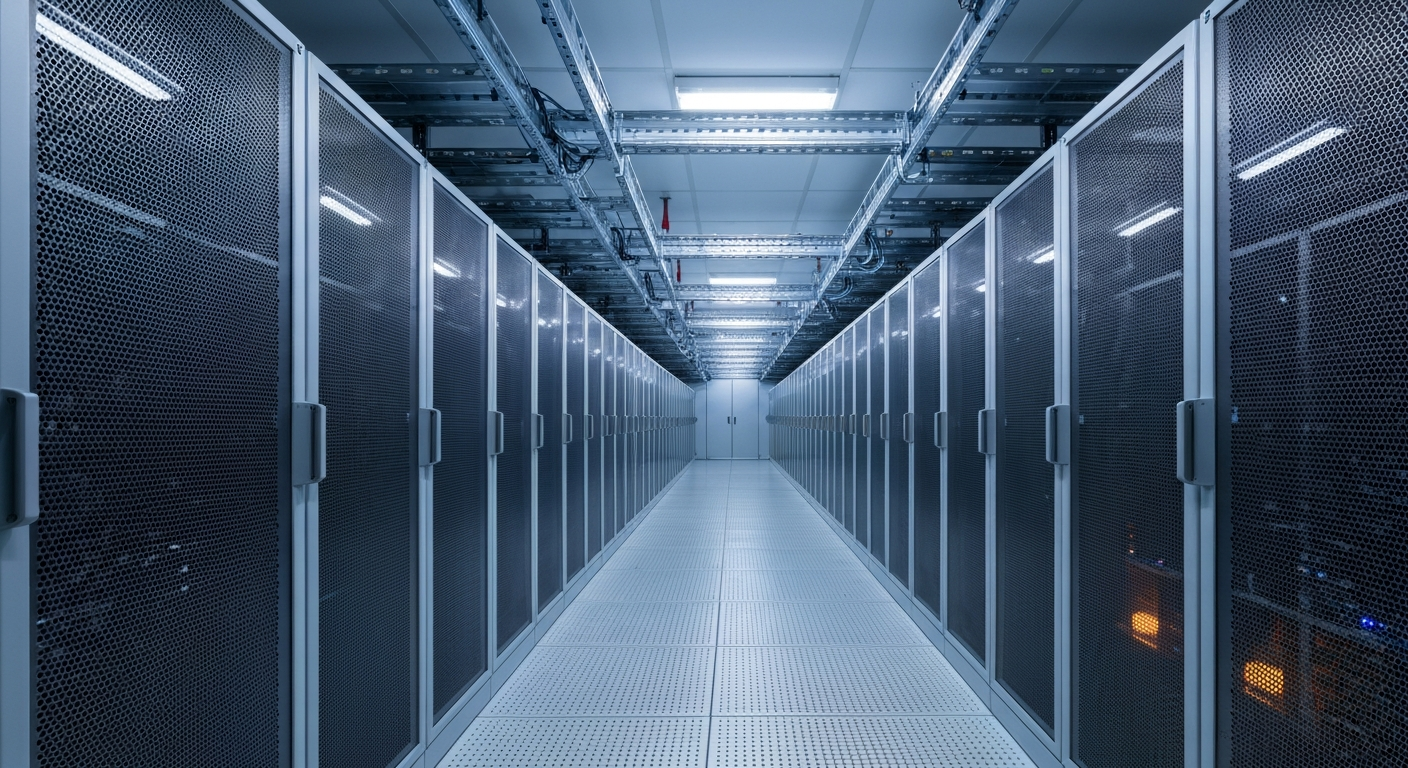
Aisle containment — physically separating the hot air that leaves the racks from the cold air that enters — is one of the lowest-cost, highest-impact modifications a data center can implement. With an investment in the order of USD 50,000 in panels, doors, and structure for a mid-sized site, you achieve a PUE reduction of 0.15 to 0.30, which translates into megawatt-hours per year off the electric bill and a more thermally stable operation.
This article describes the physical principle that makes containment effective, the three levels of implementation available, and why the decision between containment and open aisles is rarely a technical decision: it is an economic decision that pays for itself in less than 24 months at most operating sites.
The physical principle: separating hot air from cold
In a traditional data center without containment, racks are arranged in rows with alternating aisles: the front aisle receives cold air from the raised floor diffusers or from the room air conditioning, and the rear aisle returns hot air to the return diffusers.
The operational problem is that hot and cold air mix at the top of the racks due to natural convection: hot air rises, meets cold air that also moves upward from the AC injection pressure, and a mixing zone forms at an intermediate temperature. That mix reduces the temperature differential between rack intake and exhaust, which forces the air conditioning system to work harder to keep the equipment intake temperature within the ASHRAE recommended range. The result is a higher PUE and mechanical system electrical consumption that can reach 40-50% of total site consumption.
Containment attacks the problem at its source: vertical panels over the racks, doors at the aisle ends, and — at the highest implementation levels — a ceiling over the hot aisle physically separate the two air streams. Cold air enters through the cold aisle at injection temperature, crosses the racks, leaves at the back as hot air, and is channeled directly back to the AC return without mixing with cold air. The temperature differential between rack intake and exhaust approaches the design theoretical difference (typically 15-20 degrees Celsius instead of the 8-12 achieved without containment), and the mechanical system reduces its load.
Why containment is the decision (vs. open aisles)
The three reasons that justify the containment investment, ordered by impact:
- Direct energy savings. Mechanical system electricity savings typically run between 20% and 35% of total cooling consumption, depending on climate and prior system efficiency. For a site with 1 MW of IT load, that represents between 200 and 350 kW of continuous savings, which at an industrial electricity cost in Mexico of USD 0.10-0.15/kWh translates into USD 175,000 to 460,000 per year. The USD 50,000 investment pays back in less than 6 months.
- Higher rack density without investing in the mechanical system. Without containment, the maximum density per rack is limited by the mechanical system’s capacity to deliver and extract air. With containment, that effective capacity doubles or triples because air is channeled efficiently. This lets you add higher-density racks (15-25 kW) without replacing chillers or air conditioning units.
- More stable and predictable operation. Containment eliminates the localized hot zones (hotspots) that appear in open aisles when several neighboring racks run at high load. Rack intake temperature becomes more uniform, and the AC control system responds better to aggregate load.
Three containment levels and their PUE impact
Not all containments are equal. The industry recognizes three levels with growing impact on PUE and investment:
- Level 1 — Cold aisle containment. Panels over the racks and doors at the cold aisle ends seal the aisle where cold air is injected. It is the most common level, the simplest to implement, and the lowest cost. Typical PUE impact: -0.10 to -0.15 versus open aisle.
- Level 2 — Hot aisle containment. Instead of containing cold air, hot air is contained with panels over the racks and a ceiling over the rear aisle. Cold air is distributed freely throughout the room. It requires more infrastructure (ceiling, dedicated return) but delivers a lower PUE because hot air returns to the mechanical system without mixing with room cold air. Typical impact: -0.20 to -0.30.
- Level 3 — Self-contained isolation. Each rack or row of racks is encapsulated in a closed structure with its own extraction system. This is the level used in high-density sites (AI, HPC — high-performance computing) where rack density exceeds 30 kW. Typical impact: -0.30 or more, but with a several-times-higher investment.
Table: containment vs. open aisle
The level choice depends on available CAPEX, PUE target, and target density at three years. Most sites in temperate Mexican climates can operate at PUE 1.3 with Level 2 hot aisle containment, and that is usually the optimal point between investment and return.
| Variable | Open aisle | Cold aisle | Hot aisle | Full containment |
|---|---|---|---|---|
| Typical PUE | 1.5-1.8 | 1.3-1.5 | 1.2-1.4 | 1.1-1.3 |
| Supported rack density | 5-10 kW | 10-15 kW | 15-25 kW | 25-50 kW |
| Relative CAPEX | 1.0 | 1.05-1.10 | 1.20-1.40 | 1.80-2.50 |
| Cooling electrical OPEX | High | Medium | Low | Very low |
| Implementation complexity | Low | Medium | Medium-high | High |
| Hotspot risk | High | Low | Very low | None |
| Typical payback | — | 6-18 months | 12-24 months | 24-48 months |
Conclusion: The most evident ROI in infrastructure
Aisle containment is one of the modifications with the best cost-benefit ratio available for an existing data center. The investment is low (tens of thousands of dollars), the return is fast (months), and the operational impact is deep (PUE reduction, possible density increase, hotspot elimination).
The decision between containment and open aisle is rarely justified in purely technical terms: operational data shows that the typical payback is under 24 months at most sites, and that cumulative savings during the site’s useful life exceed the initial investment by a factor of 5 to 10.
Sources
[1] ASHRAE Standard 90.1: https://www.ashrae.org/technical-resources/bookstore/standard-90-1
[2] Uptime Institute — Data Center Resources: https://uptimeinstitute.com/resources
[3] Uptime Institute — Blog: https://uptimeinstitute.com/blog
[4] Wikipedia — Data center: https://en.wikipedia.org/wiki/Data_center
[5] Wikipedia — Air conditioning: https://en.wikipedia.org/wiki/Air_conditioning
[6] Wikipedia — Cooling tower: https://en.wikipedia.org/wiki/Cooling_tower
[7] Wikipedia — Vapor-compression refrigeration: https://en.wikipedia.org/wiki/Vapor-compression_refrigeration
[8] Vertiv — Thermal Management: https://www.vertiv.com/en-us/products-catalog/thermal-management/
Want to master this?
Noxtel Academy →