Relative humidity in data centers: why ASHRAE recommends 40-55% and what happens outside the range
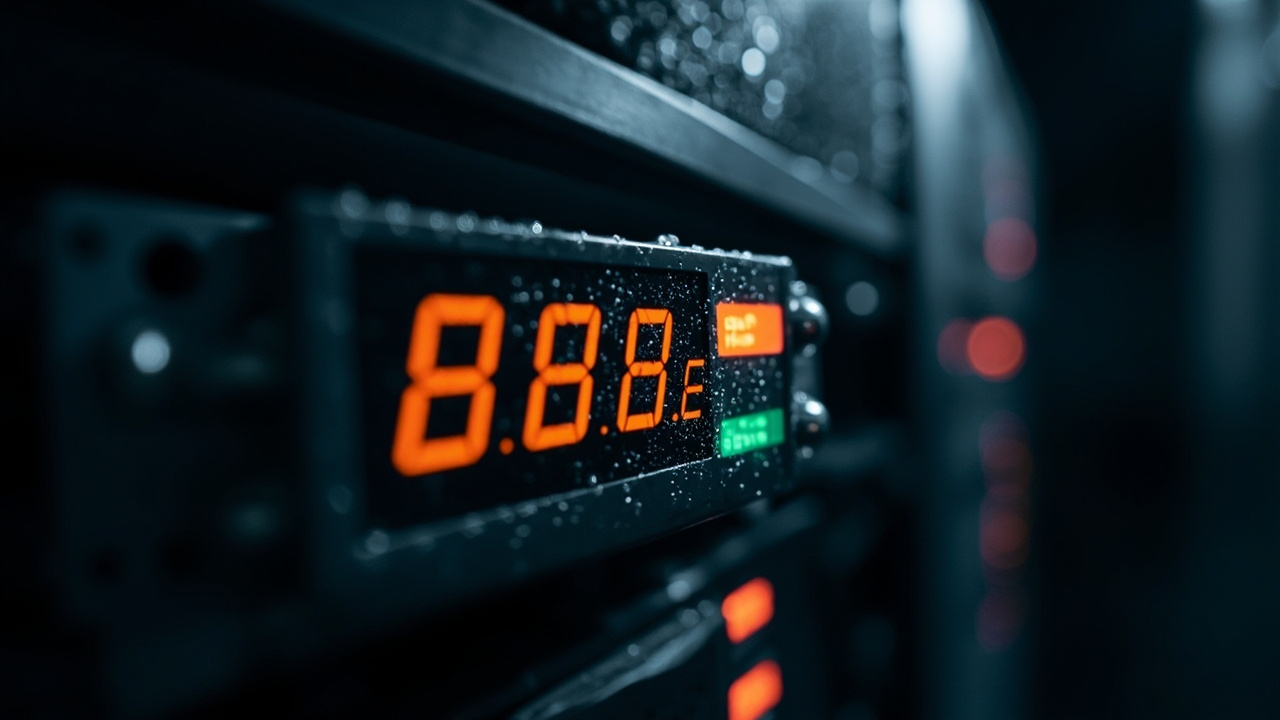
Your data center humidity sensor has been reading 38% for two years and nobody has touched it. Meanwhile, last August a server had an electrostatic discharge event that nobody could explain. The two events are connected — and the solution is not buying more servers.
ASHRAE TC 9.9 recommends keeping the data center between 40-55% relative humidity. The range exists for two opposing reasons: below 40%, electrostatic discharges damage components. Above 55%, condensation corrodes contacts and degrades insulation.
Why the 40-55% range is narrow (and why it matters)
At 40% RH and 22°C, the air conductivity is low enough to avoid electrostatic accumulation, but the air can still absorb moisture from cold surfaces without condensing. At 55% RH you are already close to the dew point if a cold surface (such as a CRAC coil at 12°C) comes in contact with the return air.
The range is 15 points wide. Operating outside it for one hour is not catastrophic. Operating outside it for weeks, yes. Electrostatic discharge (ESD) becomes a real risk below 30% — a technician walking on carpet can generate 5,000V of static electricity. Above 60%, you start to see corrosion on metal contacts of cards and backplanes.
What happens when you operate dry (<30% RH)
Electrostatic discharges are not visible until they destroy something. A technician connecting a network cable without an anti-static wrist strap at 25% RH can damage a switch’s Ethernet port. The failure shows up three weeks later as a port that suddenly drops packets.
Mechanical hard drives are the most vulnerable — a head crash induced by ESD is not recoverable. In dry climates of northern Mexico (Monterrey, Chihuahua, Hermosillo in winter), indoor RH can drop to 15-20% without active humidification. Steam humidification is the standard technical solution.
What happens when you operate humid (>60% RH)
Condensation on cold surfaces. The CRAC coil at 12°C is the perfect trap: air at 24°C with 65% RH reaches the coil, cools down to 14°C, and the relative humidity rises to 100% on contact. Droplets. The droplets fall to the raised floor or, worse, onto server cards.
Accelerated corrosion on contacts. The pins of power connectors, the backplane contacts, and the printed circuit board traces exposed to constant moisture form an oxide layer that raises contact resistance. Within 18-24 months you start seeing mysterious intermittent failures that no logic scan can detect because the problem is physical.
How to measure properly (not how vendors tell you)
One sensor per rack is the minimum. Two sensors per rack (one in front, one in back) capture the differential that the return air creates. The difference between the front sensor and the back sensor should not exceed 5-8% RH — if it does, there is an airflow problem or a CRAC failing.
Cheap sensors (DHT22, SHT31) have ±3% accuracy. For a data center you need ±2% or better. The Honeywell HIH-8120 or Vaisala HMP60 cost $2,000-4,000 MXN each but they tell you the truth. Your CRAC sensor is for unit control, not for environment auditing — do not use it as the only source.
Humidification and dehumidification as a system
Steam humidification (not ultrasonic) is the standard for data centers. Submerged electrode or resistance systems generate clean steam without aerosols. Typical capacity: 5-15 kg/h for a 100 m² room.
Dehumidification is done with the same CRAC coil you use for cooling. If your CRAC does not have independent dehumidification control (modulating the chilled water valve so it does not over-cool), you will have to complement it with a dedicated dehumidifier or accept that you will operate above the ASHRAE range part of the year.
What no vendor sells you: the habit
Measure relative humidity every hour, log the data, configure alerts at 35% and 58%. When you receive the first alert at 3 AM, you will remember this paragraph. Humidification fails silently. By the time you notice, you have been out of range for 6 hours and the electrostatic or corrosion damage has already occurred.
The habit costs $0. Ignoring the habit costs one server, one switch, or one disk. You decide which one to pay.
400G and 800G Ethernet are no longer hyperscaler technology: they are moving down to enterprise because internal data center traffic is growing at the pace of AI, virtualization, and all-flash storage. Migrating the cabling is a decision made 12 to 24 months in advance.
Sources
[1] ASHRAE TC 9.9 — 2023 Thermal Guidelines for Data Processing Environments, Chapter 7 (Humidity) — https://www.ashrae.org/technical-resources/bookstore/thermal-guidelines-for-data-processing-environments
[2] ANSI/ISA-71.04-2013 — Environmental Conditions for Process Measurement and Control Systems — https://www.isa.org/standards-and-publications/isa-standards/isa-71-04-2013
[3] Vaisala — Humidity in Data Centers: Why it matters and how to control it — https://www.vaisala.com/en/learning-center/white-papers/humidity-data-centers
[4] Wikipedia — Relative humidity — https://en.wikipedia.org/wiki/Relative_humidity
Want to master this?
Noxtel Academy →