Precision Air Filters: How Often to Actually Change Them (and What Happens in Your Cleanroom If You Let Them Go)
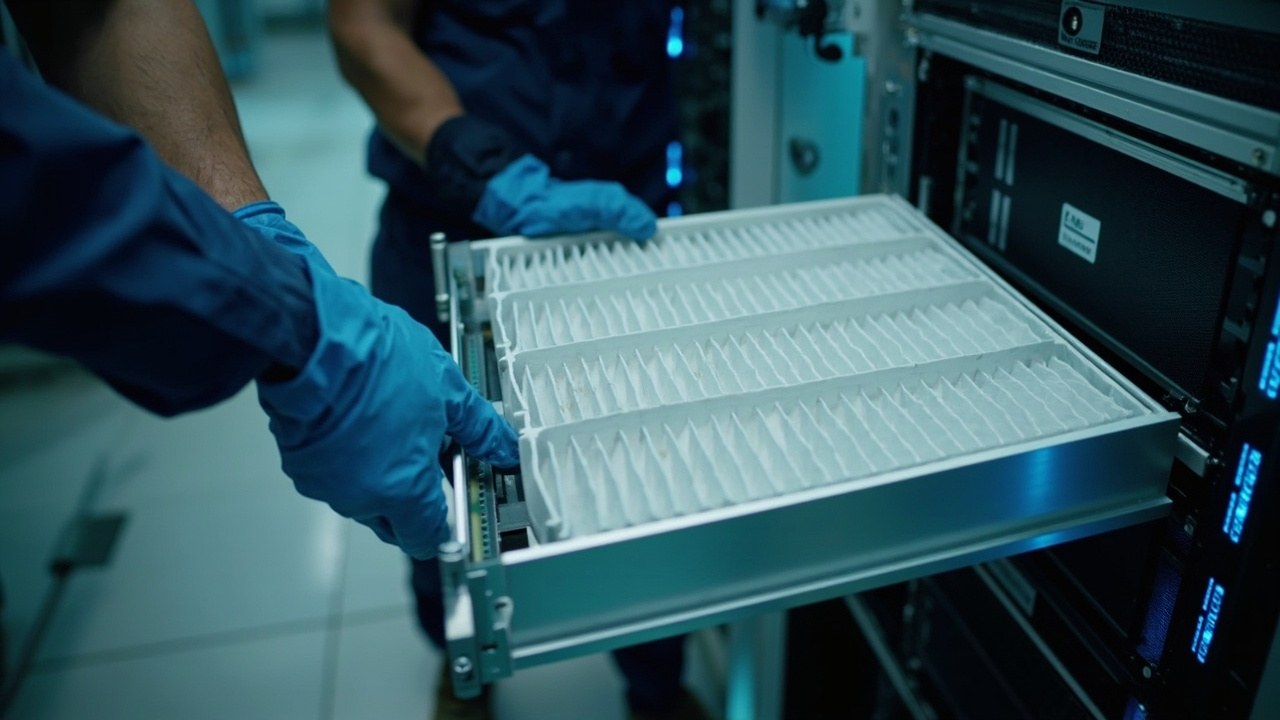
Precision air filters are the cheapest component in the cooling system, and that is exactly why they are the most neglected. The consequence: when they load up, they push power consumption between 8% and 15%, they foul the evaporator coil, and in cleanrooms they compromise the integrity of the air reaching the servers. This article covers the real replacement frequencies per filter type, how to measure when to change them before it becomes a problem, and the hidden costs of postponing the change.
What follows applies to data centers with CRAC/CRAH units running G4, F7, F9, or H13 filters. For ISO 7 or ISO 8 cleanrooms (typical in semiconductor or pharmaceutical manufacturing), H13/H14 HEPA filters have an even stricter replacement frequency, and this article does not apply.
The 4 filter types you will find in your data center
Before talking about frequencies, you need to know what type of filter you have. Efficiency is measured according to the EN 779 or ISO 16890 standard:
- G4 (EU4 / ISO Coarse 65%): coarse filter, first line of defense. Captures large particles (dust, lint). It is the most common in standard data centers. Typical service life: 6-12 months in a clean urban environment, 3-6 months in an industrial environment or in Mexico City.
- F7 (EU7 / ISO ePM10 65%): fine filter, second stage. Captures particles of 1-10 microns. Used in data centers with clean-air requirements or in ISO 9 cleanrooms. Service life: 6-12 months.
- F9 (EU9 / ISO ePM2.5 95%): high-efficiency fine filter. Captures fine particles. Used in hyperscale or high-density data centers. Service life: 8-14 months.
- H13 (HEPA): high-efficiency filter for 0.3 micron particles. Only in ISO 7-10 cleanrooms. Service life typically 24-36 months, but it requires constant differential pressure monitoring.
If your unit has 2 filtering stages (typical in mid-to-high-end CRAC units), you will have a G4 filter on the inlet (pre-filter) and an F7 or F9 on the outlet. The G4 protects the F7/F9 from loading up prematurely. If you only have one stage, both the replacement cost and the replacement frequency go up.
The metric that tells you when to change: differential pressure
The most common mistake: replacing filters every X calendar months, without measuring. The correct metric is differential pressure (delta P) between the filter inlet and outlet. It is measured with a differential manometer connected to the pressure taps on the filter or on the housing. Typical ranges:
- New filter (clean): initial differential pressure of 0.05 to 0.15 inches of water column (inWC), depending on type. This is your reference value, the one you record when you install the new filter.
- Filter at half life: differential pressure at 1.5x to 2x the initial value. Still functional, monitor monthly.
- Loaded filter: differential pressure at 2.5x to 3x the initial value. Replacement mandatory, no excuses. If you keep operating with a loaded filter, the CRAC fan works against higher resistance, draws more watts, and its service life drops.
- Blocked filter (failure): differential pressure above 3x the initial value, or a low-air-pressure alarm in the duct. This is already an emergency, not scheduled maintenance.
If your operator comes ‘every month to change filters’ without measuring differential pressure, they are either charging you for unnecessary changes OR not warning you when the filters are already loaded. Measurement is the basis, not the calendar date.
What happens if you let the change go by
The 4 operational and economic consequences:
- Power consumption rises 8-15%. The CRAC fan has to generate more static pressure to push air through the dirty filter. The power drawn by the motor rises proportionally. On a CRAC unit with 30 kW of capacity, that is between 1 and 3 kW extra per unit, 24/7.
- The evaporator coil fouls faster. A loaded filter lets more particles through to the coil. A dirty coil transfers 20-30% less heat, which drives the compressor to run more cycles. It is a cascading effect.
- Fan motor service life drops. CRAC motors are designed to operate within a certain load range. Forcing them against high pressure accelerates bearing wear and burns out the windings prematurely.
- In cleanrooms: fine particles enter the room. If your DC is ISO 9 or has a cleanroom classification, the filters are the barrier that maintains that classification. If you let them go by, you compromise the certification and can run into problems with auditors or clients who require a certain cleanliness level.
Hidden cost calculation: if you have 10 CRAC units and each one draws 1.5 kW extra because of loaded filters, that is 15 kW × 8,760 hours × $1.8 MXN/kWh = $236,520 MXN per year in wasted electricity. With $20,000 MXN per year in new filters for the 10 units, the ROI of timely replacement is 12:1 on energy alone.
When to actually change them (with numbers)
Replacement frequency depends on 3 variables:
- Outdoor environment. Mexico City, Monterrey, and Guadalajara have PM10 and PM2.5 concentrations significantly higher than coastal or high-altitude cities. In industrial zones (Tlalnepantla, San Luis Potosí, Apodaca) G4 filters load up in 3-4 months. In clean zones (central Querétaro, Mérida) they can last 8-10 months.
- People traffic in the room. If your DC has 5-10 people entering and leaving daily, the filters pick up more contaminants. A DC with restricted access and fewer than 3 visits per week can extend filter service life by up to 50%.
- Nearby construction. If there are civil works inside or next to the DC building, filters load up 2-3x faster. Typical in data centers located inside campuses that are expanding.
Practical rule: measure differential pressure monthly. When it reaches 2.5x the initial value, change it. If you do not have the initial value (filter installed months ago with nothing on record), change it when it reaches 0.5 inWC for G4 or 0.8 inWC for F7/F9. Do not wait for the alarm.
How to verify your provider is actually changing the filters, not just billing for them
There are 4 indicators that the change was really made:
- A label on the new filter with the installation date and the scheduled next-change date. If your operator does not apply a label, there is no traceability.
- A photo of the old filter (loaded) and the new filter (clean), with the date. The photo must go in the service report.
- A differential pressure reading before and after the change. Typically it drops from 0.5-0.8 inWC to 0.1-0.15 inWC. If it does not drop, the housing is leaking or the filter is not the right size.
- A drop in the unit’s power consumption after the change. If the CRAC power measurement does not drop between 5% and 10% after the filter change, the problem is something else (dirty coil, inefficient fan).
If your provider does not deliver these 4 data points on every change, you do not have maintenance, you have visits. The difference shows up on your CFE bill and in the service life of the equipment.
The real case: filters as an early warning for problems
If one filter loads up twice as fast as the others in the same DC, that is a sign that something changed in the environment around that specific unit. The 3 most common causes:
- Damaged DC door seal: if the door does not close hermetically, outside air (much dirtier than the inside) enters and loads the filter on the CRAC nearest the door.
- Poorly installed previous filter seal: if the previous filter was not properly sealed in the housing, untreated air bypasses straight to the coil and into the room environment.
- Nearby construction activity: if your provider is doing civil works on the floor below or in the adjacent equipment room, dust enters through the air intakes and loads the filters faster.
If you identify a filter that loads faster than the others, do not simply change it more often. Investigate the root cause. You are probably losing money on extra filters and there is an infrastructure problem behind it.
Sources
- ASHRAE TC 9.9 — Thermal Guidelines for Data Processing Environments (5th edition) — https://www.ashrae.org/technical-resources/bookstore/thermal-vigilance-for-data-processing-environments
- ISO 16890:2016 — Air filters for general ventilation (replacement for EN 779) — https://www.iso.org/standard/56641.html
- ASHRAE 52.2-2017 — Method of Testing General Ventilation Air-Cleaning Devices for Removal Efficiency by Particle Size — https://www.ashrae.org/technical-resources/bookstore
- Vertiv — Liebert CRV Operations and Maintenance Manual: filter specifications and replacement intervals — https://www.vertiv.com/en-us/products/brands/liebert/
- Schneider Electric — EcoStruxure Data Center: filter lifecycle management — https://www.se.com/mx/es/product-category/data-centers/
Want to master this?
Noxtel Academy →