Condensate pump and refrigerant leak: the early detection guide your room needs before water reaches the raised floor
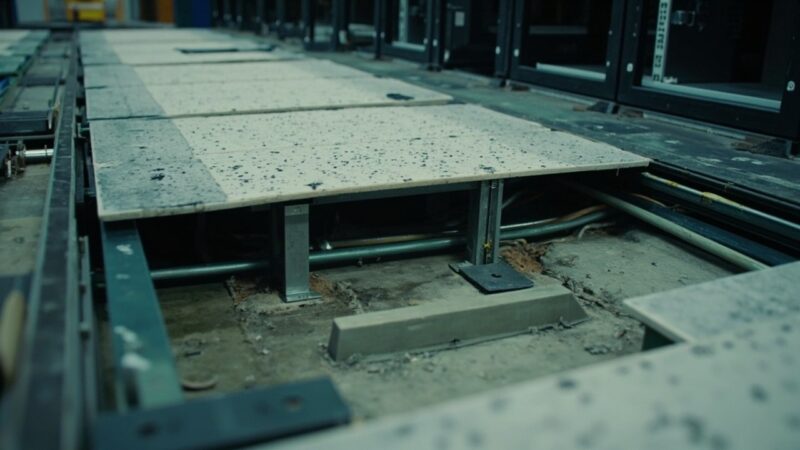
Water on the raised floor of a data center is the most common secondary failure scenario in cooling. A failing condensate pump or a minor refrigerant leak that nobody catches in time creates puddles that come into contact with power cables, generating electrical arcs, short circuits, and massive server damage. This article covers the 6 visual signs any operator can detect without tools, the 3 professional methods for early detection, and the boundaries between what your operator can resolve and what requires a vendor. If your room has CRAC or CRAH with condensate drainage, this guide applies. What follows assumes on-premise data center operation with typical CRAC or CRAH units (Vertiv Liebert, Stulz CyberAir, Schneider, etc.). Alarms vary slightly between models but the operational principles are common.
The 6 visual signs of a failing condensate pump. The condensate pump is the most underestimated part of a CRAC. When it starts to fail, there are visual signs that any operator can detect during the daily round:
The 6 visual signs of a failing condensate pump
The condensate pump is the most underestimated part of a CRAC. When it starts to fail, there are visual signs that any operator can detect during the daily round:
- Puddle of water on the floor in front of the unit. The most obvious sign. If you see water where there shouldn’t be, the pump is not draining or the drain is clogged.
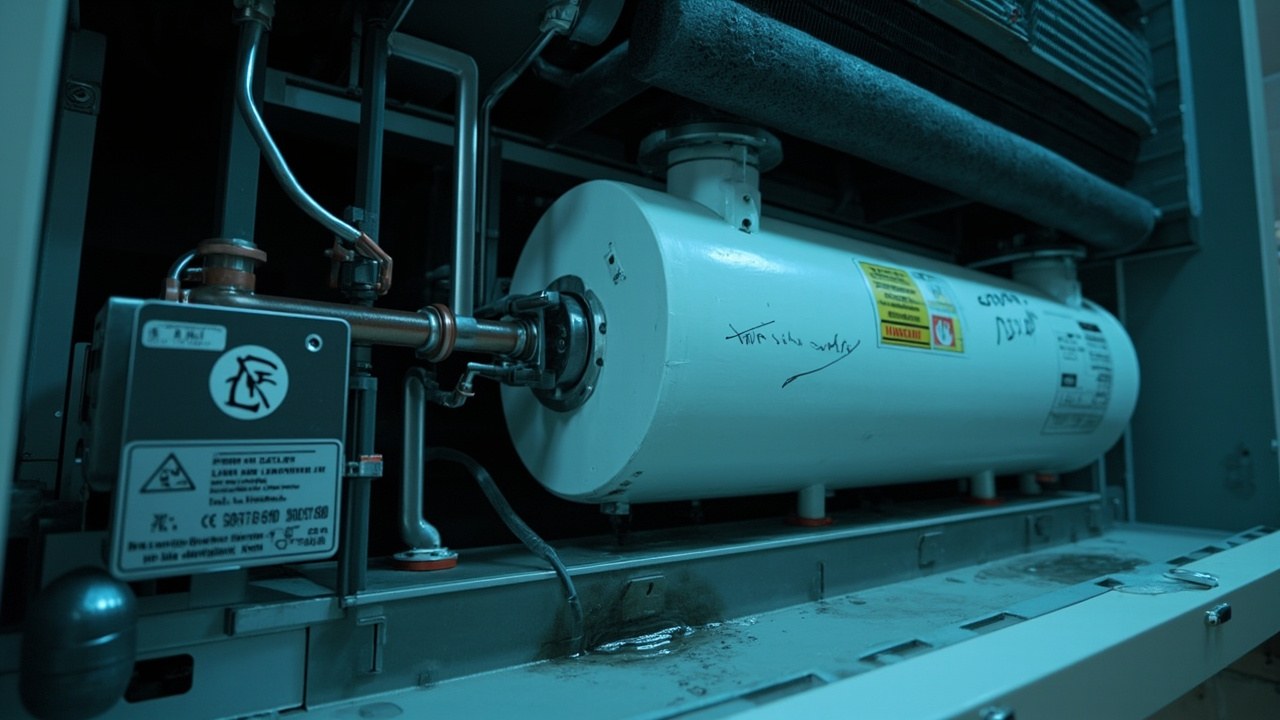
- Water spilling from the edges of the condensate pan. The pan collects water from the evaporator; if it overflows, the pump seal is compromised or the pump is not drawing.
- Irregular pump sound (starts and stops repeatedly, hums constantly without pumping). A healthy pump has a clear cycle: it starts when the level rises and stops when it drops. If it hums continuously without stopping, the float is stuck. If it does not hum when the level rises, the pump is dead.
- Algae visible in the drain trap. Algae are an indicator that the drain has not been cleaned in months. When the trap clogs with algae, water backs up and overflows the pan.
- Smell of humidity or mold on the floor under the unit. Indicates that there have been minor unaddressed spills, or that the pan is retaining moisture that is not evaporating properly.
- Pump cycle time longer than normal. If the pump used to cycle every 30 minutes and now cycles every 5 minutes, there is a continuous leak that is filling the pan faster than the pump can drain.
Detecting any of these during the daily round gives you a window to act before the puddle reaches energized cabling.
The 4 signs of refrigerant leak that you CAN detect
Refrigerant leak is harder to detect visually than pump failure, but there are signs:
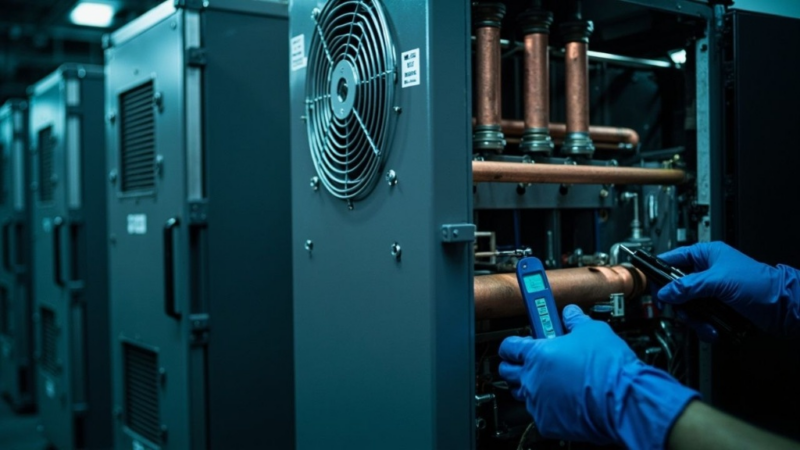
- Oil stains on connections and piping. Compressor oil migrates with the refrigerant in small leaks. If you see oily stains on unions or soldered joints, refrigerant is leaking too.
- Ice on the refrigerant lines or on the evaporator. Indicates that the refrigerant pressure is so low that the air moisture freezes on the surfaces. Active leak.
- Recurring low-pressure (LP) alarms. If the LP alarm trips and recovers by itself intermittently, there is a micro-leak that the unit compensates for with vapor.
- Drop in cooling capacity with “sufficient” gas. If the unit cools less than before despite no low-gas alarm, there is a leak that is degrading the heat-exchange surface area.
Method 1: Visual detection with soapy water (not recommended for modern refrigerants)
The traditional method is to apply soapy water on unions and solder joints and look for bubbles. It works for R-22, R-134a, R-407C. It does NOT work for:
- R-1234ze or R-1234yf (new-generation refrigerants). The molecules are too small for soapy water to detect; you need an electronic leak detector.
- R-410A. Very small leaks (less than 5 g/year) are not detected with soapy water.
If your data center uses modern refrigerants (most CRACs since 2020 use R-410A or R-1234ze), soapy water is not reliable. Use Method 2.
Method 2: Electronic leak detector (recommended)
The professional standard method. Halide or infrared leak detector detects individual refrigerant molecules in the air. Detector types:
- Halide detector (low cost, USD $115-460, approx. $2,000-8,000 MXN at 17.5 MXN/USD, verify Banxico FIX on publication day). Detects most HFC and HFO refrigerants. Typical sensitivity: 3 g/year. Good for routine rounds.
- Infrared detector (high cost, USD $1,400-3,400, approx. $25,000-60,000 MXN at 17.5 MXN/USD, verify Banxico FIX on publication day). Detects all molecules including the new ones. Sensitivity: 1 g/year. For very small leaks and post-repair verification.
For most data centers, the halide detector is the right balance of capability and operational cost. Buy the cheapest reliable model and train the operator.
Method 3: Manifold and operating pressure (trend verification)
The medium-term monitoring method. You measure the refrigerant operating pressure on the manifold every month and compare with the reading from the previous month.
- If operating pressure drops consistently month over month, there is a leak.
- If pressure remains stable for 6+ months, there is no significant leak.
This method requires a manifold (USD $50-150, approx. $875-2,625 MXN at 17.5 MXN/USD, verify Banxico FIX on publication day) and 15 minutes of the operator’s time per month per unit. Low cost, medium-term signal.
When it is cleaning vs when it is pump replacement
Decision criteria:
- If the pump cycles well but the drain is clogged: cleaning. Operator opens the trap, applies water with chlorine (1:10), verifies cycle. Time: 30 minutes.
- If the pump hums continuously without cycling: cleaning + float check. If the float is stuck by algae, cleaning with soapy water. If the float is mechanically broken, replacement.
- If the pump does not turn on at all: replacement. Test with multimeter first; if the motor receives voltage and does not turn, the motor is burned.
- If the pump works but the pan is corroded or the seal leaks: replacement of the complete pan (USD $200-500, approx. $3,500-8,750 MXN at 17.5 MXN/USD, verify Banxico FIX on publication day).
When to call the vendor (don’t try this in-house)
There are scenarios where the operator must NOT attempt repair:
- Leak greater than 2 kg of refrigerant gas. Indicates heat exchanger or major solder break. The operator does not have equipment to recover gas, recharge, or pressure-test. Requires EPA Section 608-certified technician.
- Compressor with abnormal vibration or metallic noises. Indicates internal wear. Requires compressor replacement by certified vendor.
- Condensate pan replacement (corroded, leaking). Requires removing the refrigerant, replacing the pan, pressure-testing, recharging. Certified vendor only.
- Replacement of the condensate pump if it is hardwired and not plug-in. Requires electrical work and pump replacement by vendor.
Preventive maintenance plan to avoid the failure
- Every 3 months: cleaning of the drain trap with water and chlorine (1:10). Operator. Time: 30 minutes.
- Every 6 months: operating pressure check with manifold. Operator. Time: 15 minutes.
- Every 12 months: electronic leak detector inspection of all unions and solder joints of each CRAC. Operator or vendor. Time: 1 hour per unit.
- Every 24 months: condensate pump preventive replacement. Even if it works, the impeller wears. Vendor. Cost: USD $200-400 (approx. $3,500-7,000 MXN at 17.5 MXN/USD, verify Banxico FIX on publication day).
- Every 5 years: refrigerant circuit pressure test. Verifies soldered joints and heat exchanger integrity. Vendor with pressure test equipment.
The real cost of not addressing in time
The costs of a major failure are not theoretical:
- Short circuit in power cable: USD $2,800-$15,000 (approx. $50,000-500,000 MXN at 17.5 MXN/USD, verify Banxico FIX on publication day) in electrical repair + loss of equipment.
- Server damage from humidity exposure: USD $11,500-$115,000 (approx. $200,000-2,000,000 MXN at 17.5 MXN/USD, verify Banxico FIX on publication day) in replacement + loss of data if there is no replica.
- Halon or FM-200 fire suppression discharge due to short circuit: USD $10,000-30,000 (approx. $175,000-525,000 MXN at 17.5 MXN/USD, verify Banxico FIX on publication day) in gas + downtime for recharging.
The cost of addressing the puddle the day it appears: 30 minutes of the operator. The probability of major damage if left: 15-25% in 7 days. The cost-benefit calculation always favors immediate attention.
Summary: your 5-minute daily protocol
What your operator must do EVERY SHIFT regarding condensate:
- Visually verify there are no puddles in front of the unit.
- Listen to the pump cycle (regular cycle, not constant).
- Check the unit display: condensate pump alarm or low pressure alarm.
- Log any anomaly in the logbook with timestamp.
- If an active alarm is present, follow the escalation protocol (operator → supervisor → vendor by severity).
The 5 daily minutes prevent 80% of catastrophic failures. Operational discipline is more profitable than any technology.
Sources
- ASHRAE Standard 15 — Safety Standard for Refrigeration Systems — https://www.ashrae.org/technical-resources/bookstore/standards-15-and-34
- AHRI Standard 540 — Performance Rating of Computer and Data Processing Room Air Conditioners — https://www.ahrinet.org/analytics/standards
- Vertiv — Liebert CRV and DS Maintenance: Condensate Management — https://www.vertiv.com/en-us/products/brands/liebert/
- Stulz — CyberAir Service Manual: Condensate Pump Operation and Alarm Codes — https://www.stulz.com/en/products/cyberair/
- EPA Section 608 — Refrigerant Leak Repair Requirements — https://www.epa.gov/section608
Want to master this?
Noxtel Academy →