Chiller or Condensing Unit: Which One to Choose for Your Critical Building?
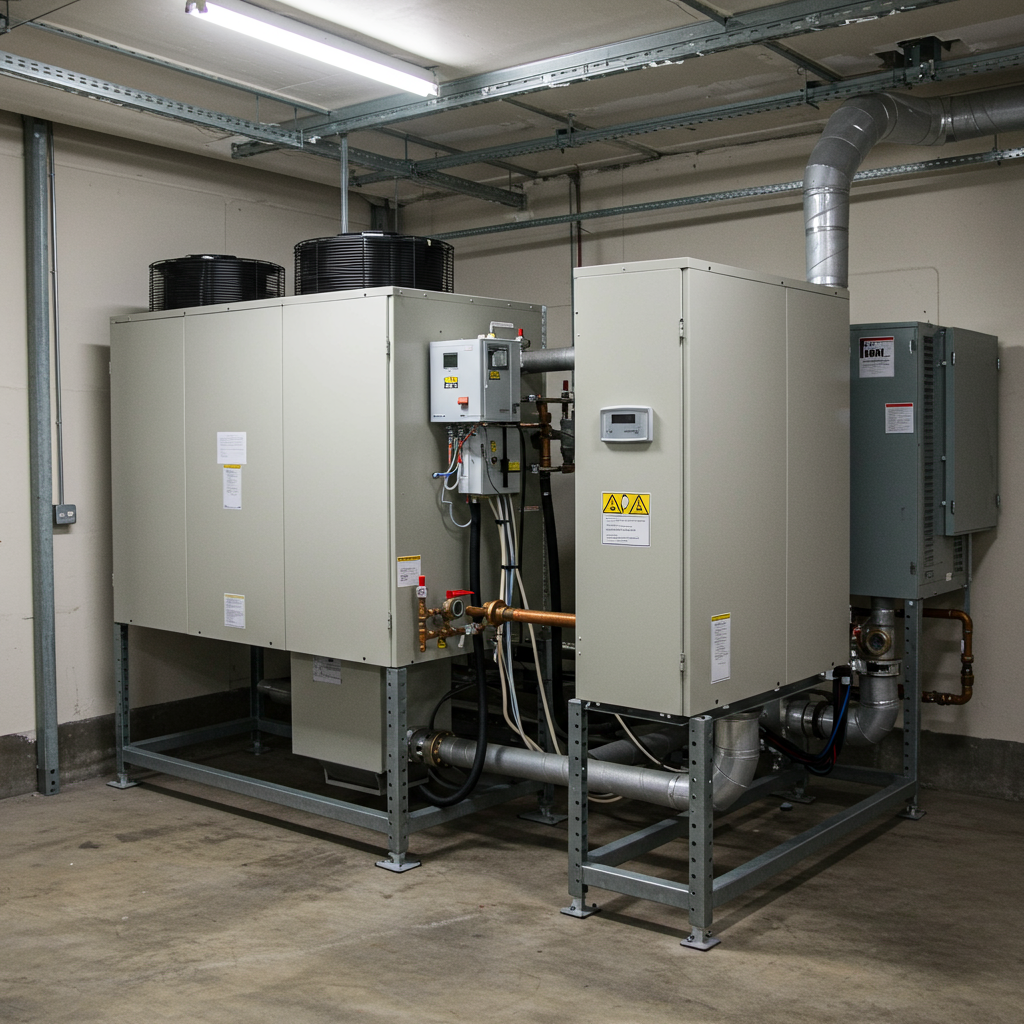
When to Choose a Chiller and When a Condensing Unit for Your Building or Industrial Process?
In the field of Facility Management, air conditioning is not limited to keeping office spaces comfortable. It is a fundamental pillar for operational efficiency, productivity, and, in many cases, the viability of critical industrial processes.
One of the most crucial decisions when designing or renovating a cooling system is choosing between a chiller (liquid cooler) and a condensing unit.
This choice, far from being arbitrary, depends on multiple specific factors of your building or process.
Understanding the Base: Chiller vs. Condensing Unit
Although both systems have the ultimate goal of cooling, they operate under different principles and scales:
- Chiller (Liquid Cooler): It is a centralized machine that cools a liquid (generally water or a glycol solution). This cold liquid is pumped through pipes to terminal units (such as Air Handling Units – AHUs, fan coils, or heat exchangers in industrial processes) where it absorbs heat from the environment or process. Chillers are high-capacity systems and offer great precision in liquid temperature control.
- Condensing Unit: It is a key component of a DX (Direct Expansion) refrigeration system. It contains the compressor, the condenser coil, and the fan that expels heat to the outside. It works together with an indoor evaporator unit to which it sends compressed refrigerant. The refrigerant absorbs heat directly from the indoor air at the evaporator unit.
Key Factors for the Decision
The choice between one or the other system is not universal and must be based on a detailed analysis of the following points:
- Capacity and Scale:
- Chiller: Ideal for large thermal loads and large buildings (hospitals, shopping centers, hotels, universities) or industrial processes that require massive and continuous cooling.
- Condensing Unit: More suitable for medium to small thermal loads, such as individual offices, commercial premises, multi-family residences, or zoned air conditioning systems (splits, VRF/VRV).
- Application Type and Precision:
- Chiller: Offer more precise and stable temperature control of the cooled liquid, which is fundamental for many industrial processes (pharmaceutical, chemical, plastic, food and beverages) and for buildings with very specific comfort requirements.
- Condensing Unit: While they are efficient, the precision in air temperature control may be slightly lower compared to a well-designed chilled water system, although sufficient for most comfort applications.
- Distribution and Flexibility:
- Chiller: By using cold water, it allows more flexible distribution through pipes and a great variety of terminal units (AHUs, fan coils). Facilitates zoning and future system expansion.
- Condensing Unit: Works with refrigerant, which implies limitations on pipe length and the number of indoor units per outdoor unit. They are less flexible for large distances or complex distributions.
- Energy Efficiency and Operating Costs:
- Chiller: Large capacity chillers can be extremely energy efficient, especially if integrated with heat recovery systems or free cooling. They usually have a longer useful life.
- Condensing Unit: DX (Direct Expansion) systems have greatly improved their efficiency (SEER/EER – Seasonal Energy Efficiency Ratio / Energy Efficiency Ratio), but at partial or very large loads, a well-managed chiller can be more efficient in the long term. Maintenance costs can be lower if they are small units.
- Initial Cost and Maintenance:
- Chiller: The initial investment is considerably higher due to equipment complexity (chiller, pumps, cooling tower, piping, AHUs). Maintenance is more specialized.
- Condensing Unit: Generally have a lower acquisition and installation cost for smaller scale applications. Maintenance is usually simpler and less expensive on individual units.
- Sustainability and Refrigerants:
- Chiller: Chilled water systems have the advantage that the refrigerant (with high Global Warming Potential – GWP) is confined to the chiller, minimizing the risk of large-scale leaks.
- Condensing Unit: The refrigerant circulates throughout the building, increasing the potential for leaks. However, refrigerants with lower GWP are being developed for these systems.
When to Choose a Chiller?
- When cooling demand is very high and constant.
- In large or complex buildings with multiple cooling zones and varied needs.
- For industrial processes that require precise and controlled temperatures.
- If high energy efficiency at scale is sought and budget is available for the initial investment.
- When flexibility in cooling distribution and future expansion are priorities.
When to Choose a Condensing Unit?
- For small to medium-sized buildings with moderate cooling demand.
- If direct expansion systems (split, multisplit, VRF/VRV) are chosen that offer direct air cooling.
- When the initial budget is tighter and installation must be simpler.
- In projects where the distance between the outdoor unit and the indoor units is not excessively large.
- If extreme precision in temperature control is not a critical requirement.
The decision between a chiller and a condensing unit is strategic and must be approached from a comprehensive Facility Management perspective.
There is no single solution for everyone.
It requires a deep analysis of the specific needs of your building or process, the available budget, energy efficiency goals, expected useful life, and environmental regulations.
Consulting with cooling and Facility Management experts is essential to ensure a choice that optimizes comfort, productivity, and return on investment in the long term.
Want to master this?
Noxtel Academy →