CFE: 83 Transmission Projects and Your Interconnection Date
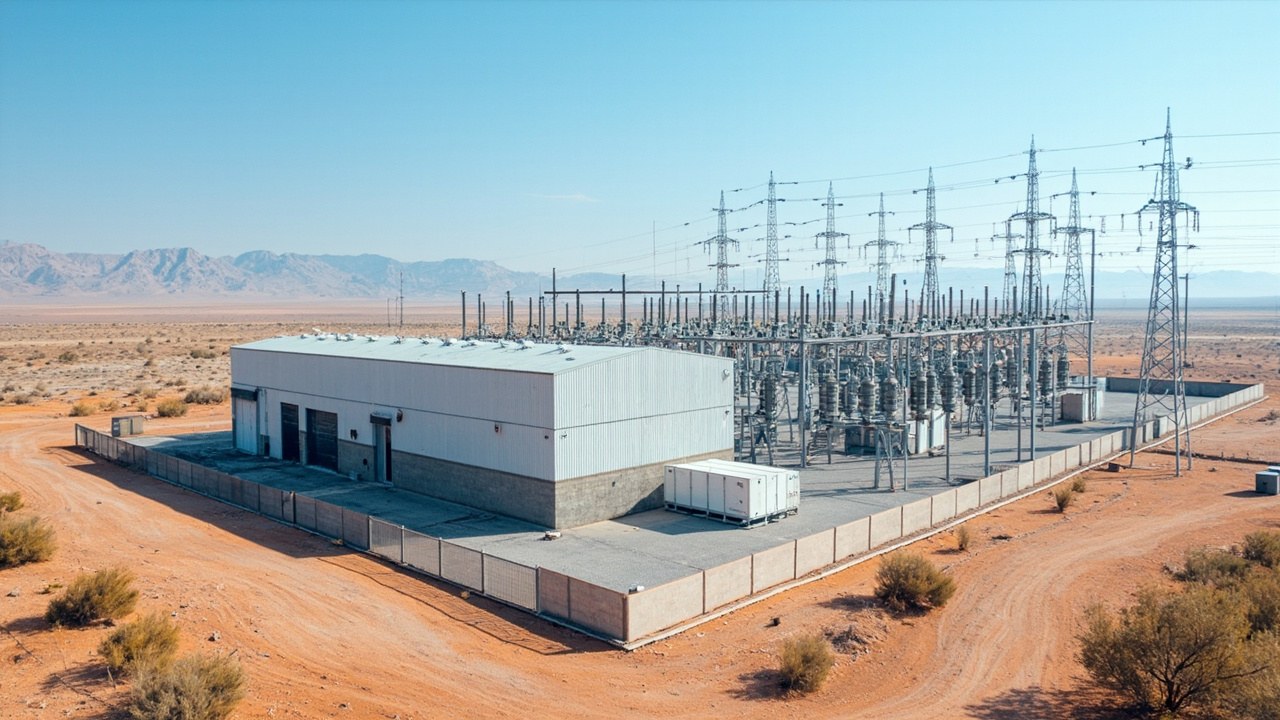
When a facility director asks the public grid for the megawatts his site needs, the answer he almost always gets is an approximate date: "in the first half of the year." That date does not come from a site study: it comes from a row in the grid's construction queue, and that row just changed.
On November 5, 2026, the Comisión Federal de Electricidad reported that it is keeping 83 transmission and modernization projects under execution, with an investment of 89,104 million pesos. The amount matters less than what it means: that grid has committed work, with a budget, stages and published targets.
What follows breaks down which part of the program is already under construction, which part is still being tendered, and what it means for the date your site can energize. It is one thing for CFE to have projects, and another for yours to have a builder.
The number your schedule doesn't include
CFE's official release of November 5, 2026 paints a picture of two speeds. In transmission, the company concluded 35 projects for 15,119 million pesos and is keeping another 83 for 89,104 million. In generation, six combined-cycle plants in service between February 2025 and May 2026 added 3,204 MW with 52,424 million pesos. In renewables, the 2024-2030 portfolio adds up to 60 projects and 9,184 MW.
The demand figure orders everything else: on August 20, 2026 the National Interconnected System recorded its all-time high, 54,530 megawatts, nearly 3 percent above the 2025 peaks. And there is one service datapoint that changes a maintenance conversation: between January and August 2026 interruptions fell 36 percent versus 2024 and restoration went from 25 to 7 h.
By the end of 2026 CFE expects 17 new substations, 16 expansions, 1,581 modernization works and more than 8,000 energy justice works, with 12,148 million pesos. If your schedule depends on public works, that is today's window.
The other side of the question is how long a project takes to go from signature to energization. I already explained it in 17 months between the contract and your data center: civil works and electrical supply are the slow part, and they are planned in parallel.
The table that separates what is already under construction from what is still being tendered
CFE's 2026-2030 Development Program (July 2026) carries the detail the release does not give: the 175 transmission projects planned for 2026-2030, by stage. Whoever is looking for an interconnection date needs it.
| Stage | Projects | km-circuit | Transformation MVA | MVAr of reactive compensation |
|---|---|---|---|---|
| Prior activities | 3 | 413 | 375 | 1,357 |
| To be tendered | 35 | 2,645 | 7,905 | 1,405 |
| Out for tender | 30 | 538 | 4,500 | 4,002 |
| Under construction | 55 | 3,475 | 6,543 | 5,562 |
| Completed and in operation | 52 | 474.4 | 3,508 | 1,268 |
| Total 2026-2030 | 175 | 7,545 | 22,832 | 13,595 |
The arithmetic in that table is the actionable part. Only 28.7 percent of the program's transformation MVA is under construction: 6,543 of 22,832. 56 percent is still in To be tendered or Out for tender, with 12,780 MVA without an awarded contract. And 55 of 175 projects are under construction: 31 percent. Of the 175, 52 are already in operation, so the real work of this five-year period is 123.
Where the instruction comes from: since 2015 SENER has instructed works based on CENACE proposals, and there are 271 instructed projects. The grid closed 2025 with 56,729 kilometers of lines between 161 and 400 kV, plus 54,466 kilometers between 69 and 138 kV, and 118,343 transformation banks.
A useful contrast: the 83 projects in the release (they will add more than 3,500 circuit-kilometers and close to 9,700 MVA) equal 42 percent of the 22,832 MVA projected across 175. CFE's live portfolio is a part of the program, not the whole program. When a provider promises to energize "with the grid up and running," what separates it from the rest is which Stage your project is in.
The three projects with a date you can ask for in writing
The release and the appearance before the Chamber of Deputies' Energy Commission name three works with an amount and a date. None of them names a data center: that is what makes them verifiable.
The program's stated purpose is "that the electrical grid keeps pace with the country's growth in a timely way," says CFE's general director, Emilia Esther Calleja Alor. It is an ambitious and verifiable sentence: the grid must anticipate demand, not follow it. CFE anticipates capacity where load concentrates, and that anticipation has a date of its own.
The honest limit: none of the 83 projects is labeled as a data center project. The public documentation speaks of industrial and tourism zones. The connection to AI load is an inference defensible on the geography of the states mentioned, but it is not a quote: it is context, not evidence of priority.
The system's reserve margin is your real risk
There is a number in the Development Program that almost never gets cited in site meetings and is more useful than the project list. In 2025 the National Interconnected System's maximum demand reached 52,945 MW, on June 9, with an operating reserve margin of 14 percent on average, but 9.69 percent at the peak, against a minimum of 6 percent. The margin did not fail, but it was not in surplus either.
The defensible observation: the annual maximum stopped falling in June. In 2025 it was June 9; in 2026 the record came on August 20. A peak that shifts toward August points to a demand curve that widens in the second half of the year, with final consumption of 306.5 TWh in 2025 and 2.2 percent annual growth expected. The shape of that curve defines when your heat rejection and your backup work at maximum.
This has a design consequence no project table will give you. ANSI/TIA-942 separates the electrical and power systems block from the redundancy and resilience planning block, and that is the point: your local redundancy and your grid dependency are two different things, and only the first is under your control. A site with two sources, UPS and its own generation absorbs a grid restriction; one with a single service drop depends on the margin not tightening.
The backup that can arrive before your diesel
The firm generation block has direct consequences for a site that still burns diesel. The six combined-cycle plants in service between February 2025 and May 2026 added 3,204 MW with 52,424 million pesos, and hydroelectric modernizations recovered 53 MW. In December 2025 CFE also announced five firm generation projects for close to 3,000 MW and 4,328.3 million dollars: Tula II, Salamanca II, Altamira, Mazatlán and Los Cabos.
The shift the manufacturer documents is the one about not waiting: Vertiv's technical paper on hybrid power notes that in some areas no more public grid capacity is expected until 2030, and proposes bringing your own energy by combining a microgrid, batteries and local generation with a management system that coordinates them. If interconnection does not fit your investment cycle, the backup conversation stops being "diesel versus grid" and becomes "what do I combine so I don't depend on a single date."
In Mexico that reasoning is already in three of our articles: microgrids for data centers in industrial zones for when the grid does not arrive in time, the real ROI between a diesel generator and BESS to decide whether your own backup is justified, and AWS's self-supply contract.
The four questions you must demand before committing to a date
Everything above comes down to four verifiable questions, and all four can be asked for in writing.
The interconnection date is not a datapoint your provider gives you: it is the result of a Stage, an amount and a public works contract. If all three are on the table, your schedule stops being a promise and becomes a verifiable plan. For a site evaluation, request an assessment of your data center.
Sources
Want to master this?
Noxtel Academy →