AIOps for data centers: how machine learning detects failures before your NOC
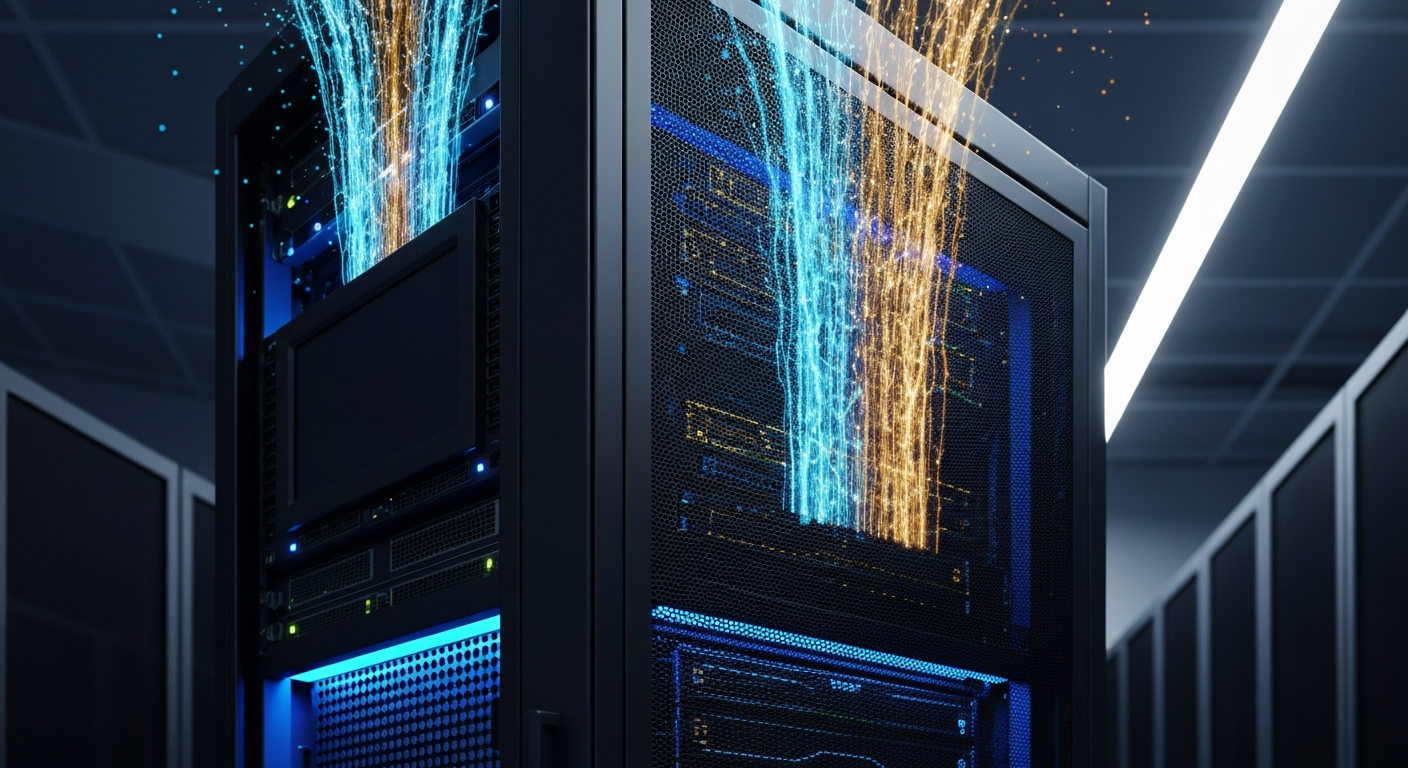
Modern data centers generate more data than any human team can review in real time: per-rack temperature telemetry, per-phase electrical consumption, chiller vibration, PDU (power distribution unit) latency, switch logs, inter-node traffic.
The question is no longer whether there is enough data to anticipate failures, but how to extract useful signal from that volume without hiring an army of analysts. AIOps (Artificial Intelligence for IT Operations) is the category of tools that applies machine learning to that telemetry to detect anomalies, correlate events, and predict equipment failures before they translate into interruption.
What AIOps does in a data center
AIOps is not a single tool or a single discipline. It is an umbrella covering several techniques applied to operational data:
- Anomaly detection: Models that learn the normal pattern of each signal (temperature, power, traffic) and alert when a measurement falls outside the expected range. Unlike traditional static thresholds, the model adapts to the actual operation of the site and reduces false alarms.
- Event correlation: When an incident occurs, tens of thousands of events fire within seconds. AIOps groups those events into actionable incidents, identifies the probable root cause, and discards noise.
- Failure prediction: Models trained on historical failure records predict when a component (chiller, UPS, disk, power supply) is showing the patterns that preceded a known failure.
- Response automation: In the most mature cases, AIOps triggers automatic remediation actions (migrate load, isolate a rack, scale a service) when the model’s confidence exceeds a defined threshold.
The four capabilities are typically applied to the data the infrastructure already generates: SNMP (Simple Network Management Protocol) and syslog (system logs) from network equipment, PDU and UPS telemetry, data from the BMS (Building Management System) and the DCIM (Data Center Infrastructure Management software), application logs, and performance metrics.
Use cases with proven operational return
Not every AIOps application has the same return. Three cases where the investment typically pays off in under 18 months:
- Chiller and CRAC failure prediction: Chillers and precision air conditioning units have measurable degradation patterns: rising vibration, increasing power consumption, gradually climbing compressor discharge temperature. Models trained on these patterns detect the degradation weeks before the equipment fails.
- Anticipated hot spot detection: Instead of alerting when a rack’s temperature exceeds 28 degrees, the model identifies that the temperature is rising at an anomalous rate and predicts that it will reach the threshold in X hours, giving time to act.
- Network event correlation: During incidents, logs from switches, firewalls, and load balancers are correlated automatically, and the system identifies the component causing the issue instead of presenting 40,000 events to the on-call team.
The three cases share two characteristics: there is enough historical data to train the model, and the success metric is clear (reduce unplanned downtime, reduce mean time to repair, reduce energy consumption).
Summary of use cases with operational return
| Use case | Required data sources | Machine learning approach | Success metric / ROI |
|---|---|---|---|
| Chiller and CRAC failure prediction | Vibration, electrical consumption, compressor discharge temperature, failure history | Time series models + multivariate anomaly detection trained with 12-24 months of data | 30-50% reduction in unplanned failures; OPEX (operational expenditure) savings on corrective maintenance |
| Anticipated hot spot detection | Per-rack temperature telemetry, relative humidity, IT load, thermal pattern history | Temperature predictive models with 4-8 hour horizon and adaptive threshold | 40-60% reduction in throttling events; lower MTTR (Mean Time To Repair) on thermal incidents |
| Network event correlation | Logs from switches, firewalls, load balancers and application services; SNMP (Simple Network Management Protocol) metrics | Clustering algorithms and causality graphs to group events and identify root cause | 50-70% reduction in mean diagnostic time; better operational SLA (Service Level Agreement) |
Where AIOps still does not replace human judgment
AIOps is a tool, not a replacement for the operations team. Three areas where human judgment remains indispensable:
- Long-term capacity decisions: Models predict failures based on past patterns, but they do not decide whether to add a second chiller or migrate to another site. Those decisions require business context, budget, and planning the model does not have.
- Complex security incidents: AIOps detects anomalies, but a real security incident requires forensic analysis, impact assessment, and coordinated response with legal and communications teams.
- Design and architecture: Models optimize what exists; they do not decide how the data center should be designed. Architecture decisions remain the responsibility of design engineers.
The right metric for evaluating AIOps is not “how many alerts does it replace”, but “how much free time does it leave the human team to focus on higher-value work”.
Where to start an AIOps program in a data center
Implementing AIOps does not require an enormous initial investment if done in phases. Three first steps with fast return:
- Inventory current data sources: What data the infrastructure already generates and where it is stored. Most sites discover they already have the data they need; they are just not using it in aggregate.
- Start with a bounded use case: Chiller failure prediction, thermal anomaly detection, or event correlation. One well-implemented use case is worth more than five half-implemented cases.
- Define success metrics before starting: Reduction in MTTR (Mean Time To Repair), reduction in unplanned downtime, reduction in electrical consumption. Without clear metrics, it is impossible to know whether the investment worked.
Once the first use case delivers value, the next is easier to justify. The machine learning platform becomes an installed tool that the operations team already knows how to leverage.
The end of reactivity in the NOC
In 2026, predictability is no longer a technological luxury: it is the minimum standard to maintain the operational availability of a data center. Reactive approaches, which wait for equipment to fail before sending an alert, are leaving operators at a disadvantage against AI, hyperscale, and distributed architecture workloads where downtime tolerance is measured in minutes and reputation is lost in seconds.
Well-implemented AIOps converts the operational knowledge of each site into a reusable asset: it detects patterns, anticipates incidents, and frees the operations team to focus on higher-value decisions. The difference between a NOC (Network Operations Center) that puts out fires and one that prevents fires is not about tools: it is about posture.
For data centers in Mexico that still operate in reactive mode, the moment to migrate to predictive is not a budget decision: it is an operational survival decision in an environment where every hour of downtime costs more than any investment in machine learning platforms.
Sources
[1] Uptime Institute — Data Center Resources: https://uptimeinstitute.com/resources
[2] Uptime Institute — Blog: https://uptimeinstitute.com/blog
[3] Wikipedia — AIOps: https://en.wikipedia.org/wiki/AIOps
[4] Wikipedia — Machine learning: https://en.wikipedia.org/wiki/Machine_learning
[5] Wikipedia — Anomaly detection: https://en.wikipedia.org/wiki/Anomaly_detection
[6] Wikipedia — Predictive maintenance: https://en.wikipedia.org/wiki/Predictive_maintenance
[7] Wikipedia — Data center infrastructure management (DCIM): https://en.wikipedia.org/wiki/Data_center_infrastructure_management
[8] Vertiv — Solutions Overview: https://www.vertiv.com/en-us/solutions/
[9] Wikipedia — Data center: https://en.wikipedia.org/wiki/Data_center
Want to master this?
Noxtel Academy →