Precision air conditioning for telecom sites: 5 differences versus data center cooling
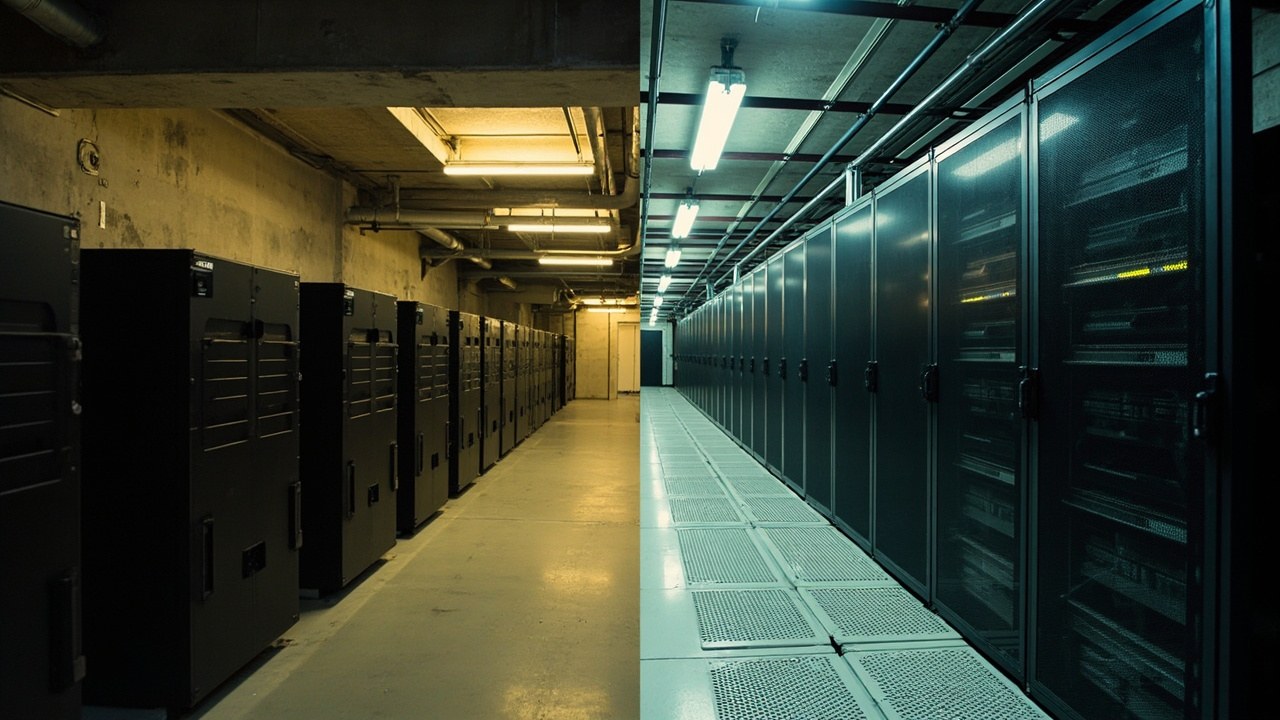
Two buildings, the same type of equipment
A switching center and a data center can receive the same family of precision air conditioning and behave in radically different ways.
The difference is not in the equipment brand, but in the building envelope and in the standard that sets the setpoint band.
Comparing both cases against ASHRAE, ETSI and the telecommunications ISTS makes five differences visible.
The five differences
1. The setpoint band is not the same
2. Outdoor air is not a design variable
3. The thermal load is an order of magnitude lower
4. The equipment scale is inverted
5. Redundancy and the dominant risk change places
Why N in telecommunications does not mean less reliable
The N number does not mean lower quality: it describes the operator’s redundancy model.
An operator managing dozens or hundreds of facilities compensates for a room with no backup with redundant routes, diverse fiber and geographic diversity, while the data center concentrates critical loads in one point and buys the redundancy at that point.
The ISTS works with two facility levels, Rating 2 and Rating 3, aligned with what ANSI/TIA-942 provides: the data center (CDC) requires two commercial feeds plus N+1 generation, and the mission support center (MSC) operates with a single feeder (N) when it serves a Rating 2 facility. In practice, asking for perimeter N+1 for a branch switching center is asking for a data center inside a switching center, with its CAPEX and without the IT load that justifies it.
In Mexico: the switching center is not the tower
As of the third quarter of 2023, the IFT counted 11 passive infrastructure providers and around 38,710 mobile access towers: this is an access network figure, not a count of switching centers.
A switching center is an indoor, cooled equipment room, not a tower shelter. The IFT distinguishes the access network, the towers, from the core network, or CNS, which performs transport and intelligence functions, and lists among the auxiliary elements the power systems, the conduit runs, the security and the air conditioning.
According to the IFT citing the UIT in 2023, Mexico has 113,822 km of fiber optic.
What changes in the specification
The weight of the technical specification shifts from the degree of precision toward the architecture: equipment inside the room, with filtration, flow alarm, filter alarm and condensate pressure control, and air delivery through overhead duct.
None of these differences justifies promising a percentage savings.
What the sources support is the equipment scale and what the site does not have: outdoor air economizer, raised floor, CFD and dedicated humidity control.
Sources
Want to master this?
Noxtel Academy →