Precision air conditioning maintenance in data centers: the 3 routines (monthly, quarterly, annual) that separate an expensive provider from one who knows what they are doing
If you run a data center with precision air conditioning, the most expensive thing isn’t the equipment. The most expensive thing is the provider who bills you for monthly preventive maintenance but only changes filters when they happen to remember. The difference between an operator who knows what they’re doing and one who improvises comes down to three concrete routines, run on fixed schedules, with verification of what was actually done. This article lays them out one by one — the order of execution, what gets measured, and what fails when you skip them.
The three routines apply to CRAC units (with compressor) and CRAH units (with chilled water). If your room is 100% in-row or perimeter with free cooling, there are variations, but 90% of the data centers in Mexico are still running CRAC/CRAH equipment that’s 5 to 15 years old. For those, what follows applies exactly as written.
The monthly routine: what your operator must do on every visit
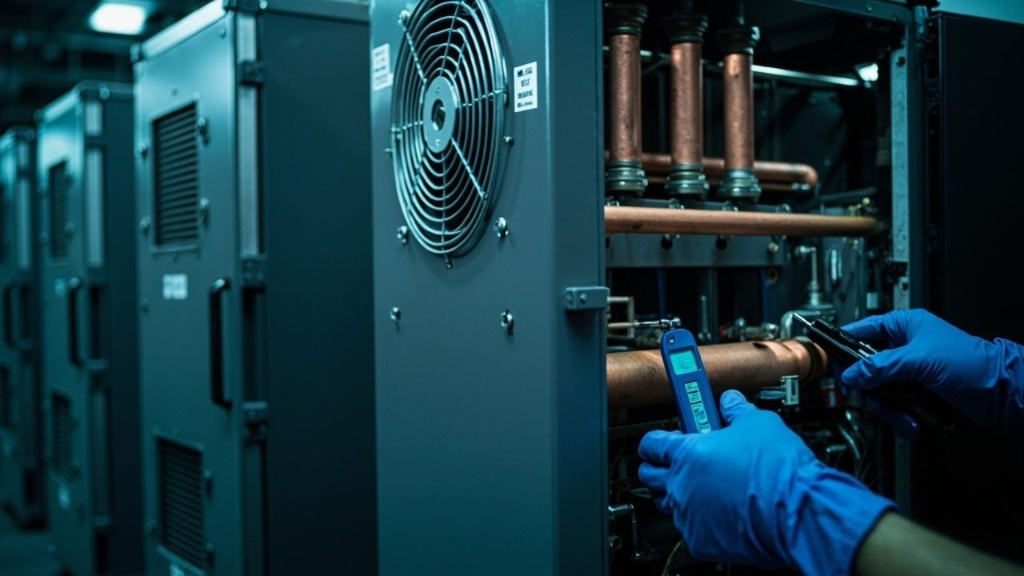
The monthly visit exists to catch small deviations before they turn into alarms. It shouldn’t run more than 45 minutes per unit if the operator brings their checklist and knows what to measure. What must happen:
- Verify the air filter’s differential pressure. If the manometer reads more than double the initial value (typically 0.1 to 0.3 inches of water column on a G4 filter), the filter is saturated. Replacement is mandatory — not optional.
- Measure return and supply air temperature with a calibrated thermometer. The difference between the two gives you the delta T. If the delta drops more than 2°C from its historical value, the coil is losing capacity (dirt on the coil, or low airflow).
- Inspect the condensate pump. Lift the cover, confirm the float moves freely, empty the reservoir, verify the drain isn’t clogged. If the pump won’t evacuate in under 30 seconds with the tank full, you’ve got a problem.
- Check the compressor’s run hours from the display. More than 8,000 continuous hours without a major service is a sign something is degrading.
- External cleaning of the unit. Dust on the grilles, on the side panels, on the floor around it. The dust you can see outside is the dust that gets pulled inside when the seals age.
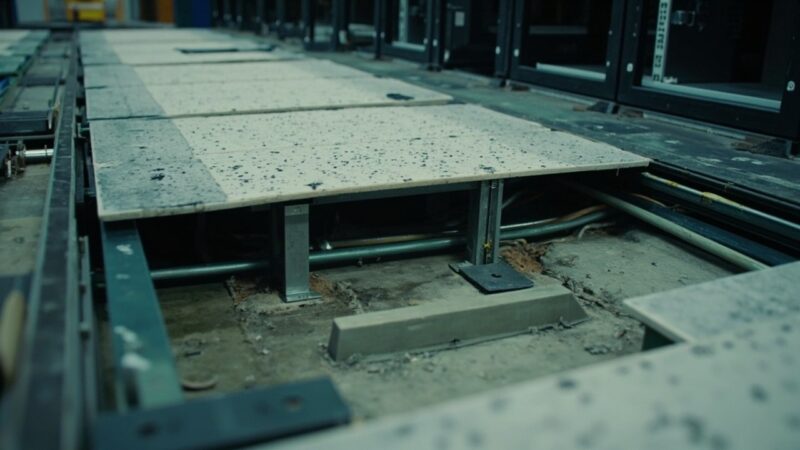
What fails if you skip the monthly routine: saturated filters cut airflow by up to 40%, which drives the compressors to full power and burns between 8% and 12% more energy per unit. On top of that, overflowing condensate can spill onto the raised floor — and if power cables run below, that’s an arc-flash risk.
The quarterly routine: what gets done every 90 days
The quarterly visit goes beyond visual inspection. There’s mechanical intervention. Estimated time: 2 to 4 hours per unit. This is the routine that defines whether your operator actually understands the difference between a “visit” and “maintenance.”
- Chemical cleaning of the evaporator coil with a non-corrosive product (mild alkaline, not acid). Compacted dust cuts heat transfer by up to 25% if you don’t clean it every 3 months.
- Verify compressor voltage and current with a true RMS multimeter. Compare against the nameplate. A current reading 15% above nominal points to a mechanical problem (valve, bearing) or a refrigerant issue.
- Inspect the compressor contactor’s electrical contacts. If they’re pitted or black, replace them. Don’t wait for them to fail.
- Calibrate the temperature and humidity sensors. The operator should bring a reference thermo-hygrometer and compare the equipment’s display readings against reality. Drift beyond 1°C or 5% RH is no longer acceptable.
- Check for refrigerant leaks with an electronic detector — not soapy water, because soapy water won’t pick up R-1234ze or R-454B. Small leaks add up and trip the low-pressure alarm at the worst possible moment, usually a Friday at 6 PM.
- Functional alarm test. Force a high-temperature alarm and verify that the DC’s monitoring system logs it with the correct timestamp. If your BMS doesn’t see it, the operator has to fix it before leaving.
What fails if you skip the quarterly routine: a dirty coil drives electrical consumption up by between 15% and 25%; missing refrigerant sends the compressor into short cycling (on-off every 2-3 minutes) and burns it out in less than 2 years instead of 8. This is the routine that buys you the most in extended service life.
The annual routine: the one the cheap provider never offers you
The annual routine is what separates a serious provider from an improviser. It means taking the unit offline (ideally rotating against N+1 or 2N redundancy), opening it up, intervening on subsystems, and leaving behind a signed record. It must include:
- Filter replacement — not just cleaning. Even if the differential pressure hasn’t hit saturation, G4 filters lose particle-retention capacity after 12 months of continuous service.
- Replacement of the fan belt (on belt-drive units) or tension and vibration check on EC fans. Vibration above 4.5 mm/s RMS is a sign of damaged bearings.
- Compressor oil analysis (where applicable). On semi-hermetic units, acid in the oil is the #1 predictor of winding failure. Measure it with a colorimetric kit, or send a sample to a lab.
- Inspection of every electronic card: bulging electrolytic capacitors, cold solder joints, loose connectors. Any one of these means a preventive replacement.
- Real capacity test — not just delta T. With precision thermometers and the unit at 100% simulated load (resistive heaters, or a real load if you can swing it), measure the cooling capacity in kW and compare it to the nameplate. If it delivers less than 85% of nominal, the unit needs an overhaul or replacement.
- Thermography of the unit’s electrical panels and connections. An annual thermal image catches hot spots before they turn into failures. Camera with a 0°C to 200°C range, emissivity adjusted for copper or steel depending on the surface.
What fails if you skip the annual routine: the unit loses 5-10% efficiency every year, electromechanical components age with no oversight, and the first sign of serious trouble is a catastrophic failure outside business hours. The annual routine costs between 8 and 20 man-hours per unit. An unscheduled failure costs between 80 and 200 man-hours, plus collateral damage to the servers.
How to verify your provider is actually doing the routines (not just charging for them)
If you have a maintenance contract, you have no way of knowing whether the operator really executed the routines — unless you demand:
- A signed report with actual readings, not just checkboxes. Temperature, pressure, current, vibration — everything with a number and a timestamp. The operator who fills in fabricated values is obvious when one month they log 22°C return and the next month 19°C without anything having changed.
- Before-and-after photos of every intervention. Old filter vs new filter, coil before cleaning vs after, thermography of the electrical panel.
- A service log accessible from your side — not buried in a folder at the provider’s office where you can’t see it. A shared Google Sheet, your own ticketing system, whatever, as long as you can see what the operator claims to have done.
- Quarterly comparison of the unit’s electrical consumption. One of the best signals: if after the quarterly maintenance the consumption doesn’t drop between 5% and 15%, the coil cleaning probably didn’t happen — or was done badly.
If your current provider doesn’t meet any of these four points, you don’t have a maintenance contract. You have a visits contract. The cost is similar. The operational risk difference is enormous.
How much skipping a routine costs (in numbers)
To put real numbers on it: a CRAC unit with 30 kW of capacity, running 24/7 in a room with a 12°C delta T and a 24°C return temperature, has a baseline electrical draw of roughly 11 kW. If the coil is dirty and cuts heat transfer by 20%, the compressor compensates by running longer and consumption rises to 13 kW. The difference: 2 kW × 24 hours × 365 days = 17,520 kWh per year. At an average Mexican industrial rate of $1.8 MXN/kWh, that’s $31,536 MXN per year extra on a single unit. If you have 10 units in your DC, that’s $315,360 MXN per year flushed down the drain because you skipped the quarterly routine.
The math scales linearly: for every 30 kW CRAC unit on irregular maintenance, you’re spending between $25,000 and $35,000 MXN per year extra on electricity. The quarterly routine costs between $3,500 and $8,500 MXN per unit. The ROI is 3 to 6 months on energy alone — before you even count the extended service life of the equipment and the reduction in unscheduled failures.
What a decent provider puts in writing before you sign the contract
If you’re about to hire or switch precision air conditioning maintenance providers, here’s the minimum that has to be in the contract:
- An exact list of tasks for each routine (monthly, quarterly, annual), with the frequency and the estimated execution time per unit.
- A commitment to deliver a report with real readings within 48 business hours after the visit, accessible through a customer portal or by email.
- Emergency response time: a maximum of 4 business hours for on-site attendance after a failure is reported.
- An inventory of critical spare parts that the provider keeps in their warehouse or on consignment at your site — filters, contactors, capacitors, control cards for the models you have installed.
- A penalty clause if the operator fails to execute the routines. Typically a proportional discount on the next month’s bill, or 5% of the annual contract for each month without an executed routine.
If your current provider doesn’t meet at least 3 of these 5 points, you already know why your data center feels hotter every summer and your CFE bill keeps climbing with no explanation.
Sources
- ASHRAE TC 9.9 — Thermal Guidelines for Data Processing Environments (5th edition) — https://www.ashrae.org/technical-resources/bookstore/thermal-vigilance-for-data-processing-environments
- Uptime Institute — Avoiding redundancy and accelerating the smart-hands SLA (2024) — https://datacenter.uptimeinstitute.com/
- Vertiv — Liebert CRV Operations and Maintenance Manual (public technical reference) — https://www.vertiv.com/en-us/products/brands/liebert/
- Schneider Electric — EcoStruxure for Data Centers: preventive maintenance reference — https://www.se.com/mx/es/product-category/data-centers/
- Stulz — CyberAir 3 technical documentation (service interval specifications) — https://www.stulz.com/en/products/cyberair/
Want to master this?
Noxtel Academy →