Precision air conditioning vs office A/C: the 4 technical differences your CFO needs to understand (before the next failure)
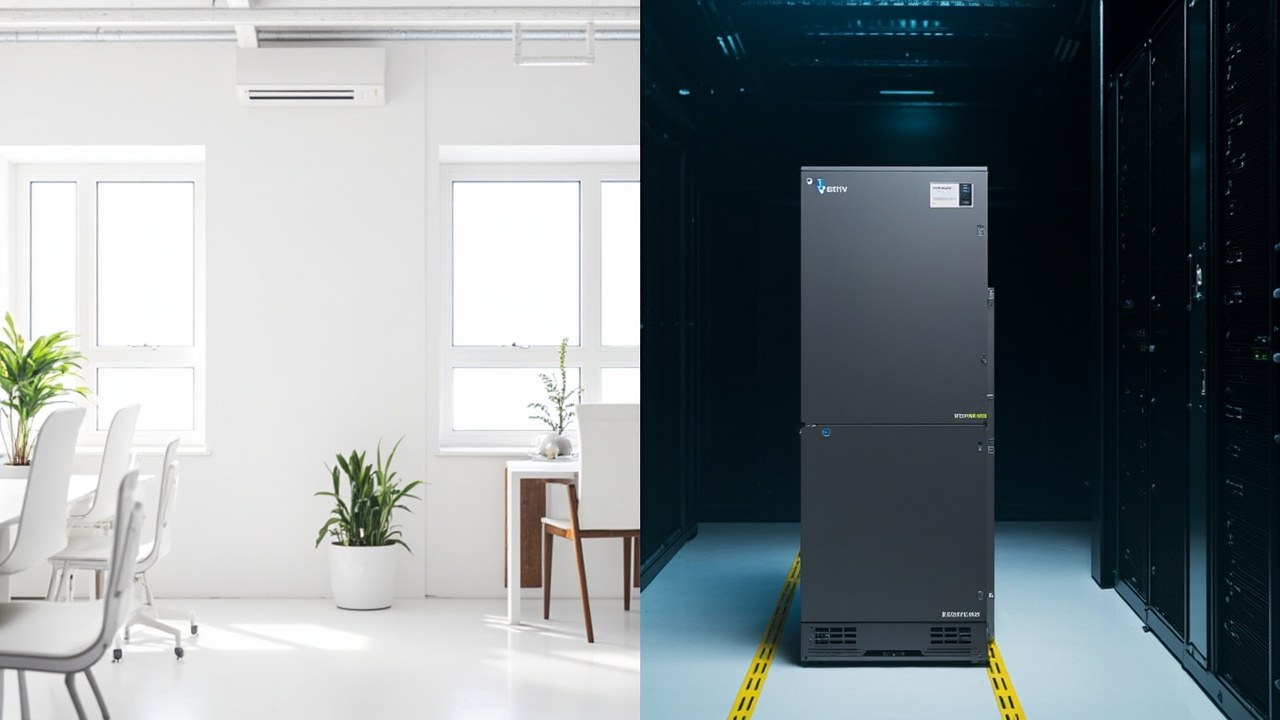
Your CFO asks you ‘why can’t we use the same office air conditioning for the server room?’ It is a legitimate question. The short answer: office A/C is designed for human comfort (22-26 degrees C, variable humidity), not for electronic equipment that requires strict control (18-27 degrees C, 40-55% humidity). The technical differences are 4, all affecting operation, equipment lifespan, and total cost.
What follows applies to small and medium data centers where the temptation to ‘use what is available’ is common. For enterprise DCs with a site provider, precision A/C is standard. The problem is in SMBs with internal server rooms.
Difference #1: Sensible vs latent capacity
The most important technical difference, which most CFOs do not understand:
Result: office A/C, calibrated for 40% latent, dehumidifies more than necessary in a server room. Relative humidity drops below the ASHRAE recommended range (40-55%).
Precision A/C has balance calibrated specifically for 95% sensible heat and 5% latent. It maintains stable humidity without over-drying the air.
Difference #2: Humidity control
Office A/C has limited humidity control. Precision A/C has strict control:
Why it matters: in humid climates (Veracruz, Tabasco, coastal areas), ambient humidity can reach 80-90% without building control. Office A/C does not control it; servers operate with excessive humidity.
Precision A/C controls actively. During rainy season, the difference is brutal: servers survive with precision A/C, fail with office A/C.
Difference #3: Redundancy and continuous operation
Office A/C is designed for intermittent use (8-10 hours per day in offices). Precision A/C is designed for 24/7 operation:
For an office, 4-24 hours of heat is tolerable (employees go home or to another office). For a data center, 4-24 hours without cooling is total downtime with possible data loss.
Precision A/C redundancy costs 30-50% more upfront but ensures continuous operation. It is operational safety, not luxury.
Difference #4: Monitoring and telemetry
Office A/C has a local display (temperature buttons, operating mode). Precision A/C has a network interface:
The operational difference: if office A/C fails at 3 AM, nobody knows until the temperature rises and servers start failing (cascading events). If precision A/C fails, the operator receives a remote alarm.
Integrated monitoring is the difference between ‘reacting to disaster’ and ‘preventing disaster’. Precision A/C allows the second; office A/C only allows the first.
The real case: 6 months of failing servers
Real operation in a Mexican SMB in 2024. Server room with commercial mini-split A/C (investment USD $580 / approx. $10,000 MXN). 6 months later, recurring failures:
Symptoms observed onsite (6 months of operation)
Forensic diagnosis — root cause
Final diagnosis: relative humidity in the server room was 12-20% (ASHRAE minimum range is 40%). The commercial mini-split was drying the air without control. Air that dry + servers = constant ESD + progressive physical damage. The combination of static dust and humidity below the ASHRAE minimum creates the perfect environment for failures.
Solution applied and TCO lesson
Solution: install a 5 kW precision A/C. Investment: USD $10,500 (approx. $180,000 MXN). Replacement of damaged equipment: USD $10,500 (approx. $180,000 MXN). Total lesson cost: USD $21,500 (approx. $370,000 MXN) versus USD $580 (approx. $10,000 MXN) of the original mini-split. The perceived CAPEX saving became a 37x higher cost at the end of 6 months.
When you CAN use office A/C (valid scenarios)
There are 3 scenarios where office A/C is valid:
- Very small server room (<5 racks), with limited budget, where the operator accepts the risk. If the room fails, the servers are cheap to replace.
- Short-duration operation (1-2 years) as contingency before migrating to enterprise DC. It is a temporary patch, not a permanent solution.
- Distributed edge sites with low-criticality servers (branch office). The server is local, not critical, and is replaced if it fails.
Outside these 3 scenarios, office A/C is a gamble. If your CFO asks you to save on A/C, document the risk in writing. If an incident occurs, responsibility falls on whoever approved the decision.
How to present the decision to your CFO
Your CFO will ask: ‘is USD $10,500 vs USD $580 (approx. $180,000 MXN vs $10,000 MXN) justified?’ Your answer:
- ‘Office A/C costs 18x less but statistically generates server damage in 6-12 months. Replacement cost: USD $11,500-29,000 (approx. $200,000-500,000 MXN) in servers depending on quantity.’
- ‘Precision A/C has a useful life of 10-15 years vs 5-8 of office A/C. Annualized cost: USD $700-1,050 (approx. $12,000-18,000 MXN) vs USD $85-115 (approx. $1,500-2,000 MXN) of office A/C, but office A/C generates USD $11,500 (approx. $200,000 MXN) in incident damage.’
- ‘5-year TCO of precision A/C is LOWER than office A/C TCO considering replacement of damaged servers.’
- ‘If you approve office A/C and there is an incident, the cost falls in next fiscal year’s budget. If you approve precision A/C, there is no incident.’
The CFO who understands TCO approves precision A/C. The one who only sees upfront CAPEX approves office A/C. Your job is to give them the complete information so they can make an informed decision.
The metrics your CFO must understand
ASHRAE TC 9.9 defines operating ranges:
Office A/C typically operates outside the A1 range (humidity below 25%). Servers survive initially, but with accelerated degradation.
The USD $10,500 investment pays for itself
Return calculation:
If you have 10+ servers with a value greater than USD $2,900 each (approx. $50,000 MXN, total USD $29,000+ / approx. $500,000+ MXN), the risk of damage from office A/C is significant. Precision A/C is operational safety, not excessive spending.
When precision A/C is NOT worth it
There are scenarios where precision A/C is excessive:
- Very low-value servers (Raspberry Pi clusters, micro-servers). The equipment value does not justify the precision A/C investment.
- Operation < 1 year before migrating to cloud. If you are going to power down the DC in 6 months, office A/C is acceptable.
- Commercial edge sites (branches) where the server is only for local operation and is replaced annually.
If your case fits these scenarios, office A/C is valid. If not, it is an unnecessary gamble.
How to verify if your existing A/C meets requirements
If you have office A/C and want to verify if it provides adequate service:
- Measure relative humidity with a calibrated hygrometer. If it is persistently outside 40-55%, the A/C does not meet requirements.
- Measure temperature with a calibrated thermometer. If it is persistently outside 18-27 degrees C, the A/C does not meet requirements.
- Verify 24/7 availability. If the A/C turns off at night or on weekends, it does not meet requirements.
- If any check fails, consider replacing with precision A/C or adding complementary humidifier/dehumidifier.
The complementary humidifier is a lower-cost alternative (USD $1,750-4,650 / approx. $30,000-80,000 MXN) that can extend the life of existing office A/C. Not ideal but better than nothing.
Summary: the 4 differences your CFO must understand
Synthesis to present:
- Difference #1: Sensible/latent capacity. Office A/C over-dries. YES, this damages servers.
- Difference #2: Humidity control. Office A/C does not dehumidify. Precision A/C does.
- Difference #3: Redundancy and 24/7 operation. Office A/C is not designed for continuous use.
- Difference #4: Integrated monitoring. Office A/C has no telemetry. Precision A/C has SNMP/BACnet.
The 4 differences together justify the investment of USD $10,500 (approx. $180,000 MXN) for precision A/C vs USD $580 (approx. $10,000 MXN) for office A/C. If your CFO approves office A/C, they are accepting the risk. Document it in writing.
Sources
- ASHRAE TC 9.9 — 5th edition: Thermal Guidelines for Data Processing Environments — https://www.ashrae.org/technical-resources/bookstore/thermal-vigilance-for-data-processing-environments
- AHRI Standard 540 — Performance Rating of Computer Room Air Conditioners — https://www.ahrinet.org/analytics/standards
- TIA-942-B-2023 — Section 5.3: HVAC and Precision Cooling — https://www.tia.org/standards/tia-942
- BICSI 002-2024 — Data Center Design: Precision Cooling vs Comfort Cooling — https://www.bicsi.org/standards/data-center
- Uptime Institute — Tier Topology: Cooling Architecture Requirements — https://datacenter.uptimeinstitute.com/
Want to master this?
Noxtel Academy →