Wind energy in Tamaulipas and Nuevo León: the real potential for powering a 50 MW data center
The resource that already exists, the announced megaprojects, and the operational reality
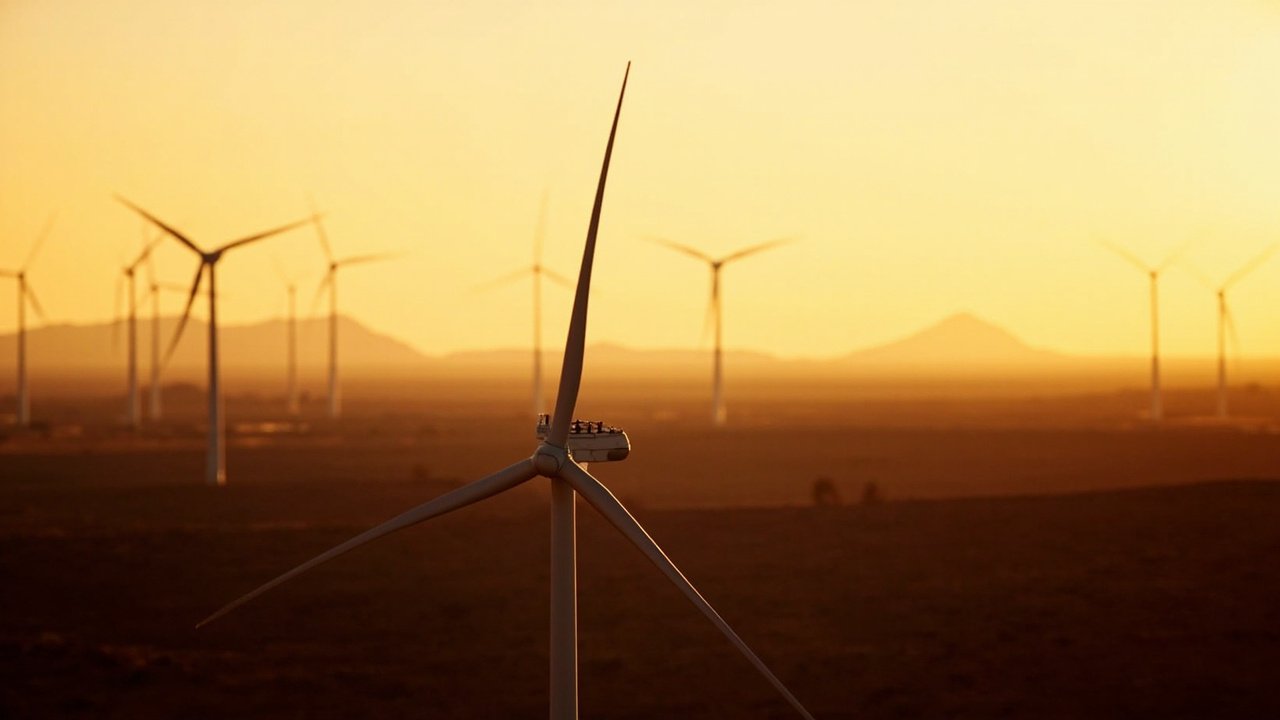
Northern Mexico, specifically Tamaulipas and Nuevo León, has one of the most underutilized wind power potentials in the country. Tamaulipas has just 2.3 MW of installed wind capacity when its estimated potential exceeds 22,558 MW. That gap of four orders of magnitude between what is installed and the potential is no coincidence: it reflects decades of shifting regulation, insufficient transmission, and private disinvestment that the new mixed-investment framework aims to reverse. For data centers seeking clean, firm, and cost-competitive energy, northern Mexico is an increasingly viable option, but the operational reality differs from the theoretical potential.
The context of the Mexican wind market
Mexico had approximately 8,100 MW of installed wind capacity at the close of 2025, with cumulative investments of approximately $9 billion USD. Distribution by state shows Oaxaca dominating with more than 2,700 MW, followed by Tamaulipas and Nuevo León. But installed capacity does not reflect real potential: a recent federal government study estimates that Mexico could produce around 71,000 MW of wind power nationally, more than 40% of the country’s total electricity demand.
That gap between what is installed (8,100 MW) and the potential (71,000 MW) is what the new mixed-investment scheme from the federal government aims to close. In June 2026, AMDEE organized a specialized seminar where it was announced that the Mexican wind sector is entering its most active investment cycle in nearly a decade, with plans to deploy up to $6 billion USD in 13 new wind farms with approximately 4,000 MW of capacity.
The projects announced in Tamaulipas and Nuevo León
The new scheme contemplates two calls. The first, for private investment, designated approximately 900 MW. The second, focused on mixed contracts (public-private), could add approximately 3,000 MW more. All plans will include battery storage systems with capacity to retain at least 30% of each installation’s capacity, guaranteeing up to 4 hours of operation off-grid.
Projects specifically identified in Tamaulipas include wind farms in the municipalities of Villagrán (the Huizache project at 800 MW), Mier (Central Eólica 24Wind), Llera, Güémez, Reynosa, Matamoros, Villa de Casas, San Fernando, Méndez, and Victoria. Other states on the wind development map include Puebla, Veracruz, Zacatecas, Chiapas, Campeche, and Quintana Roo.
In Tamaulipas, the Victoria project in Güémez is a concrete example in operation. It consists of 15 wind turbines of 3.3 MW each (49.5 MW total), connected to the CFE Güémez substation via a 115 kV transmission line of 26.7 km. It produces approximately 184 GWh per year, displacing 72,345 tons of CO₂. It is a modest project compared to the state’s potential, but it demonstrates the technical viability of the resource.
Why Tamaulipas and Nuevo León matter for data centers
For data centers seeking clean energy, Tamaulipas and Nuevo León have three structural advantages:
1. Proximity to industrial demand centers. Monterrey is Mexico’s third-largest industrial center with advanced manufacturing, automotive, and electromobility. The demand for clean energy from data centers serving those industries is geographically concentrated in the Monterrey-Saltillo-Apodaca corridor.
2. Proven wind resource. Average wind speeds on the Tamaulipas coast (8-10 m/s) and in the sierras of Nuevo León (7-9 m/s) are competitive with the world’s best wind zones, including Tehuantepec. Seasonal variability is lower than in the south of the country, with more stable production throughout the year.
3. Connection to the national grid. The National Interconnected System (SIN) has nine zones, and the northeast zone includes Tamaulipas, Nuevo León, most of Coahuila, and some municipalities of San Luis Potosí. The northeast zone had a generation capacity of 7,587 MW in 2011 according to CFE’s POISE program, with average demand growth of 4.9% annually in the prior five years. The new mixed investment promises to expand that capacity significantly.
The obstacles that have held development back
Despite the potential, three obstacles have held back wind development in Tamaulipas and Nuevo León:
1. Insufficient transmission lines. The Tamaulipas State Energy Commission suspended at least 30 wind projects due to lack of CFE transmission lines. Without transmission, generated energy cannot reach consumption centers. SENER announced an investment of approximately 8 billion MXN in transmission infrastructure, but progress has been slow.
2. Shifting regulation. The 2013 energy reform opened the market to private investment. The 2018-2024 policy partially reversed that opening, generating legal uncertainty. The new 2026 mixed framework aims to recover private investor confidence, but reputational damage takes years to repair.
3. Social conflict and land use. Some wind projects in Tamaulipas have faced opposition from rural communities over visual impact, noise, and use of communal lands. Prior consultation processes have delayed projects and increased costs.
The real potential for powering a 50 MW data center
To size what it means to power a 50 MW data center with wind, the basic numbers:
- A modern 4.5 MW wind turbine produces approximately 15-18 GWh per year on-site with good resource (capacity factor 38-45%).
- To power 50 MW continuous (IT load + overhead), approximately 125-150 MW of installed wind capacity is required, assuming an average capacity factor of 35-40% in Tamaulipas.
- That capacity requires a wind farm of 30-35 turbines of 4.5 MW, occupying an area of approximately 50-75 km² (depending on spacing).
- The CAPEX investment for a farm of that scale is between USD $200 and $300 million (approx. $3.5B-$5.25B MXN at 17.5 MXN/USD), with resulting LCOE between $35-50 USD/MWh.
Operational viability depends on:
- Long-term PPA (Power Purchase Agreement). The data center signs a 15-20-year energy purchase contract with the wind farm developer. This gives revenue stability to the developer and cost certainty to the data center.
- Dedicated transmission infrastructure or connection to the SIN. The data center can have a dedicated transmission line from the wind farm (more expensive, more reliable) or buy energy from the SIN with CEL certificates (cheaper, less direct traceability).
- Battery storage. To guarantee 24/7 firmness, the wind farm needs a storage system covering the hours without wind. The new regulation requires at least 30% capacity in batteries with 4 hours of autonomy. For a 50 MW data center, that implies 15 MW of battery with 60 MWh of storage.
- Coordination with CFE or a private generator. The data center needs a backup agreement with CFE or with a private generator for periods when neither wind nor batteries are sufficient. That backup typically comes from natural gas or diesel.
What is already happening in Tamaulipas
Several data center operators have begun evaluating Tamaulipas and Nuevo León for combined wind-energy projects. The patterns:
- Demand from nearshoring clients requiring clean manufacturing and clean operations.
- Availability of industrial land at lower cost than in Querétaro or Monterrey (Tamaulipas has industrial land between $30-80 USD/m² vs $80-150 in the Bajío).
- Proximity to the Texas border, with the option of redundancy with the ERCOT grid.
- Regulatory and market pressure to reduce the carbon emission factor of the electricity consumed.
The Victoria project in Güémez is a modest but demonstrable example: 49.5 MW of wind, 184 GWh/year, 72,345 tCO₂ displaced. For a data center, the numbers multiply by 1-2 orders of magnitude, but the operational pattern is replicable.
What your next data center energy analysis should ask
To properly evaluate the viability of powering a data center with wind from northern Mexico, the questions that need to appear:
- What is the wind resource measured at the specific site (not a regional estimate)? Is there an installed met tower?
- Is there transmission capacity available from the site to the data center? What is the line cost?
- What type of PPA is viable: physical direct with the farm, or financial with a generator?
- What is the real firmness of the wind resource during the data center’s peak demand hours?
- Is the battery storage system sized for the required autonomy?
- What is the projected LCOE of the wind farm at the specific site, considering the measured capacity factor?
- Are there precedents of operational coordination between the wind farm, CFE, and the data center?
The answers to those questions indicate whether northern Mexico is viable today as a source of clean energy for a 50 MW data center, or whether one has to wait for the new mixed investment to materialize and the transmission to expand.
Sources
- Mexico Business News (July 2026). Wind Industry Projects More Investment Under Mixed Scheme. https://mexicobusiness.news/energy/news/wind-industry-projects-more-investment-under-mixed-scheme
- North American Development Bank. Victoria Wind Energy Project in Güémez, Tamaulipas. https://nadb.org/our-projects/infrastructure-projects/victoria-wind-energy-project-in-gueemez-tamaulipas
- Wilson Center (2012). Wind Energy Potential in Mexico’s Northern Border States. https://www.wilsoncenter.org/sites/default/files/media/documents/publication/Border_Wind_Energy_Wood.pdf
- Mordor Intelligence (2026). Mexico Renewable Energy Market Size & Growth Analysis 2031. https://www.mordorintelligence.com/industry-reports/mexico-renewable-energy-market
- Mordor Intelligence (2026). Mexico Wind Energy Market Size, Trends & Outlook 2031. https://www.mordorintelligence.com/industry-reports/mexico-wind-energy-market
Want to master this?
Noxtel Academy →