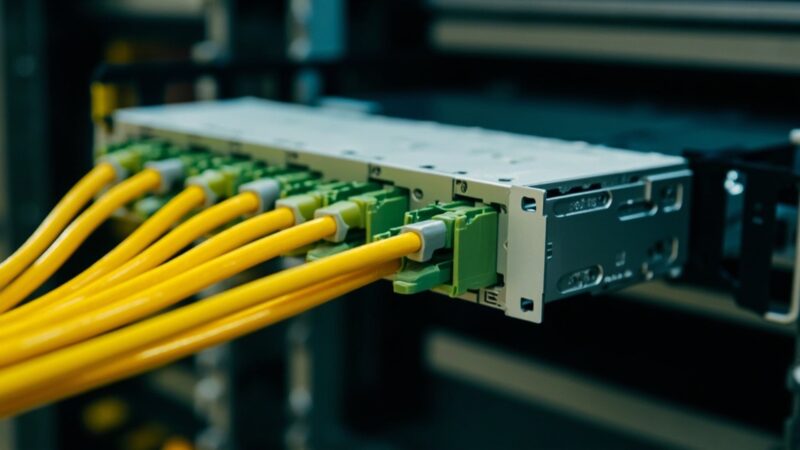
Co-packaged optics vs pluggable transceivers 800G: what is coming for your DC cabling

800G and 1.6T are the cabling speeds dominating the 2026 to 2030 data center roadmap. Two technology paths compete: pluggable transceivers (the traditional route with QSFP-DD or OSFP hot-swappable modules) and co-packaged optics (CPO), which integrates optical functions directly into the switch ASIC. Each path has a different impact on port density, power consumption, latency, maintenance, and total CAPEX. This article breaks down the technical criteria that matter for a Mexican data center that is planning to upgrade to 800G in 24 to 36 months.
What changes with 800G (mandatory context)
The IEEE 802.3df standard (approved 2025) defines Ethernet at 800G and 1.6T using four media types: copper (up to 2 meters over twinax DAC), multimode OM4 and OM5 (up to 50 meters), single-mode (up to 10 kilometers with WDM), and Active Electrical Cable (AEC). The dominant transceiver today is QSFP-DD800 and OSFP800 pluggable, both modular successors to previous generations (QSFP28, QSFP56). Power consumption per 800G port is 14 to 22 W with current pluggable transceivers (depending on reach and PAM4 200G per lambda modulation), comparable to the sum of 8 previous 100G ports.
The fundamental technical change is that 800G uses four lanes of 200G PAM4 over single-mode or multimode fiber, not eight 100G NRZ lanes as in previous generations. This reduces the number of optical fibers required per link but increases module complexity. Operators with Tier III-IV sites in Mexico are evaluating migration between 2026 and 2028 according to the hyperscaler roadmap (Broadcom Tomahawk, Cisco Silicon One, Marvell, Nvidia Quantum).
What CPO is and where it changes the architecture
Co-packaged optics (CPO) integrates the optical components directly onto the switch or router ASIC substrate, eliminating the front panel where pluggable transceivers connect. The optical fibers enter the ASIC directly through edge connectors. The main saving is electrical: between 30% and 50% less consumption per port, because the electrical signal path between ASIC and transceiver module is eliminated. The trade-off is that optics are now part of the switch: if a fiber or an optical component fails, the entire switch must be replaced, or specialized personnel in CPO is required.
CPO has been in commercial development since 2024. The first operational generations are for 12.8T to 25.6T per chip (Broadcom Tomahawk 5, Cisco Silicon One G200, Marvell Spad). The 2026 to 2028 roadmap targets 51.2T to 102.4T per chip with CPO. For Mexican data centers, the decision between pluggable and CPO is a 3-5 year decision.
The 5 operational differences
Five points where the two paths diverge:
- Port density: pluggable 800G (QSFP-DD/OSFP) allows 36 to 72 800G ports in a single 1U switch; CPO allows 2 to 3 times higher densities because the transceiver socket is eliminated. For data centers with limited space, CPO wins on density.
- Power consumption: CPO consumes between 30% and 50% less per port because it shortens the electrical path. For a site with 200 switches and 14,400 800G ports, the annual energy savings are 200 to 400 MWh (cost at CFE GDMTO: USD $35,000 to $70,000/year for 200 switches, depending on the tariff mix).
- Maintenance: pluggable transceiver is hot-swapped in 30 to 60 seconds without affecting other ports. In CPO, an optical failure may require replacing the switch or specialized personnel in substrate-level repair (microscope tools, laser alignment, etc.). Operators with current maintenance staff benefit from pluggable; operators that outsource maintenance can choose CPO.
- Latency: CPO reduces latency by 5 to 15 ns per port because it eliminates the intermediate electrical-to-optical transition. For trading applications, HPC, or distributed AI compute with low-latency networks, CPO adds real performance.
- Total cost: 800G pluggable transceiver costs between USD $1,200 and $4,000 per port (depending on reach and modulation); CPO encapsulates the optical cost in the switch, adding between 15% and 25% to the ASIC price, but eliminating USD $800 to $1,500 per port in transceivers. For sites planning 10,000+ 800G ports, the balance tilts to CPO in CAPEX; for sites with 1,000 ports, pluggable remains more economical.
When planning CPO migration IS the right choice
Three cases where CPO makes sense on the 2026 to 2030 roadmap:
- New sites starting at 800G (greenfield from 25.6T per chip): if you will buy new switches, evaluating CPO from the initial specification reduces total cost and leaves room for future upgrades. Hyperscale operators in Mexico (if AWS, Azure, Google arrive at Tier III) typically choose CPO for greenfields.
- AI factories with low-latency GPU networks: distributed AI workloads (large model training, parallel fine-tuning) require 5 to 15 ns less latency per port, and CPO delivers it natively. AI sites in Mexico (KIO in Querétaro, Ascenty under construction) are natural candidates for CPO from the start.
- Operation with specialized maintenance personnel on site: if you have technical staff capable of substrate-level repair (microscope tools, laser alignment) or contracts with manufacturers for in-situ support, CPO is viable. Operators without these capabilities should stay with pluggable.
When to wait with pluggable
Three cases where pluggable is the right decision in 2026:
- Sites with existing 400G switches and gradual migration. 800G QSFP-DD/OSFP pluggable is backward-compatible with 400G sites using existing twinax cabling or fiber. CPO requires new ASICs incompatible with 400G switches.
- Operators that outsource technical maintenance (switch manufacturer vendor) and have no in-house staff. Pluggable allows transceiver replacement without opening the switch; CPO requires return to manufacturer.
- Modest port density (up to 72 800G ports per switch). Pluggable in QSFP-DD800/OSFP800 form factor already covers this density with good price-performance options. CPO offers no advantage until densities above 100 ports per switch.
The Mexican data point 2026
Mexican Tier III-IV operators are in the evaluation phase, not adoption. KIO Networks has published a 400G use case with QSFP-DD transceiver at some sites; Ascenty has deployed Infiniband NDR (GPU interconnect links, not Ethernet 800G, different technologies). Triara and ODATA are evaluating for new sites. CPO is a 2027-2028 decision for any Mexican Tier III-IV operator; until then, pluggable 800G QSFP-DD/OSFP is the operational choice. For enterprise on-prem data centers (not colocation), the practical decision in 2026 is still 400G pluggable with migration to 800G pluggable in 24 to 36 months.
Sources
- TIA: Telecommunications Industry Association (TIA-942-B-2023 for data center cabling) — https://tiaonline.org/
- IEEE 802.3 Working Group: Ethernet standards including 802.3df for 800G and 1.6T — https://www.ieee802.org/3/
- IEEE 802.3df Task Force: technical specification for 800G — https://www.ieee802.org/3/df/
- TIA Standards: current list of standards applicable to cabling — https://www.tiaonline.org/standards/
- BICSI: standards for telecommunications infrastructure in buildings and data centers — https://www.bicsi.org/
Want to master this?
Noxtel Academy →