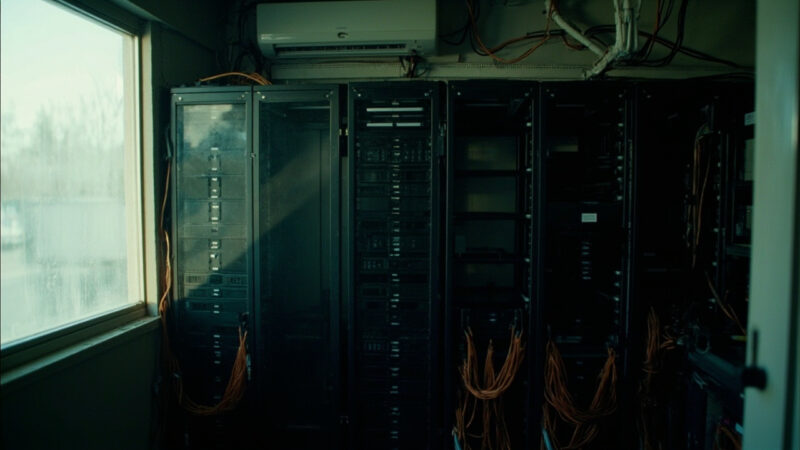
Containerized data centers: when a container DC makes sense (and when it doesn’t)
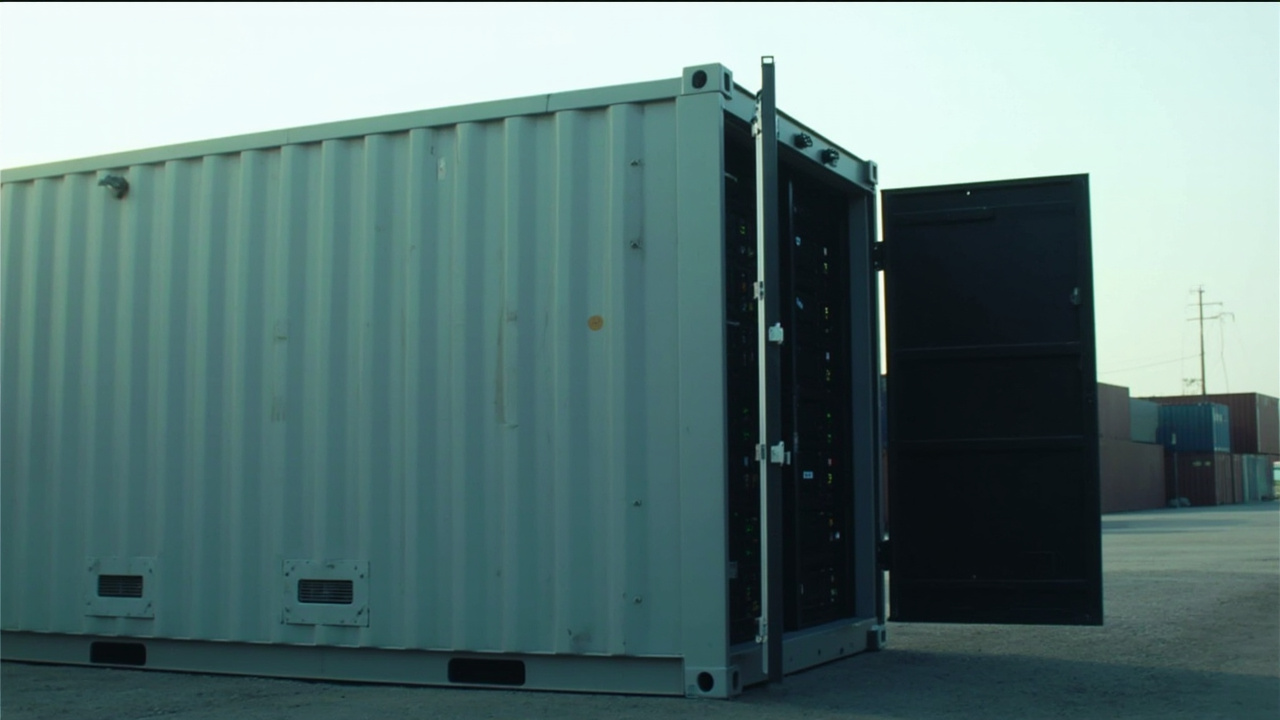
A containerized data center (or container DC) is a prefabricated data center built inside a standard shipping container (20- or 40-foot ISO). It arrives on site with power, cooling, racks, and cabling preinstalled; it is connected to the site’s electrical grid and fiber and goes live in weeks, not months.
It is one of the fastest ways to add capacity, but it is not always the right choice. This guide separates the cases where a container DC makes technical and economic sense from the cases where a traditional brick-and-mortar DC built on site remains the better option.
What a container DC typically includes
A serious prefabricated container DC arrives with everything needed to operate as a self-contained server room:
- Server racks (from 4 to 12 racks per container, depending on manufacturer and dimensions).
- Dedicated cooling system: chillers, precision air conditioning, hot-aisle containment, depending on the target thermal envelope.
- UPS and battery bank (lithium or VRLA) with maintenance bypass.
- Distributed PDU with per-outlet monitoring.
- Fire detection and suppression system (VESDA + clean agent).
- Basic DCIM or remote monitoring system.
- Pre-terminated Cat6A structured cabling or OM4 fiber.
When a container DC makes sense
- Rapid incremental capacity: the vendor delivers in 8 to 16 weeks, versus 6 to 12 months for a traditional DC. If the customer needs additional capacity in under 6 months, the container wins.
- Site with construction constraints: a building without floor-load capacity for high density, without space for external chillers, or without permits for major civil works.
- Temporary or mobile deployments: remote operations, events, construction sites, defense infrastructure, or disaster response.
- Edge computing in space-limited sites: manufacturing, telecom, sites where a full white-room DC is not justified.
- Sites with favorable climate: the container DC usually assumes partial free cooling; in temperate or cold climates, performance improves substantially.
When a container DC does NOT make sense
- IT load above 100–150 kW per container: the bottleneck of traditional air cooling (DX / Chilled Water) inside the limited space of an ISO enclosure is reached at this range. Exceeding 150 kW requires migrating to Direct Liquid Cooling (DLC) or wider non-ISO prefabricated modules; a traditional DC built on site is more efficient at that scale.
- 24×7 operation over 20+ years: although the container shell (Corten steel enclosure with IP65 protection rating and C5-M marine coating) lasts 20 to 25 years, a built civil DC remains the better long-term option. The closed format of the module limits complex retrofits, spatial expansion, and the multiple hardware refresh cycles that occur over two decades; a traditional building allows growth, redistribution of space, and absorption of density changes without the geometric constraints of the ISO enclosure.
- Extreme humid tropical climate: the container’s containment and cooling capacity degrade under persistent heat and humidity; OPEX skyrockets.
- Sites where upfront capex is constrained but OPEX matters less: a container DC has a high capex-per-kW compared to a built DC, and low OPEX. If the model relies on fast payback, it may not close.
- Operations with daily on-site technical staff: the container has limited workspace; a traditional DC with an operations room, spare racks, and a staging zone is preferable.
Operational considerations
A container DC demands specific operational discipline. High per-rack density requires attention to hot spots and phase load balancing. Service entry is through the top or one of the side faces, not through front doors like an office rack.
Air filter maintenance, heat exchanger cleaning, and seal inspections are more frequent than in a traditional DC. For coastal or industrial zones, the enclosure is built in Corten steel (self-protecting steel) with IP65 protection rating and C5-M marine coating, which extends the shell’s useful life to 20–25 years; internal mechanical components (compressors and batteries) keep their own replacement cycle at 10–12 years.
Typical price and capacity ranges
A 20-foot container DC (4 to 6 IT racks, 20 to 50 kW of IT load) costs between USD 80,000 and 200,000. A 40-foot container (8 to 14 IT racks, 50 to 150 kW) costs between USD 200,000 and 600,000. High-density containers (over 100 kW) with liquid cooling can reach USD 800,000 or more.
These prices include full equipment but exclude exterior civil works, medium-voltage grid connection, and backbone fiber runs. Total deployment cost (site preparation + container + commissioning + connection) usually multiplies the container price by 1.5 to 2.5x.
A container DC is a tool, not a universal solution. It works well in specific scenarios of rapid capacity, edge computing, and space constraints. Where high-density 24×7 operation is required for more than a decade, the built DC remains the dominant option.
Sources
[1] TIA-942-C — Telecommunications Infrastructure Standard for Data Centers — https://tiaonline.org/resource/tia-942-c-data-center-infrastructure-standard/
[2] Uptime Institute — Tier Classification System — https://uptimeinstitute.com/resources/asset/tier-classification-system
[3] ASHRAE TC 9.9 — Thermal Guidelines for Data Processing Environments — https://tpc.ashrae.org/?cmtKey=fd4a4ee6-96a3-4f61-8b85-43418dfa988d
Want to master this?
Noxtel Academy →