UPS and cooling for data centers: which type your facility needs based on density
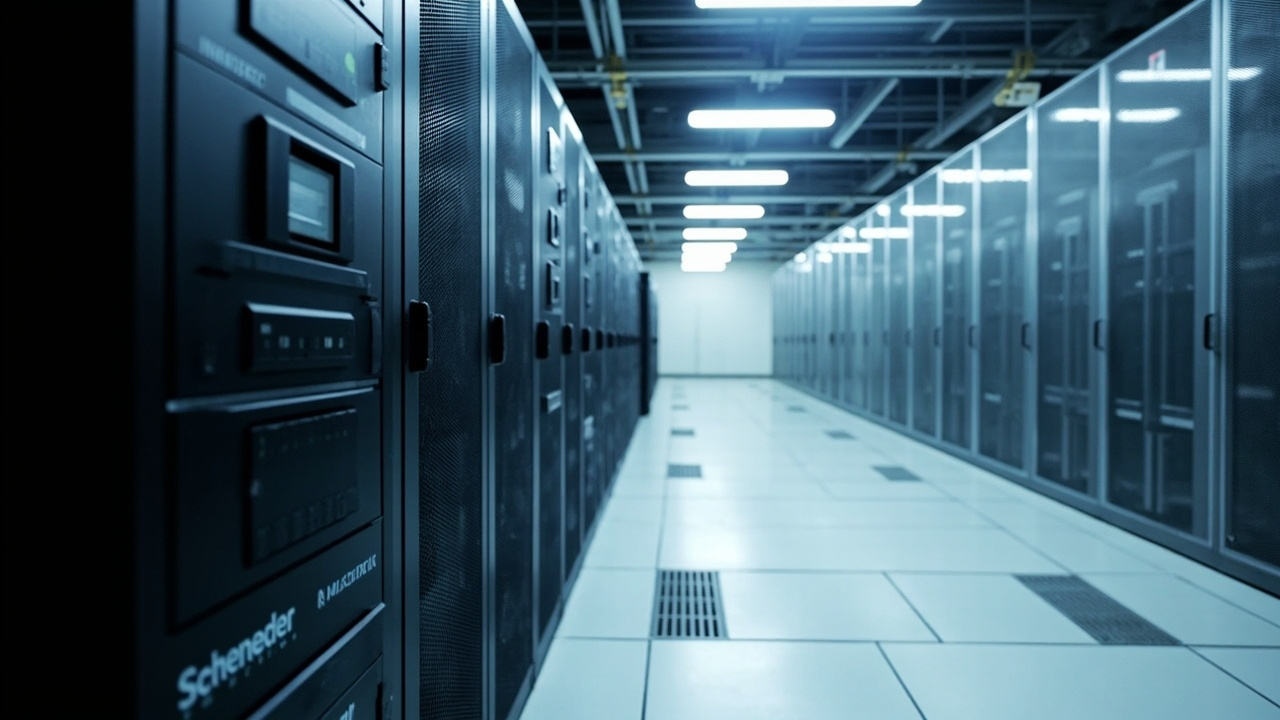
The choice between UPS and cooling technologies stopped being a generic decision several years ago: IT load density (kilowatts per rack) is the variable that has the greatest impact on the sizing, operational cost, and useful life of both subsystems. A room with 5 kW per rack servers cools comfortably with air; a room with AI clusters at 40 kW per rack needs liquid. Between those two extremes there is a gray zone where the decision depends more on growth projection than on current density.
This article describes the density ranges that define the choice of UPS and cooling, how they relate to each other (because the UPS defines how much energy it delivers and the cooling how much energy it dissipates), which technologies dominate each segment, and the criteria for sizing correctly without over-investing or falling short. The goal is for the reader to finish with a concrete decision map for their target density.
The density map: from 5 kW to 80 kW per rack
Four density ranges define the universe of UPS and cooling you need.
The first, from 5 to 10 kW per rack, is the historical enterprise operation range: typical 1U servers, switches, storage. The dominant UPS is online double-conversion of 20 to 100 kVA per unit; cooling is perimeter CRAC (Computer Room Air Conditioning) with chilled water or direct expansion.
The second range, from 10 to 20 kW per rack, appears with consolidation and virtualization: cabinets with higher compute density. Here the modular online double-conversion UPS begins to replace the traditional one, and cooling migrates to in-row systems or rear-door heat exchangers.
The third range, from 20 to 40 kW per rack, is where the convergence between compute and cooling changes paradigm. AI clusters with GPU (Graphics Processing Unit, a chip originally for graphics but today used massively for AI model training) enter this segment, along with dense all-flash storage. The high-capacity modular UPS (300 kVA to 1.2 MVA per unit) dominates, and cooling migrates to active rear-door heat exchangers or direct cold plate on CPU/GPU.
The fourth range, from 40 to 80 kW per rack, is hyperscale and large model training territory: here the UPS remains high-capacity online double-conversion, but cooling migrates to immersion or direct liquid cooling to the chip (DLC).
How the UPS choice conditions the cooling choice
There is an inverse relationship that many projects ignore: the higher the density, the greater the cooling efficiency, but the more heat to dissipate per square meter. An online double-conversion UPS has an efficiency of 93% to 96% (it loses 4% to 7% as heat). A modular online double-conversion UPS with eco mode (operating mode that prioritizes efficiency over isolation) reaches 98% to 99% at medium load, but loses that advantage at full load. Multiplied by 1 MW of IT load, that 2 to 3 percentage point difference is between 20 and 30 kW of additional heat that the cooling system must dissipate.
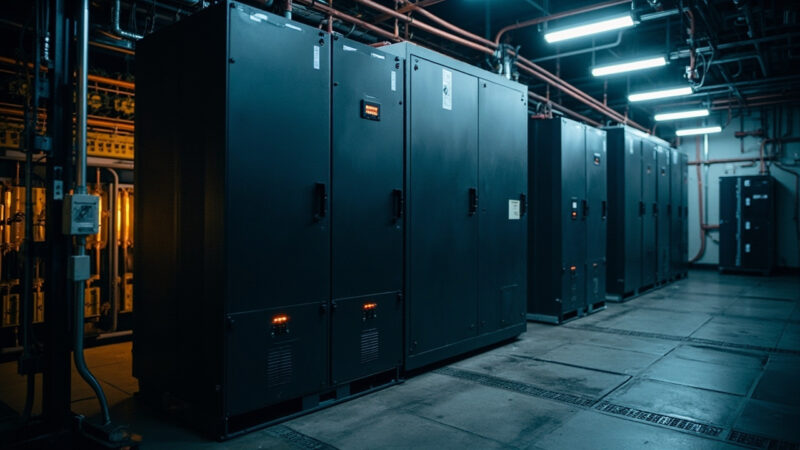
The second relationship is the footprint: a 500 kVA modular online double-conversion UPS occupies 1.5 to 2 square meters of floor space and weighs between 800 and 1,500 kg. A rotary UPS (UPS based on a rotating motor-generator, used for loads that do not tolerate even micro-outages) for the same power occupies 8 to 12 square meters and weighs between 4,000 and 7,000 kg, which requires reinforced floor and limits placement in the room. In data centers where footprint is expensive, the rotary UPS is discarded even though it offers greater electrical robustness.
UPS technologies by target density
Three families dominate the UPS market for data centers in 2026:
Cooling technologies by target density
Five families dominate the data center cooling market in 2026:
Decision table by density range
Common mistakes when sizing UPS and cooling together
Four mistakes concentrate most of the decisions that get reviewed at two years.
How to start if you are evaluating your project
Three questions filter 90% of the cases.
Answering these three questions before quoting avoids 80% of the decisions that get reviewed at 24 months.
Sources
[1] ASHRAE — Technical Resources (thermal management guidance) — https://www.ashrae.org/technical-resources
[2] TIA-942-C — Telecommunications Infrastructure for Data Centers — https://tiaonline.org/product/tia-942-c/
[3] IEEE — Institute of Electrical and Electronics Engineers — https://www.ieee.org/
Want to master this?
Noxtel Academy →