PDU with per-outlet metering: why every outlet should have its own ammeter
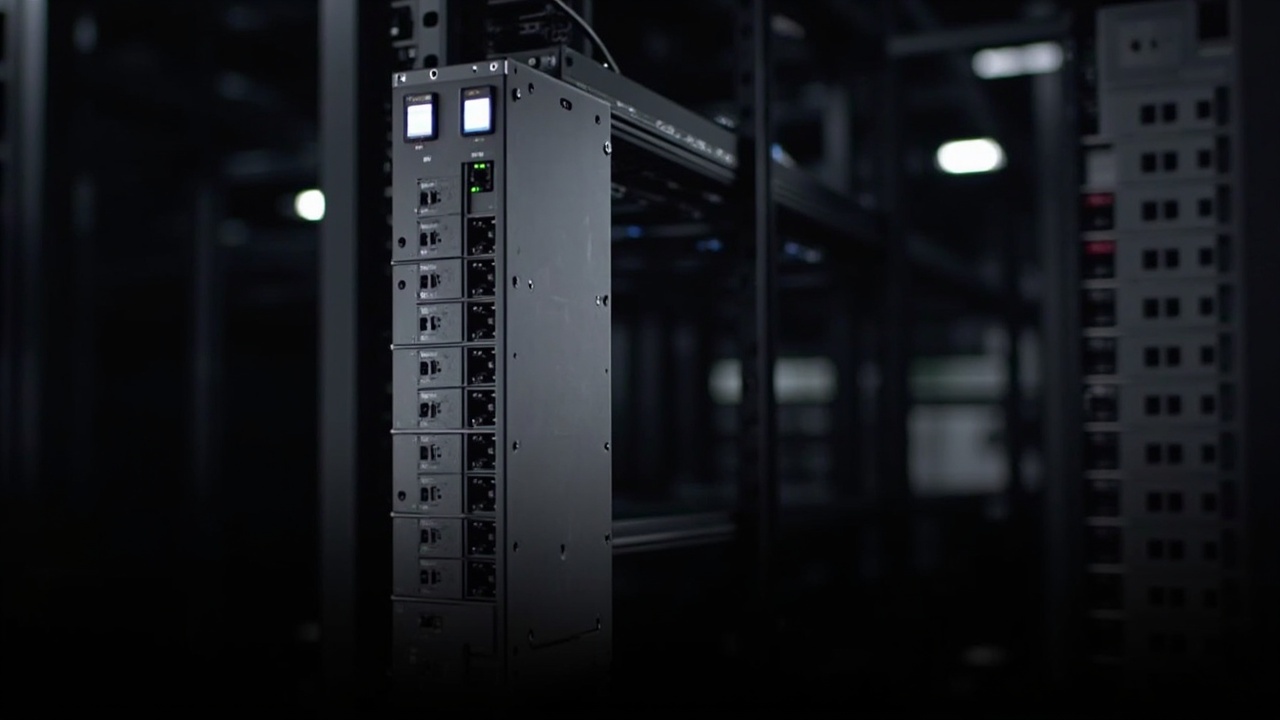
A PDU (Power Distribution Unit, power distribution unit) with per-outlet metering is a smart PDU that measures power consumption, current, voltage, and power factor at each individual outlet, not only at the unit’s total input. The operational difference is bigger than it looks at first glance: moving from aggregate metering to per-outlet metering changes load visibility, early problem detection, and capacity planning capability.
This article describes what technical difference exists between a basic PDU and a PDU with per-outlet metering, why it matters in operation, when the investment pays for itself, what metering topologies exist, and what mistakes are made when choosing. The goal is for the reader to finish with a clear criterion to decide whether their operation needs the jump or whether input-level metering is enough.
What difference exists between a basic PDU and one with per-outlet metering
A basic PDU measures (if at all) total consumption at the input: how many amps come in, what voltage, what total power. A PDU with per-outlet metering measures, at each C13 or C19 outlet, the individual consumption of the connected equipment. This lets you answer questions that aggregate metering cannot: which specific server is drawing more than expected, whether a PDU has real margin on the occupied outlets or is at its limit, or whether a newly added piece of equipment is causing phase imbalance.
The jump in granularity is not trivial. A PDU with per-outlet metering typically costs between 2x and 3x what a comparable basic PDU (aggregate metering) costs. For an operation of 20 racks with two PDUs per rack, that is between USD $40,000 and $60,000 (approx. $700,000–$1,050,000 MXN at 17.5 MXN/USD, verify Banxico FIX on publication day) in additional hardware alone. The relevant question is whether the additional visibility translates into operational savings, incident prevention, or better planning.
Why per-outlet amperage matters
Three technical reasons justify the investment.
The first is the detection of unbalanced loads: a three-phase PDU (three-phase power feed for load balancing) with 24 outlets can have an imbalance of 30% to 40% if equipment is connected without planning. Imbalance degrades efficiency, trips breakers (thermomagnetic switch) on the most loaded phase, and shortens cable service life. Without per-outlet metering, detecting the imbalance requires manual measurement with a clamp meter at each outlet, a task that nobody executes preventively.
The second reason is the early detection of impending failures: a server with a degrading power supply (from age or a failing capacitor) typically increases its consumption between 10% and 25% in the months before the failure. Per-outlet metering detects this trend weeks before the server goes down, allowing scheduled replacement instead of emergency response.
The third reason is real capacity planning: when you know which PDU has how much margin on which outlets, you can place a new piece of equipment without fear of tripping the breaker on the saturated phase, and you can identify the PDUs that are at 70% or 80% of capacity to replace them before they become the bottleneck of the next deployment.
Cases where the ROI is immediate
Four scenarios make the investment pay back in less than 18 months. The first is the operation with high equipment turnover (more than 20% annually): each equipment change requires rebalancing loads, and without per-outlet visibility it is done late and poorly. The second is the operation with mixed loads (servers, storage, network) on the same PDU: balancing resistive and inductive loads is impossible to optimize without measuring. The third is the data center that already had an overload incident: the avoided cost of a single incident (typically between USD $20,000 and $100,000 — approx. $350,000–$1,750,000 MXN at 17.5 MXN/USD, verify Banxico FIX on publication day — in downtime and response) pays the investment immediately. The fourth is the multi-client operation (colocation): measuring per-outlet consumption enables precise per-client billing, eliminating disputes and enabling fairer rates.
Metering topology comparison
Four granularity levels exist in the market, with marked differences in cost and functionality:
| Topology | What it measures | Relative cost | Ideal use case |
|---|---|---|---|
| No metering (basic PDU) | Nothing, only distributes power | Low | Auxiliary loads, office, non-critical racks |
| Input metering (PDU with meter) | Total aggregate of the PDU | Medium | Small operation with low equipment turnover |
| Per-outlet metering (monitoring) | Each individual outlet, without actuation | Medium-High | Production data center with operational visibility |
| Per-outlet metering + switching | Each outlet + remote on/off capability per outlet | High | Operation with remote management, remote commissioning, high turnover |
The choice depends on the operating model. An operation that requires remote on/off of loads (remote commissioning of servers, scheduled restart, off-hours energy savings) needs the fourth category. An operation that only wants visibility is well served by the third.
Common mistakes when choosing a PDU with metering
Five mistakes account for most of the decisions that get revisited at the two-year mark. Recognizing them before buying avoids expensive rework.
- Buying per-outlet metering without verifying that the management software supports the APIs needed for integration with DCIM (Data Center Infrastructure Management, infrastructure management software) or the existing monitoring tools: a smart PDU without integration is just an expensive PDU.
- Undersizing current capacity: many metering PDUs are sold in 16A, 24A, or 32A versions; underestimating growth leads to replacing the entire PDU in 3 years.
- Ignoring measurement accuracy: economy PDUs measure with ±3% to ±5% error, enough for general estimates but insufficient to detect fine trends or to bill; data-center-grade units offer fiscal/billing accuracy (Revenue Grade of ±1% or ±0.5%), indispensable for transparent sub-billing in colocation.
- Not planning the management network: smart PDUs need their own Ethernet network (out-of-band, off the production data network) so they do not share traffic with the data network.
- Buying by brand without comparing the software ecosystem: the cheapest PDU with poor management software ends up costing more in operational time.
How to decide whether your operation needs the jump
Three questions filter 90% of the cases. First: do you have more than 30 racks in production with equipment turnover greater than 10% annually? If yes, per-outlet metering pays for itself. Second: have you already had any incident from overload, imbalance, or lack of load visibility? If yes, the investment is mandatory. Third: do you operate a multi-client model where you need consumption-based billing? If yes, per-outlet metering is the only technically defensible way to bill. If you answered no to all three, a PDU with aggregate metering is enough and the per-outlet investment can be deferred.
Sources
[1] Vertiv — Products overview — https://www.vertiv.com/en-us/
[2] TIA-942-C — Telecommunications Infrastructure for Data Centers — https://tiaonline.org/product/tia-942-c/
[3] IEEE — Institute of Electrical and Electronics Engineers — https://www.ieee.org/
Want to master this?
Noxtel Academy →