What It REALLY Costs to Build a Data Center in Mexico in 2026
The question every IT director or CFO ends up asking when evaluating building their own data center is: what does it really cost? The honest answer is that it depends on a dozen technical and commercial variables that most initial quotes do not include. This article breaks down investment ranges with Mexican market figures from 2026 and the variables that change the final result by 30% or more.
The ranges are in US dollars because 85% of the critical equipment is imported, and the exchange rate is the dominant financial variable. Conversion to Mexican pesos at the spot exchange rate at the time of quotation.
CapEx (initial capital expenditure) Range per kW by Tier
CapEx per kW (kilowatt) of IT load is the industry standard metric for comparing projects. In Mexico, the 2026 market ranges are:
- Tier II with N+1 redundancy: USD 8,000 – 12,000 per kW of IT load. Applies to sites where occasional downtime is tolerable. This is the range for SMB (small and medium business) projects and backup sites.
- Tier III with concurrent maintainability: USD 12,000 – 18,000 per kW. This is the range for most corporate projects in Mexico, including manufacturing, retail, financial services, and government sites.
- Tier IV with fault tolerance: USD 18,000 – 28,000 per kW. This is only justified for carrier operators, cloud providers, or industries where the cost of downtime exceeds six figures per hour.
A typical 500 kW Tier III project (averaging 8 kW per rack across 60 racks) ranges between USD 6 and 9 million in total CapEx. A Tier IV project of the same capacity is between USD 9 and 14 million. These figures do not include land or building construction if it is a greenfield project (new construction from scratch); they only include the critical interior infrastructure.
The six components that make up 90% of the cost
Any Mexican data center project distributes its CapEx into six large blocks. The proportion varies by Tier and location, but the order is consistent:
- Electrical system (UPS, generators, transformers, distribution): 30-40% of CapEx. Includes UPS (Uninterruptible Power Supplies) in 2N or N+1 configuration, parallel diesel generators, isolation transformers, distribution panels, and medium and low voltage cabling.
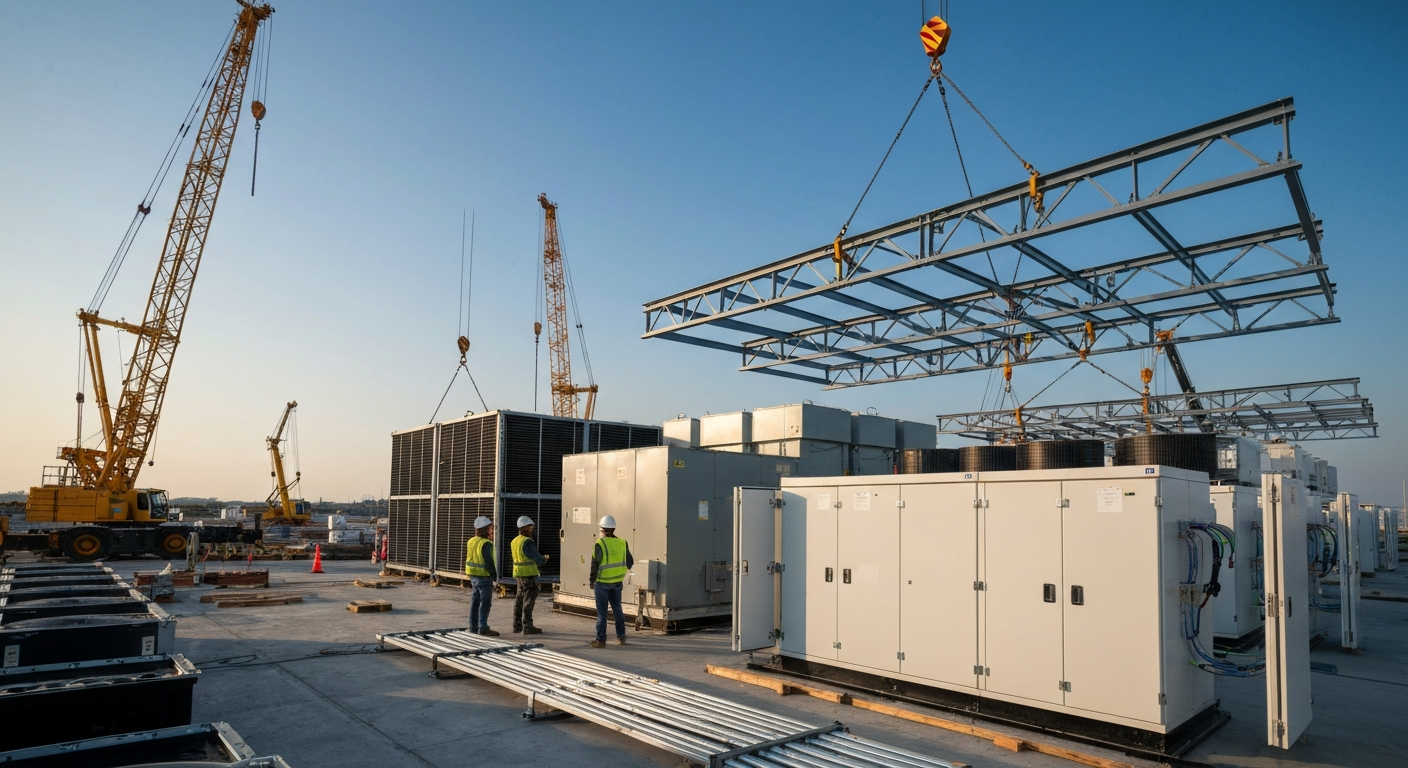
- Mechanical system (chillers, CRAC/CRAH, piping): 15-22% of CapEx. Redundant precision cooling, chillers, pumps, piping, water treatment systems.
- Racks, structured cabling, and patch panels: 8-12% of CapEx. 42U racks, Cat6A or OM4/OM5 fiber cabling, cable organization.
- Physical security and fire detection/suppression: 6-10% of CapEx. Biometric access control, CCTV, very early smoke detection (VESDA, Very Early Smoke Detection Apparatus), clean agent gas or water mist suppression.
- DCIM (Data Center Infrastructure Management) and monitoring: 4-8% of CapEx. Platforms such as Schneider EcoStruxure, Vertiv Trellis, Nlyte, or Sunbird.
- Civil works and raised floor finishes: 10-15% of CapEx. Raised floor, firewalls, seals, epoxy paint, detection and suppression system.
Variables that change the cost by 30% or more
There are five technical and site variables that can move CapEx 30% up or down from the base range:
- Density per rack: moving from 8 kW to 25 kW per rack is not linear. The cooling system, electrical distribution, and raised floor weight change specifications. A site with 25 kW per rack can cost 40% more per kW than one with 8 kW.
- Power availability in the area: if the quality of CFE’s supply is poor (frequent voltage variations or micro-outages), the design requires a dual feed, UPS with greater autonomy, and generators with additional redundancy. This can add 15-20% to the electrical block.
- Altitude above sea level: Querétaro and Guadalajara are at 1,800-2,000 meters. Lower air density reduces chiller efficiency and requires oversizing the mechanical system by between 5% and 10%.
- Free cooling capacity: the number of hours per year that the outdoor temperature allows for free cooling (without chiller consumption) defines the operational TCO. In Querétaro, free cooling accounts for 30-40% of the year. Maximizing this variable reduces annual electrical OPEX (operating expenditure) by between 20% and 30%.
- Tier certification vs. self-declaration: a site designed and built with Uptime Institute supervision for formal certification costs 8-15% more than the same self-declared Tier III site. The difference is justified if you need the certification to sell services to enterprise clients.
Comparison with regional hyperscaler: when building no longer makes sense
Before committing to a CapEx of USD 6 to 14 million, it is advisable to compare with what hyperscalers (large-scale cloud operators such as AWS, Microsoft Azure, Google Cloud) offer in their Mexico region. Hyperscaler Mexico regions available in 2026 include:
- Microsoft Azure Mexico (central region, available).
- Google Cloud Mexico (Querétaro region, announced 2024).
- AWS Mexico (commercial presence, with services in US regions).
- Oracle Cloud Mexico (Monterrey region operational).
The decision threshold is clear: if your IT load fits into a hyperscaler with acceptable latency and data can reside in the Mexico region, the monthly hyperscaler OpEx is lower than the OpEx of your own site when the site does not exceed 200-300 kW of load. Below that threshold, building is no longer financially justified. Above that threshold, the economics change.
What is never in the initial quote
There are five costs that initial quotes consistently omit and that the client ends up paying:
- Independent third-party commissioning (Cx): USD 80,000 – 250,000 depending on the site size. Without independent Cx, there is no valid Tier certification.
- Operations staff training: USD 15,000 – 60,000 for a team of 4-6 technicians certified in specific systems.
- Critical spare parts inventory for 24 months: USD 40,000 – 120,000. UPS modules, filters, control cards, sensors. Without this inventory, a single failure event can shut down the site for weeks.
- Specific insurance policies: standard property policies exclude data center equipment. Specific coverage is required with insurers such as Chubb, AIG, or Zurich. USD 25,000 – 80,000 annually.
- Reserve for the first corrective commissioning: 5-8% of CapEx as a reserve for corrections detected in the first 12 months of operation.
A project of USD 7 million ends up costing USD 8.5 million in its first year of life if these five blocks are included. Quoting without them is quoting incorrectly.
Sources
[1] Uptime Institute — Global Data Center Survey and Research Reports: https://uptimeinstitute.com/resources/
[2] Turner & Townsend — Data Center Cost Index Insights: https://www.turnerandtownsend.com/insights
[3] Cushman & Wakefield — Global Data Center Market Comparison: https://www.cushmanwakefield.com/en/insights/global-data-center-market-comparison
[4] TIA — TIA-942 Telecommunications Infrastructure Standard for Data Centers: https://tiaonline.org/products/tia-942/
[5] IEEE — IEEE 1100 Recommended Practice for Powering and Grounding Electronic Equipment: https://standards.ieee.org/ieee/1100/7199/
[6] Wikipedia — Data center: https://en.wikipedia.org/wiki/Data_center
Want to master this?
Noxtel Academy →