What is a PDU (Power Distribution Unit) and why it is not the same as a UPS
Confusing a PDU with a UPS causes more preventable outages than almost any other data center design error. The PDU distributes electrical power; the UPS stores it to keep your load alive during an outage. They are complementary functions, never interchangeable. If your operator assumes the PDU “will hold the load while the generator starts,” you’ll discover the error at the worst moment: with hours of downtime and an enterprise client questioning your DRP.
What is a PDU (and what it is not)
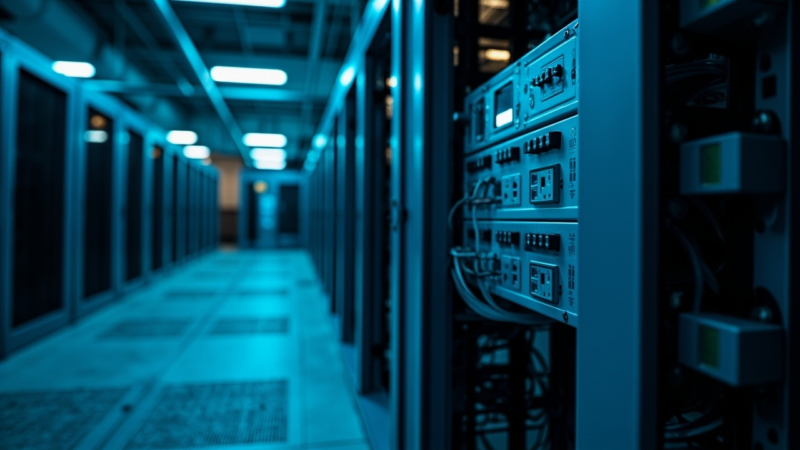
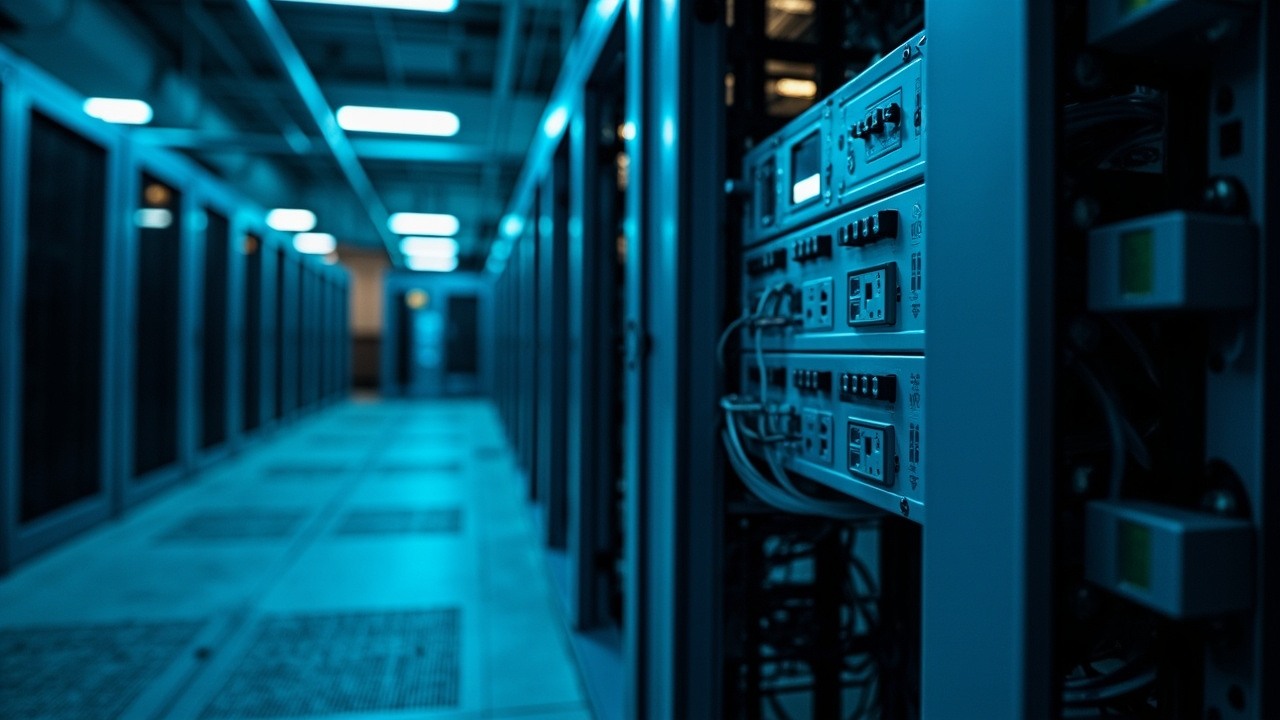
A PDU (Power Distribution Unit) in a data center is a rack-mounted device (typically 0U vertical at the rear of the rack, or 1U/2U horizontal) that takes the power arriving from the branch circuit and distributes it to multiple outlets for the servers, switches, and other rack equipment.
A PDU does three things, and only those three:
- Distributes: converts a high-amperage circuit (typically 30A, 50A, or 60A) into multiple 15A-20A or C13/C19 outlets for equipment.
- Monitors (in metered and monitored versions): measures current, voltage, active power (kW), and power factor per outlet or per circuit. This allows you to know if a breaker is at 80% of its capacity and prevent trips.
- Switches (in switched versions): allows remote activation or deactivation of outlets. Useful for restarting an unresponsive server, or performing an orderly rack shutdown during a prolonged UPS failure.
What a PDU does NOT do: it does not store energy, does not condition the waveform, does not generate backup power, does not protect against sustained voltage spikes, does not synchronize with a generator. If what you need is to keep your load alive during an outage, you need a UPS, not a PDU.
What is a UPS (and why it is not a glorified PDU)
A UPS (Uninterruptible Power Supply) in a data center is a system that takes power from the service entrance, converts it to DC to charge a battery bank, and converts it back to clean AC to power the load. In normal mode, the load passes through the UPS with very little loss. When the service entrance fails, the batteries take over without the load noticing (typical transfer time: 0 to 4 ms, depending on topology).
A UPS does four things a PDU cannot do:
- Conditions power: filters harmonics, regulates voltage against spikes and sags, protects against transients. The UPS output is pure sine wave, stable, isolated from CFE grid quality.
- Stores energy: the battery bank (typically VRLA, lithium, or flywheel) gives you between 5 and 30 minutes of autonomy, depending on sizing. Enough for the diesel generator to start and stabilize, or to perform an orderly server shutdown if the generator doesn’t kick in.
- Synchronizes with generator: modern UPS units have remote start signaling and sync input so that, when the generator enters and stabilizes, the UPS transfers the load without additional interruption.
- Isolates the load from the grid: the load never sees the service entrance directly. This protects against CFE failures, distribution network switching spikes, and power quality events that in Mexico (with its distribution infrastructure) are more frequent than in countries with a more robust grid.
How they connect in a real data center
In a typical site, the power chain is:
- CFE / public grid arrives at the site in medium voltage (13.8 kV, 23 kV, or 34.5 kV).
- Transformer reduces to low voltage (220V/127V three-phase or 480V/277V three-phase).
- Low-voltage switchgear with main breakers, ATS (Automatic Transfer Switch) that switches between CFE and diesel generator.
- UPS (one or several in parallel) takes the power, filters it, stores it in batteries, and delivers it clean to the load.
- Floor PDU (sometimes called site PDU, do not confuse with rack PDU) reduces current and distributes it to rack PDUs in each row.
- Rack PDU (the one typically called simply PDU in jargon) distributes power to servers, switches, and other equipment inside the rack.
The confusion between the two PDUs and the UPS generates RFPs where someone asks for “a PDU with 30 minutes of autonomy,” which doesn’t exist. Autonomy comes from the UPS, not the PDU.
The 3 most common errors when confusing them
- Sizing the UPS by the capacity of the PDU instead of the actual load. A metered PDU reporting 8 KW does not contemplate transient spikes (inrush when turning on servers or the ramp-up of GPUs), which double consumption for seconds. If the UPS is overloaded and goes to bypass, you risk an outage. Rule: size the UPS at 1.5X sustained peak load.
- Assuming a monitored PDU replaces a BMS electrical system. The PDU measures consumption per outlet, but does not analyze power quality (harmonics, transients, or power factor) nor control upstream switches. For that you need a power quality meter before the UPS. Confusing them is designing blind.
- Ignoring that a single PDU is a SPOF (Single Point of Failure). If the PDU fails, your entire rack goes down even if the UPS operates correctly. The standard in critical environments requires A+B redundancy: two PDUs per rack connected to independent circuits and servers with redundant power supplies.
When you need a smart PDU vs a basic one
Not all racks need a smart PDU. The decision depends on the SLA and the cost of unavailability:
- Basic PDU (no monitor or switch): sufficient for non-critical racks (development, staging, QA). Cost: between 200 and 600 USD per rack.
- Metered PDU (circuit monitoring, no remote switch): necessary when you want load visibility per rack without paying for switched. Useful in sites where unavailability is expensive but remote operation is not essential. Cost: between 800 and 2,500 USD per rack.
- Monitored + switched PDU: essential in enterprise data centers with multiple clients and measured SLA. Allows remote equipment restart, orderly shutdown during prolonged UPS failure, and real load measurement per outlet. Cost: between 1,500 and 5,000 USD per rack, depending on brand and outlet density.
The verdict
A PDU is not a UPS, a UPS is not a generator, and a generator is not a redundant service entrance. Each fulfills a distinct function in the power chain, and confusing them at the design stage is the root cause of outages that cost between 8 and 24 hours of downtime and between 200,000 and 2,000,000 pesos in penalized SLA. You understand the correct chain when you know what each one does and why the other cannot substitute it. If your provider offers you a “PDU with autonomy,” leave the meeting. They don’t know what they’re talking about, and in a data center that’s an existential problem.
Sources
- TIA-942-B-2023 — Telecommunications Infrastructure Standard for Data Centers (Section 5: Power Infrastructure) — https://tiaonline.org/standards/
- Uptime Institute — Tier Classification System (redundancy N+1, 2N, 2N+1) — https://uptimeinstitute.com/resources/asset/tier-classification-system
- IEEE 1100-2020 — Powering and Grounding Electronic Equipment (EMI mitigation, power quality) — https://standards.ieee.org/standard/1100
- NFPA 70 (NEC) 2023 — Article 645 (Information Technology Equipment) and Article 700 (Emergency Systems) — https://www.nfpa.org/codes-and-standards/all-codes-and-standards/list-of-codes-and-standards/detail?code=70
- ASHRAE TC 9.9 — Thermal Guidelines for Data Processing Environments (5th Edition, 2021) — https://ashrae.org/technical-resources/ai-data-center-framework/energy-and-thermal-efficiency
Want to master this?
Noxtel Academy →