UPS Preventive Maintenance: Step-by-Step Checklist
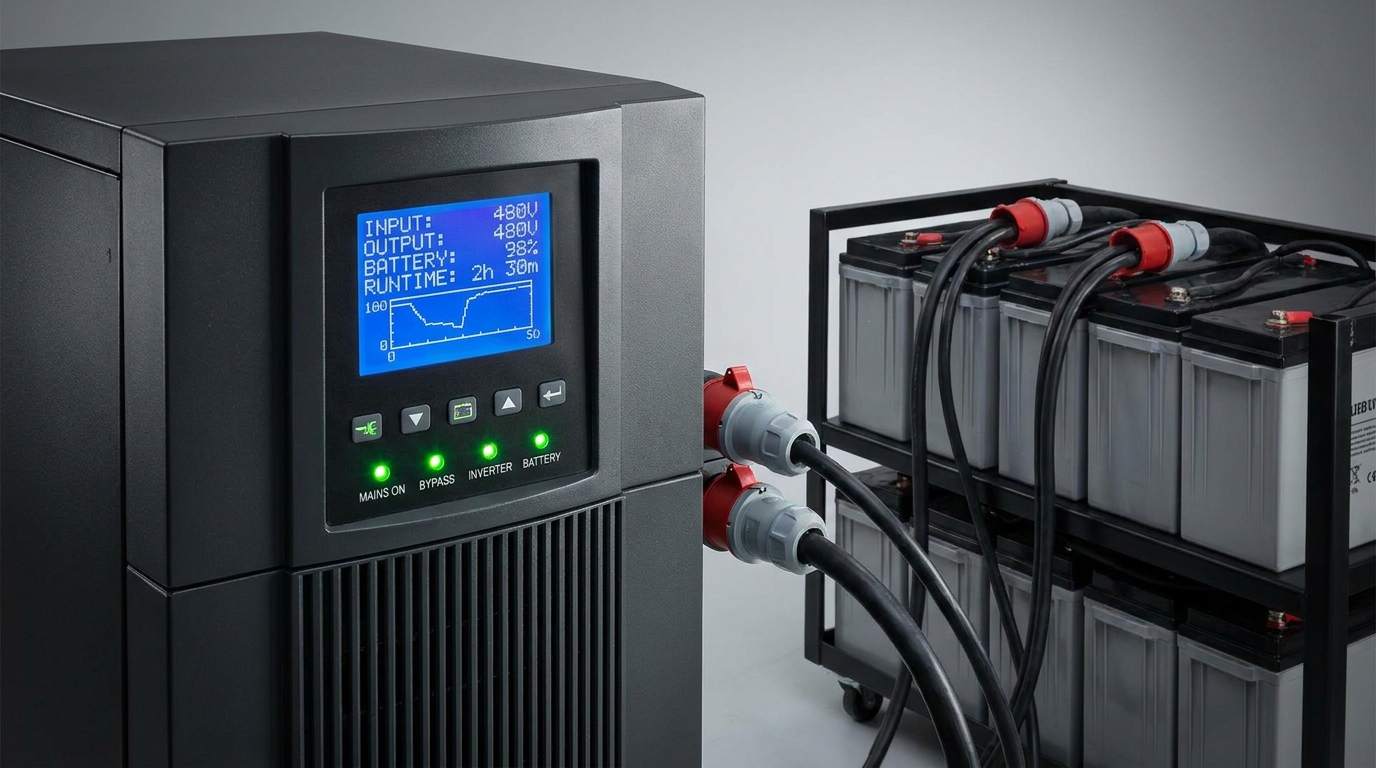
Your UPS works perfectly. Until the day it does not. The UPS system (Uninterruptible Power Supply) is the last line of defense between your operations and a power outage. If it fails, there is no immediate plan B. A UPS without preventive maintenance has a 40% higher probability of failure during a power event.
And in Mexico, power events are not rare: fluctuations, micro-outages, and blackouts occur daily in most cities.
Recommended frequency
Visual inspection — weekly, internal staff. Battery measurement — monthly, certified technician. Discharge test — quarterly, specialist. Full maintenance — semi-annual, manufacturer or integrator. Battery replacement — every 3 to 5 years, manufacturer.
Preventive maintenance checklist
1. Visual inspection (weekly). LED indicators and display without active alarms, fans operating without abnormal noise, no burning smell or overheating, clean area without dust or objects blocking ventilation, cables and connections without visible damage, room temperature between 20°C (68°F) and 25°C (77°F).
2. Battery measurement (monthly). Batteries are the most critical component and the one that fails most: voltage per cell between 2.25 and 2.27 V in float, internal resistance compared with factory values (increase greater than 20% means replacement), battery temperature (every 10°C above 25°C halves useful life), corrosion on terminals (clean with bicarbonate solution if there is sulfation), swelling or leakage (immediate replacement).
3. Discharge test (quarterly). This is the real test: does it work when you need it? Partial test — disconnect AC power for 5 to 10 minutes. Monitor battery voltage, real backup time, temperature. Record time until low-battery alarm. Compare against original manufacturer specifications. Document everything in the maintenance log. If the UPS does not hold even 60% of the specified time, the batteries need replacement.
4. Full maintenance (semi-annual). This requires a specialized technician: internal cleaning with compressed air (equipment off and discharged), DC bus capacitor verification, voltage and current sensor calibration, UPS firmware update, transfer-to-bypass test, alarm and remote monitoring system check, power connection torque verification per spec.
Expensive mistakes
Ignoring alarms: the alarm has been sounding for a week — until one day the UPS turns off. Not recording temperatures — the silent killer of batteries. Mixing old and new batteries — the new one degrades at the pace of the old. Not testing under load — a UPS that is never tested is an empty promise. Buying generic batteries — saving 30%, risking 100% of your operation.
When to replace the UPS itself
Not only batteries expire. The UPS itself has a useful life: more than 10 years of operation (electronics degrade), no spare parts available (obsolete), load growth (you need more capacity than it can provide), efficiency below 90% (modern UPS reach 96 to 97%), and no remote monitoring support (you cannot know if it fails until it is too late).
The real cost of not maintaining
Consider these numbers: preventive maintenance cost per year — USD $750 to $1,750 (approx. $13,000 to $30,000 MXN at 17.5 MXN/USD). Battery replacement cost — USD $1,150 to $4,600 (approx. $20,000 to $80,000 MXN). Unplanned outage cost (1 hour) — USD $2,800 to $28,500+ (approx. $50,000 to $500,000+ MXN). Cost of lost or damaged data — incalculable.
The math is simple. Preventive maintenance costs less than a single failure event.
Sources
[1] IEEE 1188-2005 — Recommended Practice for Maintenance, Testing, and Replacement of Valve-Regulated Lead-Acid Batteries — https://standards.ieee.org/ieee/1188/4776/
[2] Schneider Electric — UPS Preventive Maintenance Guide — https://www.se.com/us/en/product-subcategory/3780-preventive-maintenance/
[3] Vertiv — UPS Service and Maintenance — https://www.vertiv.com/en-us/services/
[4] Wikipedia — Uninterruptible Power Supply (background reference) — https://en.wikipedia.org/wiki/Uninterruptible_power_supply
Want to master this?
Noxtel Academy →