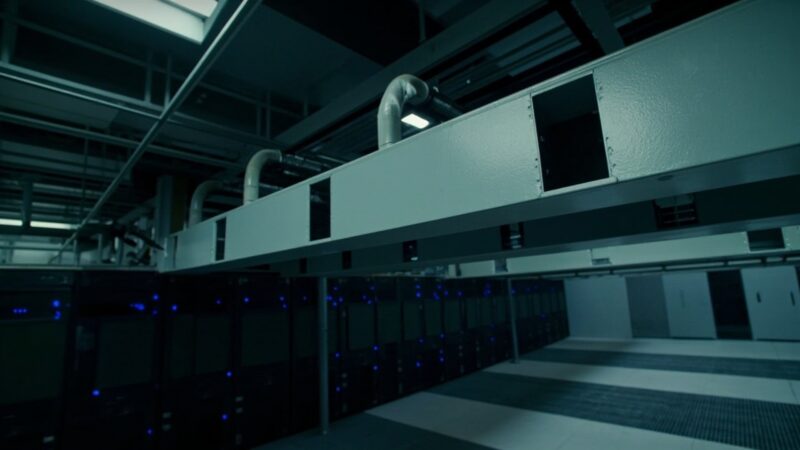
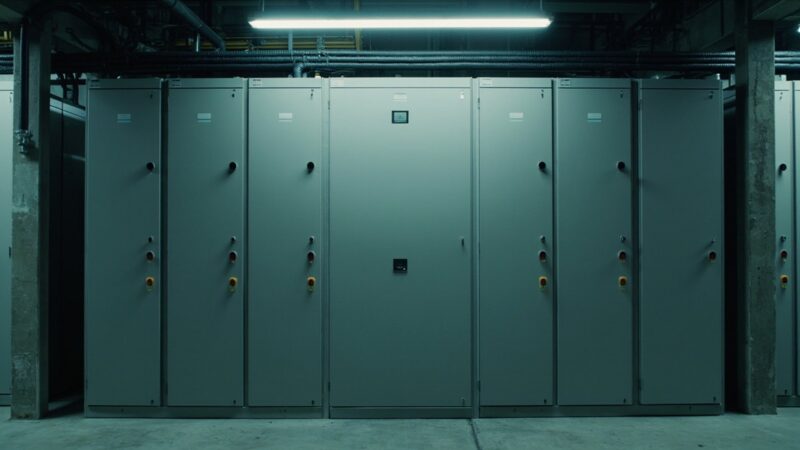
UPS commissioning: the startup sequence that decides if your Tier IV comes online

A Tier IV UPS installed in a room that has no power is still a Tier IV on paper. What separates a correct commissioning from one that only looks correct is the startup sequence, the tests that were run, and the documents that remain. And all three can be demanded: no press release is needed to ask for them.
This article draws on the startup manuals from Vertiv and Always On, the commissioning guide from Critical Power Resource, the ANSI/NETA standards, and the Uptime Institute Journal.
The startup sequence is not improvised
The Vertiv Liebert EXM manual documents startup in eight steps, and the order is not negotiable. You close the input breaker, the rectifier runs its sequence and the static bypass is enabled, you close the output breaker, you press Operate and the inverter turns on. After roughly one minute the inverter goes into service and the static bypass opens. Only in step eight is the battery breaker closed.
The Always On manual confirms the order and quantifies it: input, bypass, rectifier, wait 30 seconds for the DC bus to come up, close the battery breakers, start the inverter. The load transfers to the inverter output in approximately 7 seconds. In other words, the load starts on static bypass.
Why the batteries go last
There is a documented technical reason for that order. The Vertiv manual warns that if the UPS feeds a downstream transformer that was not supplied by the manufacturer, it must be placed on maintenance bypass in order to energize it, in order to mitigate the risk of inrush current.
The other reason is one of control sequencing: you wait for the DC bus to come up and for the low-battery indicators to go out before closing the breakers. Closing the batteries too early is the most common way to start a UPS badly, and the one nobody documents in the report because the equipment does turn on.
Bypass is where the UPS stops being a UPS
The Vertiv manual is explicit: in bypass operation, the load is not protected against power abnormalities such as spikes, sags and failures. And there is a second fact: with the UPS on maintenance bypass and powered off, parts of the system remain energized.
That is why the bypass procedure has to be rehearsed. If your maintenance plan depends on working in bypass, the question you have to be able to answer is not what equipment you have, but what criterion is followed to work with a partially energized system.
The Tier IV on the wall and the Tier IV in the room
Uptime Institute says it in writing in its Journal: the rigor associated with data center commissioning has little to do with its Tier level. The technical requirements of the commissioning team should not vary between levels: they must be equally rigorous for a Tier I as for a Tier IV. And it adds the rule that is the most uncomfortable: all critical components and systems must be tested in full.
In Level 4 of the Uptime standard that means tests with load banks on generators, UPS and battery banks at design and nominal capacity, with a minimum continuous operation of 8 hours. In Level 5 the script becomes explicit: load steps of 25, 50, 75 and 100 %, tests both with utility power and with generator, and load and temperature readings every 30 to 60 seconds.
The four documents you can demand today
The ANSI/NETA ATS-2025 standard defines the field tests and recommended inspections for assessing the suitability of electrical equipment before its initial energization. And ANSI/NETA ECS-2024, which replaced the 2020 edition, adds new commissioning-by-source sections, among them UPS and ATS. The framework for demanding the evidence exists and is normative.
The Critical Power Resource commissioning guide turns the standard into four concrete deliverables.
The reason it is worth demanding them is contractual: manufacturers condition the warranty on it. Always On is explicit: startup and commissioning tests must be carried out by factory-certified personnel or the warranty is void.
Altitude: the kW that are not on the nameplate
There is a design figure in the altitude table of the Vertiv manual: the equipment is specified up to 1,500 meters, and above that elevation there is a derating of up to 1 % of kW for every 100 meters of climb, up to 3,000 meters. Mexico City sits at 2,240 meters, which means about 7 percentage points less usable power.
Combined with the rule that commissioning verifies performance within standard and manufacturer tolerances, the conclusion is direct: a UPS energized and left at 100 % of its nameplate nominal in a site at 2,240 meters will never operate at its valid design point.
Sources
Want to master this?
Noxtel Academy →