The R-410A refrigerant your data center still uses: how many tons of CO₂ equivalent it is releasing into the atmosphere
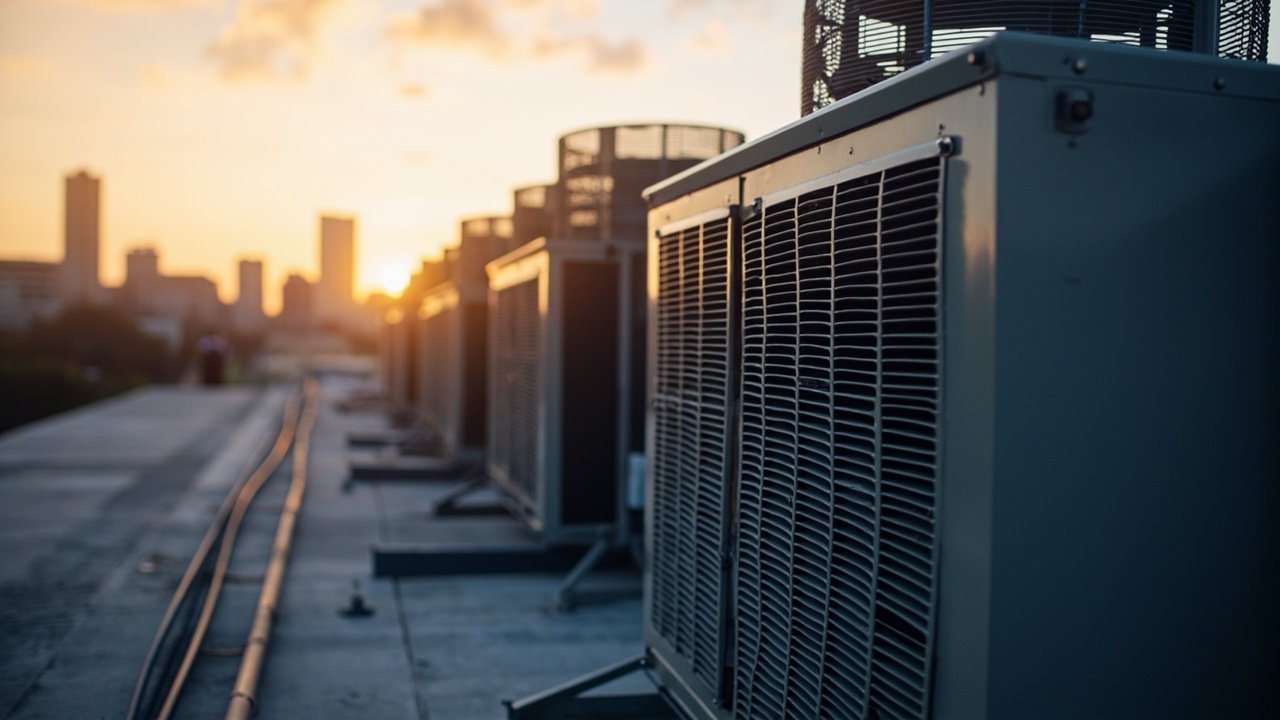
The question your air conditioning system already answered for you
If your data center uses CRAC units with direct expansion, there’s a high probability you are operating with R-410A as the refrigerant. That means every kilogram of refrigerant in your system has a Global Warming Potential (GWP) of 2,088 times that of CO₂, according to the AR4 values the U.S. EPA uses for regulation. A typical 20-ton CRAC unit charges between 22 and 28 pounds (10 to 13 kg) of refrigerant. Multiply that by the 20 CRAC units plus the two redundant chillers you have in your mechanical room, and the total mass of refrigerant in your site may be between three and five metric tons. If all of that leaked into the atmosphere in an uncontrolled way, the CO₂ equivalent would be similar to what a commercial aircraft engine emits on a transatlantic flight.
What the regulation that is already in force says
The American Innovation and Manufacturing Act (AIM Act) of 2020 established the framework for the phase-down of HFCs in the United States. Under the final rule of Section 103, since January 1, 2025 U.S. manufacturers can no longer produce new residential and light commercial equipment charged with R-410A. By January 2027, the prohibition extends to new data center refrigeration equipment above the 700 GWP threshold.
R-410A has a GWP of 2,088. That is well above the regulatory threshold. The replacements the industry is adopting are R-454B (GWP 466), R-32 (GWP 675), and, in some new applications, natural refrigerants such as R-1234yf or R-1234ze with a GWP below 10. The transition has already happened in manufacturing; what remains pending is what to do with the installed equipment.
The installed equipment trap
Equipment installed before the regulatory deadline may continue to operate and receive technical service with recovered or reclaimed refrigerant. That is the part your CRAC vendor probably already told you. What your vendor may not have told you is what is happening with the price and availability of reclaimed R-410A as global HFC production declines under the phase-down.
The structure of the HFC phase-down is an annual reduction of the production and import allocation. Every year less new R-410A enters the market, but the installed base remains large. The expected economic effect is upward pressure on the price of reclaimed refrigerant and, on sites with recurring leaks, on corrective maintenance cost. For a data center that changes equipment every 10 to 12 years, that pressure arrives exactly during the useful life cycle of the current equipment.
The concrete calculation for your site
To do the calculation you need three pieces of data you probably already have:
- Total mass of R-410A charged in the system, in kg. You will find it on the nameplates of each CRAC, chiller, or pumped refrigerant economizer.
- Annual leak rate, as a percentage of the total charge. For well-maintained systems, 1 to 3% per year is typical. For systems with recurring leaks, it can be 10 to 15% or more.
- Refrigerant GWP: 2,088 for R-410A, 466 for R-454B, 675 for R-32.
The formula is straightforward:
`CO₂ equivalent = Total mass charged (kg) × Annual leak rate (%) × GWP`
Concrete example: 4,000 kg of R-410A in the system (40 average CRACs with 100 kg each), annual leak rate of 5%, GWP 2,088:
- CO₂eq from annual leaks: 4,000 × 0.05 × 2,088 = 417,600 kg CO₂eq per year
That is what goes into the atmosphere from normal operational leaks on a medium-sized site. A single Airbus A320 on a transatlantic flight emits between 50 and 80 metric tons of CO₂eq per trip according to the ICAO Carbon Emissions Calculator. Your cooling system has a climate impact equivalent to five transatlantic flights every year, from leaks alone.
The calculation that matters for the board
What your client’s board will understand is the conversion to money. The social cost of carbon varies by methodology, but the most used ranges are between $50 and $200 per metric ton of CO₂eq. For the example above:
- 417 metric tons of CO₂eq per year × $50 = $20,850 per year in social cost of carbon
- 417 metric tons × $200 = $83,400 per year
If your client is publicly traded and reports to Science Based Targets, this calculation enters its Scope 1 emissions inventory (because the leaks are direct from its system). If it only reports Scope 2, this number is hidden in its inventory.
What EU Delegated Regulation 2024/1364 says
The European Union published in 2024 a regulation that requires data centers with more than 500 kW of installed IT power to report 24 sustainability indicators, including refrigerant composition and leak rate. Implementation began in September 2024. For a Mexican company with European operations or with European clients, this reporting becomes contractual even though the Mexican authority does not require it.
What the European report asks for is exactly what the calculation above does: document the mass, the composition, the leak rate, and the annual CO₂ equivalent. The difference is that in Europe the report is mandatory and verifiable, while in Mexico the calculation is rarely made.
Why this topic will stay in the conversation
Three factors converge to make data center refrigerants a permanent topic:
- The global phase-down continues. Every year less new R-410A is available. The price of reclaimed refrigerant rises. The cost of maintaining old systems rises with it.
- Mexican regulation advances slowly but it advances. SEMARNAT has published energy efficiency guidelines for commercial refrigeration systems that converge with international best practices. There is still no specific R-410A prohibition for data center equipment in Mexico, but the GWP regulatory framework for commercial air conditioning has been aligning with global trends.
- Corporate emissions reporting already includes this number. Companies with Science Based Targets commitments or reporting under the EU CSRD should already be documenting refrigerant leaks. The day a Mexican company with European clients has to consolidate its inventory, the R-410A number will appear.
What can be done before it becomes mandatory
For a site with R-410A installed, the options are:
- Improve the leak detection and repair program. 40 CFR Part 84 Subpart C rule 84.106 establishes that a leak above 30% of the annual charge must be repaired within 30 days. Documenting and maintaining that standard reduces annual emissions between 30 and 60%.
- Document the composition and mass of the system. That turns the number from “estimate” to “verified inventory,” which is what any regulatory report will require.
- Include the refrigerant change in the end-of-life planning of the equipment. If the current CRAC is 8 years old and you expect to replace it in 4, the transition to R-454B or R-32 can be done as part of the technology refresh, not as a separate project.
Sources
- U.S. Environmental Protection Agency (EPA). HFC Phase-Down Overview. https://www.epa.gov/climate-hfc-phase-down
- Power Solutions (May 2026). The R410A Refrigerant Transition in Data Center Cooling. https://power-solutions.com/2026/05/12/the-r410a-refrigerant-transition-in-data-center-cooling
- ASHRAE. Standard 15 — Safety Standard for Refrigeration Systems. https://www.ashrae.org/technical-resources/standards-and-guidelines
- European Commission (2024). Delegated Regulation 2024/1364 — Sustainability indicators for data centres. https://eur-lex.europa.eu/legal-content/ES/TXT/?uri=CELEX:32024R1364
- U.S. EPA. 40 CFR Part 84 Subpart C — Stationary Refrigeration and Air Conditioning. https://www.ecfr.gov/current/title-40/chapter-I/subchapter-C/part-84
Want to master this?
Noxtel Academy →