Stulz vs Vertiv Liebert: Precision Cooling Comparison for Small Data Centers
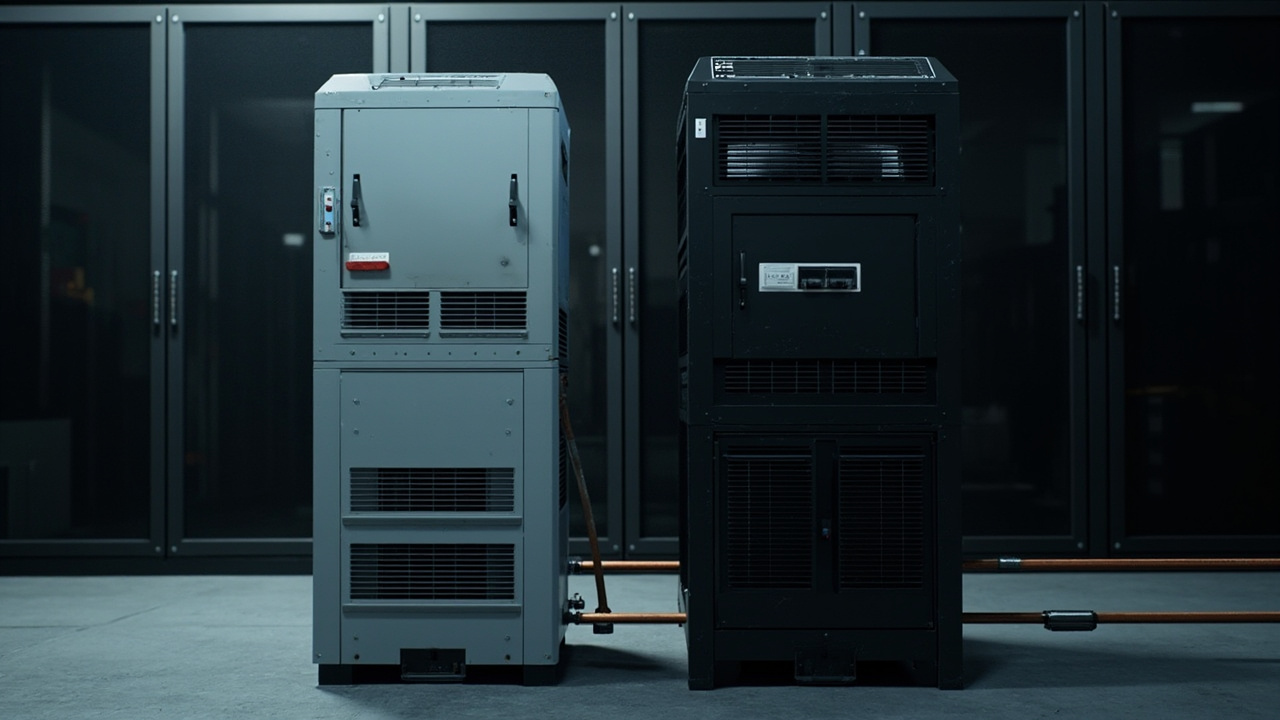
For a small or medium-sized data center (up to 200 kW of IT load), the two brands that dominate the Mexican precision cooling market are Stulz and Vertiv Liebert. Both are reliable, both have local representation, and both comply with ASHRAE TC 9.9. The difference lies in the design philosophy and the type of maintenance each one demands.
Choosing between them is not a question of quality — it is a question of operational profile. The decision changes depending on whether the data center has its own technical staff, relies on a maintenance contract, and whether the IT load will grow aggressively over the next three years.
Stulz CyberAir: the German approach to direct expansion
Stulz has operated its main plant in Hamburg for more than four decades, and that experience shows in the consistency of its portfolio. The CyberAir line — available in direct expansion (DX), chilled water, and free cooling versions — is designed for data centers of 20 to 200 kW per unit, with N+1 redundancy integrable at the factory. Its strong point is mechanical engineering: factory inverter compressors, electronic expansion valves, and proprietary control logic (Stulz C7000).
For operators who value fine control and traditional mechanical maintenance, CyberAir is hard to beat.
Vertiv Liebert CRV / LDS: the American modular approach
Vertiv inherited the CRV (computer room vertical) line and the LDS / CW series for water cooling from Liebert. Its recent evolution includes the Liebert PDX and PCW units, designed to couple with the Vertiv monitoring ecosystem (iCOM) and for high-density per-rack deployments.
Where Vertiv pulls ahead is in integration: the same vendor delivers UPS, PDU, monitoring, and cooling under a single console. For data centers that are growing and where control cabling starts to get complicated, that convergence translates into operational labor-hours.
Technical comparison
For an informed decision, these are the points to compare: capacity per unit — Stulz CyberAir reaches up to 200 kW in its large models; Liebert CRV/PCW operates in the 30-120 kW range per unit. Energy efficiency — both offer free cooling, but Stulz tends to present higher COPs in temperate climates; Vertiv compensates with more granular savings modes. Maintenance — Stulz uses industry-standard HVAC mechanical parts; Vertiv often requires OEM parts. This impacts on-site response time. Plant integration — Vertiv is strong if you already have Liebert/Geist UPS and PDU; Stulz is more neutral and integrates via standard Modbus/BACnet protocols. Initial cost — comparable in the 50-100 kW range. CyberAir is usually 8-15% more expensive in the high range, but with efficiencies that pay off in 3-4 years.
When each one makes sense
Stulz CyberAir is the natural choice when the data center is new, the technical staff has HVAC training, and a robust mechanical solution that lasts 15+ years is desired. Liebert is the natural choice when the data center already has the Vertiv ecosystem, when high density per rack is required, or when the comprehensive maintenance contract demands it as a requirement.
Do you need help with Stulz or Vertiv Liebert solutions?
At Noxtel we specialize in the design, supply, installation, and preventive maintenance of critical infrastructure for data centers. If you are comparing equipment, need to size a project, or require certified technical support for Stulz or Vertiv Liebert solutions, our engineering team is ready to help.
? Contact us today and schedule a consultation with the Noxtel team
Sources
[1] Stulz — CyberAir product page — https://www.stulz.com/en/products/precision-air-conditioning/cyberair
[2] Vertiv — Liebert CRV product page — https://www.vertiv.com/en-us/products-catalog/thermal-management/precision-cooling/
[3] ASHRAE TC 9.9 — Thermal Guidelines for Data Processing Environments — https://www.ashrae.org/technical-resources/bookstore/thermal-guidelines-for-data-processing-environments
[4] Wikipedia — Vertiv — https://en.wikipedia.org/wiki/Vertiv
Want to master this?
Noxtel Academy →