Liquid Cooling vs. Immersion: When Each Makes Sense for Your Data Center in Mexico
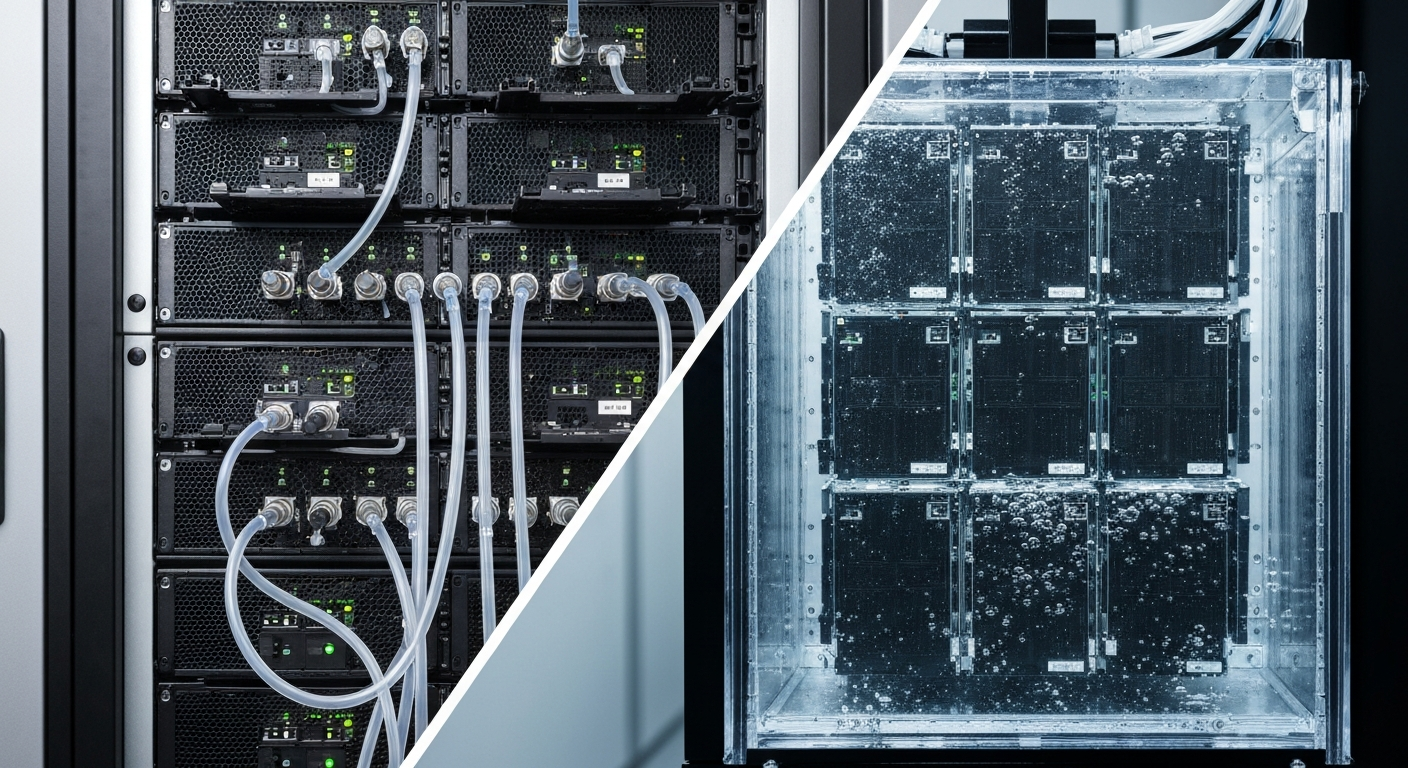
Once racks exceed 30 kW, air cooling stops being a technically reasonable option. Air density and specific heat impose a physical ceiling that no incremental improvement to CRAC units (Computer Room Air Conditioning, precision air-conditioning units) can overcome. This article describes the two liquid-cooling architectures available in 2026—direct-to-chip cold plates and immersion cooling—and the technical and operational criteria for deciding when each one makes sense.
The physical ceiling of air cooling
Air has a density of approximately 1.2 kg/m³ at sea level and a specific heat capacity that limits the amount of energy it can absorb per unit of volume before its temperature rises. With a temperature difference of 10°C (18°F) between the rack inlet and outlet, each cubic meter of air can carry roughly 12 kJ of energy.
Removing 50 kW from each rack requires moving an air volume that, in practice, demands flow velocities beyond what diffusers, containment grilles, and raised-floor plenums can support. The result is insufficient static pressure, localized hot spots, and eventually server throttling. The practical operating limit for air cooling is typically between 30 and 40 kW per rack in conventional designs.
Direct-to-chip cold plates (DLC, Direct Liquid Cooling)
A cold-plate architecture places a cooled metal plate directly on the chip or other high-heat components. A coolant flows through internal channels in the plate, absorbs heat, and carries it to an external heat exchanger, where the heat is dissipated to air, chilled water, or a free-cooling system that uses favorable outdoor conditions to reduce mechanical cooling load.
The operating characteristics of this architecture are:
- It handles rack densities from 50 to 100 kW, depending on the manifold design and coolant flow rate.
- It supports a gradual migration: operators can begin by cooling only the hottest chips while leaving the rest of the rack air-cooled.
- The coolant is usually a water-glycol mixture treated to prevent corrosion and biological growth.
- The critical point is the integrity of the connections and manifold: a fluid leak inside a rack with energized electrical equipment poses a serious operational risk.
Immersion cooling
Immersion cooling completely submerges computing modules in a dielectric fluid that does not conduct electricity. The fluid absorbs heat directly and far more efficiently than air. There are two operating variants:
- Single-phase immersion: the fluid remains liquid throughout the cycle. Pumps circulate it, and an external heat exchanger removes the heat.
- Two-phase immersion: the fluid boils on the surface of the components, and the vapor condenses in a heat exchanger at the top of the tank. Phase-change heat transfer is significantly more efficient.
The operating characteristics of immersion cooling are:
- It handles densities above 100 kW per rack, with documented production deployments at 200 kW and higher.
- It completely eliminates the need for air conditioning in the compute area, reducing the associated auxiliary electricity consumption.
- Dielectric fluid is expensive and requires specific management for service life, material compatibility, treatment, and final disposal.
- Replacing physical equipment in an immersion tank is operationally different from replacing equipment in a conventional rack; it requires dedicated procedures and staff training.
When each architecture makes sense
The choice between cold plates and immersion is not purely technical. It depends on the workload profile, target density, the operations team’s maturity, and long-term efficiency goals. A practical way to evaluate the options is:
- If the target density is between 30 and 60 kW per rack and the goal is a gradual transition from an existing site, cold plates with selective migration are usually the most operationally efficient option.
- If the target density exceeds 60–80 kW per rack, or if a new site is being built for compute-intensive workloads, immersion offers better energy and thermal economics in exchange for new operating procedures.
- If regulations or safety requirements restrict fluid handling near electrical equipment, cold plates with a closed-loop coolant circuit and leak detection are preferable.
What the fluid loop requires
A liquid-cooling architecture adds an operational dependency that air cooling does not have: the integrity of the fluid loop. This dependency requires:
- A water or dielectric-fluid treatment system, with monitoring of fluid quality and service life.
- Leak detection at the rack, row, and site levels, with automatic shutoff and safe drainage.
- Physical-equipment replacement procedures compatible with the fluid and manifold connections.
- Training for operations staff in fluid handling, including waste management and disposal.
- Continuous monitoring of flow, temperature, and pressure at every rack or tank.
A data center that adopts liquid cooling without investing in these five capabilities will end up with a system operating below its rated capacity and with failure rates above projections.
When air cooling is still sufficient
For sites with an average density below 20 kW per rack, well-designed air architectures with hot-aisle or cold-aisle containment remain the most cost-effective option. A move to liquid cooling should be justified by a specific density or energy-efficiency requirement, not by an argument about being modern.
The final decision should consider the total cost of ownership over five and ten years, not just the architecture’s initial cost. The specific figures depend on the design, local climate, and availability of free cooling, and they should be obtained from the system provider using a documented calculation methodology.
Sources
[1] ASHRAE — Technical Resources for Data Center Thermal Management: https://www.ashrae.org/technical-resources
[2] TIA — TIA-942 Telecommunications Infrastructure Standard for Data Centers: https://tiaonline.org/products/tia-942/
[3] Vertiv — Thermal Management Catalog (manufacturer reference): https://www.vertiv.com/
[4] Submer — Immersion Cooling Solutions (manufacturer reference): https://submer.com/
[5] Iceotope — Precision Liquid Cooling (manufacturer reference): https://iceotope.com/
[6] Uptime Institute — Data Center Cooling Research: https://uptimeinstitute.com/resources/
[7] Wikipedia — Immersion cooling: https://en.wikipedia.org/wiki/Immersion_cooling
[8] Wikipedia — Free cooling: https://en.wikipedia.org/wiki/Free_cooling
[9] Wikipedia — Data center: https://en.wikipedia.org/wiki/Data_center
Want to master this?
Noxtel Academy →