Liebert XD: 30 kW per rack without water, no excuses, without migrating the entire
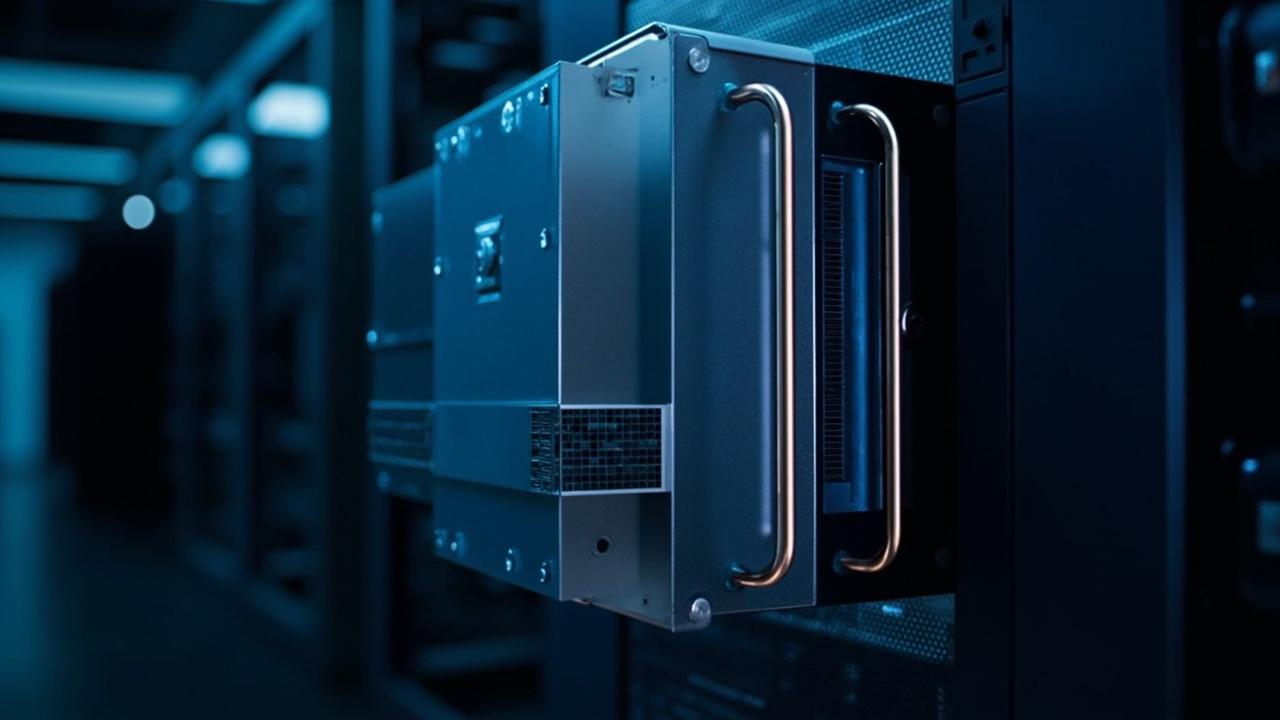
If you have racks of 20-50 kW each and thought you needed liquid cooling to manage them, the Liebert XD gives you another option: refrigerant-based high-density cooling, without water in the room, without a water-based rear-door heat exchanger, without rewiring the site. This guide tells you when it is suitable and when it is NOT.
The Liebert XD is a dedicated rack cooling system, based on direct expansion of refrigerant (NO water, NO glycol). Each XD cools a specific rack up to 35 kW per rack, using a rear-door or top-mount heat exchanger that extracts heat from the rack before it mixes with the room air.
What is the XD and why is it unique in the Vertiv portfolio?
Its position in the Vertiv portfolio is unique: neither perimeter nor in-row nor traditional rear-door. It is dedicated rack-cooling — the unit couples to the rack like just another peripheral, and heat is rejected to the exterior (air) or to a water loop (external to the site).
- Liebert XDO (Overhead): cooling modules mounted on the ceiling or false ceiling, ideal for rooms with limited floor space (10-30 kW).
- Liebert XDV (Vertical): top-mount modules placed directly on top of the rack (10-30 kW).
- Liebert XDH (Horizontal): In-Row cooling modules installed between the rows of racks (10-35 kW).
- Liebert XDR (Rear-Door): heat exchangers installed directly on the rear door of the rack.
Key technical specifications
- Capacity per rack: 10-35 kW depending on model and configuration.
- Refrigerant: R-134a (legacy), R-407C (transition), R-410A (current). In new installations consider R-454B for lower GWP — confirm availability with Vertiv.
- Compressor: hermetic scroll, dedicated per XD system.
- Dry system: the refrigerant circulates in a closed loop between the rack and the outdoor unit. No water in the room.
- Voltage: 380-415 V / 480 V, three-phase, 50/60 Hz.
- Controller: iCOM with specific profile for XD.
- Refrigerant leak sensor: critical — the XD uses refrigerant in the room in small quantities; buildings with strict regulations require it.
- Additional weight on the rack: 80-150 kg depending on configuration. Verify raised floor capacity (raised floor, elevated false floor on pedestals that creates a plenum for cable and air passage).
When the XD is suitable
- You have racks of 20-50 kW that perimeter or in-row do not manage efficiently.
- You do not want (or cannot) install water piping in the room.
- You do not want a water-based rear-door heat exchanger for regulatory or maintenance reasons.
- Your site is HPC (High-Performance Computing, high-performance computing), AI/ML (Artificial Intelligence / Machine Learning, model training or inference), dense virtualization, or rendering.
- You want a modular solution that grows rack by rack.
- You have technical staff who can maintain a refrigerant system (does not require a chiller operator, but does require an HVAC technician).
When the XD is NOT suitable
- Average density less than 15 kW/rack — the XD is oversized.
- You do not have technical staff to maintain a refrigerant system — the learning curve is greater than perimeter.
- The target rack is not standard 19″ — the XD assumes a 600/800 mm wide rack.
- Your site has regulations prohibiting refrigerant in the room (LEED Platinum, strict green buildings).
- You need cooling for 5+ high-density racks — evaluate direct-to-chip liquid cooling (DLC, Direct Liquid Cooling, where a cooling liquid circulates through cold plates in direct contact with the processor) or CDU (Coolant Distribution Unit, unit that distributes coolant to multiple racks) for cost and scalability.
- Your raised floor does not support the additional weight of the XD.
Comparison with CRD and liquid cooling
| Technology | Capacity per Rack | Fluid in Room | Ideal Scenario |
|---|---|---|---|
| Liebert XD (Refrigerant) | 10-35 kW | Refrigerant in closed loop (R-407C / R-410A) | HPC / AI 20-50 kW without water piping in the room |
| Liebert CRD (Water/Glycol) | 5-30 kW | Water or water-glycol | Sites with existing piping and available chillers |
| Direct Liquid Cooling / DLC | 50-200+ kW | Water or dielectric refrigerant | Dense AI/HPC (>50 kW/rack) and GPU farms at scale |
Practical decisions and errors we see in field service
- Verify raised floor load capacity BEFORE installing — the XD adds 80-150 kg to the rack; an unprepared floor collapses.
- Leak sensor ALWAYS — even if local regulation does not require it. The difference between a controlled incident and losing the site.
- Do not confuse XD with CRD — they are different technologies. XD uses refrigerant; CRD uses water.
- Do not oversize — installing XD in racks that only have 8-10 kW is a waste of CAPEX and energy.
- Rack cable management — if the cabling blocks the rear-door, the XD loses 30-40% of capacity. This is an operational problem, not an equipment one.
- Operation: rack setpoint 24-28°C supply to the server. ASHRAE A1 allows up to 27°C; A2 up to 35°C in some cases.
- Maintenance: annual compressor vibration analysis; annual leak test with electronic detector. Compressor useful life 80,000-100,000 hours.
Conclusion: High density without rewriting the site rules
The Liebert XD is, in 2026, the perfect middle ground for AI and HPC adopters who do not want (or cannot) bring water into the computer room. It gives you a rack capacity of 20-35 kW with dry installation, without new piping, without additional chiller rooms, without rewriting your site regulations. If your AI load is landing on legacy infrastructure —which is what happens in most corporate sites in Mexico today— the XD lets you scale without the risks or regulatory costs of a liquid cooling project from scratch.
It is not the cheapest option on the market nor the most advanced (that is provided by direct-to-chip DLC). But it is the most pragmatic for 90% of corporate sites that are landing AI workloads on existing infrastructure: you do not break your architecture, you do not skyrocket the cost of the raised floor, and you grow rack by rack according to real demand, not by projection.
Is your site ready for 20-35 kW per rack but you do not want to switch to liquid cooling? Talk to a Noxtel advisor. We evaluate your current density, your load roadmap, and your raised floor capacity to tell you if the XD is the right path, or if it is better to stay with CRD/DFC or jump straight to DLC/CDU.
Sources
- Vertiv Liebert XD — product search — https://www.vertiv.com/en-us/search?q=liebert+xd
- Vertiv Thermal Management / Cooling — https://www.vertiv.com/en-us/products/thermal-management/cooling/
- ASHRAE Technical Resources — https://www.ashrae.org/technical-resources/
- TIA-942-C — https://tiaonline.org/product/tia-942-c/
- Montreal Protocol / Kigali Amendment — UNEP — https://ozone.unep.org/treaties/montreal-protocol
- Uptime Institute Research & Reports — https://uptimeinstitute.com/resources/research-and-reports/
Want to master this?
Noxtel Academy →