
Free Cooling in Data Centers: When Liebert AFC, Stulz CyberAir 3 EC, or Schneider EcoBreeze Make Sense
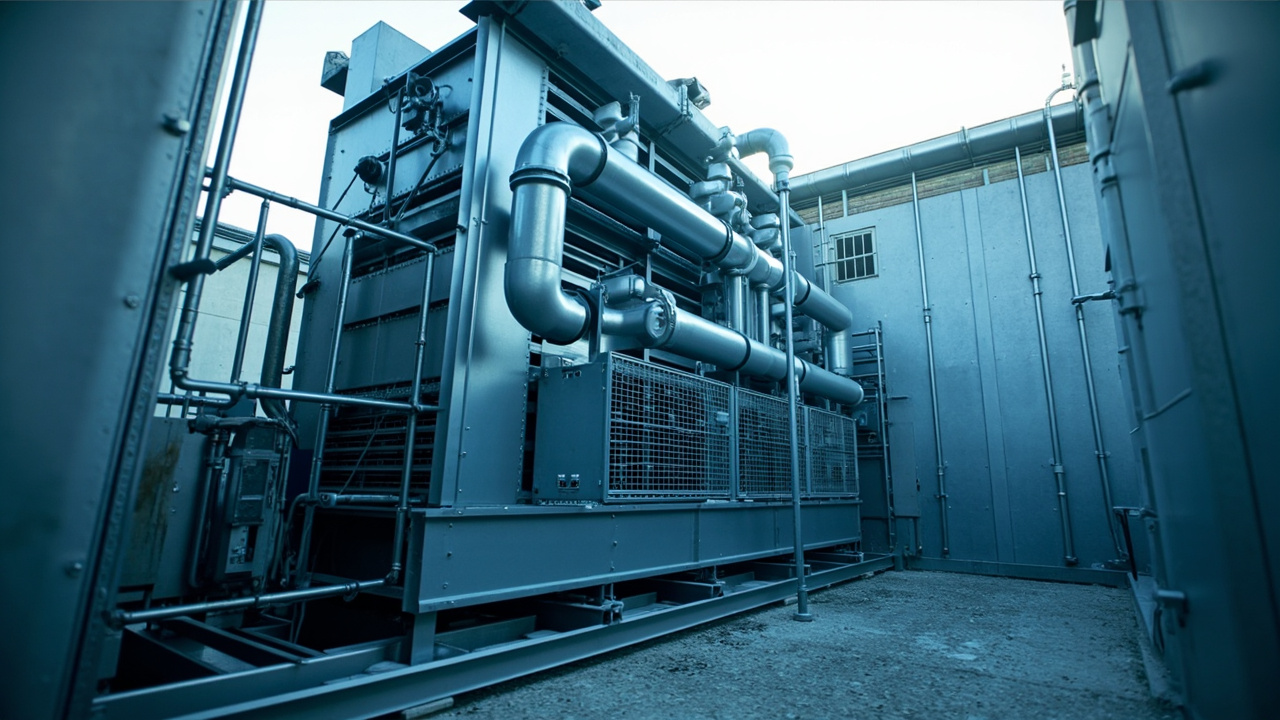
Free cooling is not a luxury: it is the fastest lever to lower PUE
PUE (Power Usage Effectiveness, that is, the ratio between the total energy consumed by the data center and that consumed solely by the IT equipment; a value close to 1.0 indicates maximum efficiency) is the most cited and worst-measured metric in the industry. Nearly all operators report PUE between 1.3 and 1.5 as "optimal", but the reality is that most operating rooms are between 1.6 and 2.2. The difference is not in the UPS or the servers: it is in the cooling system.
Cooling is typically 40-50% of the total energy consumption of a data center. Any technology that reduces that fraction without sacrificing reliability has a direct impact on OPEX (recurring operating expense). Free cooling —using outside air or water to help cool the room without activating the compressor— is the fastest and most proven lever to achieve it.
Vertiv, STULZ, and Schneider Electric have specific precision air lines with integrated or dedicated free cooling: the Liebert AFC (Advanced Free Cooling) from Vertiv, the CyberAir 3 EC from STULZ, and the Schneider EcoBreeze. This article helps you understand which applies to your climate, room, and type of operation, and when free cooling is not advisable despite the appeal of the figure.
Variants and part numbers of free cooling equipment
The three manufacturers offer different free cooling architectures, and each has specific SKUs based on capacity, type of rejection (air or water), and level of integration with the building system.
| Family | Free cooling type | Available modes | Capacity range | Typical application |
|---|---|---|---|---|
| Liebert AFC (Advanced Free Cooling) | Direct air + economizer | Total, partial, mechanical free cooling | 20-100 kW | Tier II/III room with favorable climate |
| Stulz CyberAir 3 EC (Economizer Cool) | Hybrid air + water | Free cooling air, water, mixed, mechanical | 15-80 kW | Medium-sized room with climatic variability |
| Schneider EcoBreeze | Modular air with damper | Direct, adiabatic, mechanical free cooling | 30-250 kW | Medium-large room, moderate hyperscale |
The physical location defines the scope of the civil works. The Stulz CyberAir 3 EC is an internal perimeter unit (installed inside the room or in an adjacent technical room, with short ducts to the IT room). The Schneider EcoBreeze is an external AHU (Air Handling Unit) module with evaporative cooling, and the Liebert AFC is an external adiabatic chiller — both are installed outside the room or on the rooftop, which requires exterior works and ducts or piping toward the interior. This difference directly impacts the installation cost: exterior units require construction permits, storm drainage, and, in many cases, rooftop slab reinforcement.
Manufacturer part numbers follow internal nomenclatures: the AFC is identified with `AFC` prefixes followed by the capacity; the CyberAir 3 EC uses the `EC` suffix to distinguish it from the standard CyberAir 3; the EcoBreeze has its own identifiers per module size. For quotation, the exact SKU must come from the manufacturer’s catalog or the certified integrator.
How free cooling works: the basics before choosing equipment
The principle is simple: if the outside temperature is lower than the required indoor temperature in the room, there is no need to activate the compressor; it is enough to bring in cold air from outside, filter it, and return it. Energy efficiency goes from a coefficient of performance (COP, that is, the ratio between heat extracted and electricity consumed; a COP of 3 means that for every electrical kW, 3 thermal kW are extracted) of about 3 (compressor) to an effective one of 8-12 (fans only).
There are three main architectures:
- Direct air free cooling (air-side economizer). Dampers (adjustable louvers) or motorized dampers are used to mix outside air with return air according to demand. Simple, robust, requires favorable climate (mean annual outside temperature below 18 °C, for example).
- Water free cooling (water-side economizer). Outside cold water (cooling tower, river or sea water) is used to feed the precision air coil instead of the compressor. It requires a tower, piping, and water treatment.
- Adiabatic free cooling. The outside air is humidified before entering the heat exchanger, enabling free cooling at higher outdoor temperatures. The Schneider EcoBreeze uses this architecture in its modules.
The choice depends on the local climate, available space, CAPEX budget, and operational risk tolerance. None of the three is universally better; each one wins in a different context.
Technical specifications of the Liebert AFC, CyberAir 3 EC, and Schneider EcoBreeze
Electrical
- Power supply: 380-415 V three-phase, 50/60 Hz on all models.
- Consumption in free cooling mode: fans and controls only, typically 0.05-0.10 kW per kW of thermal output delivered.
- Consumption in mechanical mode (active compressor): 0.30-0.45 kW per thermal kW, similar to conventional precision air.
- Control: iCOM display (Vertiv), STULZ Microprocessor (STULZ), Schneider Ecostruxure (Schneider). All support BMS Modbus, BACnet, and SNMP.
Cooling
- Refrigerant: R-410A in mechanical modes; free cooling modes do not use refrigerant on the unit side.
- Typical transition point: 12-18 °C outdoor temperature, depending on the indoor setpoint and humidity.
- Partial free cooling capacity: 30-70 % of nominal capacity, sufficient for temperate climate for most of the year.
Mechanical
- Dimensions: vary by capacity; the Liebert AFC at 50 kW measures approximately 900 x 1200 x 2000 mm.
- Weight: 400-700 kg per unit, requires a slab with a load capacity ≥ 800 kg/m².
- Noise level: 62-72 dB(A) in mechanical mode; 50-58 dB(A) in free cooling mode (fans only).
Pros of well-implemented free cooling
- Energy savings of 40-70 % of the cooling system consumption. This typically translates into a PUE improvement of 0.2-0.4 points in rooms that previously operated with conventional air.
- Carbon footprint reduction. Fewer kW consumed means fewer emissions if your data center is in an area with an electricity grid based on fossil fuels (most of Mexico). The emission factor from CENACE (Centro Nacional de Control de Energía) during peak hours can reach 0.55 kg CO₂/kWh.
- Fewer accumulated hours on the compressor. The compressor is the component with the highest failure rate in precision air conditioning units. Operating it less extends its useful life from 10-12 years to 15-18 years.
- Suitable for new rooms and retrofit. Free cooling can be installed in new rooms (designed from the start) or retrofitted into existing rooms with duct dampers or dedicated modules such as the EcoBreeze.
- Native support from the three main manufacturers. Vertiv, STULZ, and Schneider provide certified service in the main cities of Mexico. It is not experimental technology; it has been mainstream for over a decade.
Drawbacks and when free cooling is NOT advisable
- Requires favorable climate. If your data center is in a city with an annual average outdoor temperature greater than 22 °C (e.g., Hermosillo, La Paz, Villahermosa), free cooling only activates a few days a year and the investment is not justified. Review the climate data from the last five years before requesting a quote.
- Higher initial investment. A free cooling system costs between 25-50% more than an equivalent conventional one. The return on investment (ROI, i.e., the time it takes for the accumulated savings to equal the extra installation cost) is typically 3-5 years in favorable climate, but can exceed 10 years in warm climate.
- Requires space for dampers or modules. The EcoBreeze and AFC occupy more floor space than an equivalent conventional air conditioning unit. In existing rooms with limited space, retrofit may not be viable.
- Humidity and outdoor air particles. Bringing in outdoor air without adequate treatment introduces contaminants, dust, pollen, and humidity. Final filters for direct economizers should be MERV 11 to MERV 13 (or ISO class ePM1 / F7) to retain microparticles and pollen before entering the room. The system must actively control humidity to prevent condensation.
- Risk of failure due to improper sizing. If the free cooling is undersized for the peak load, the transition to mechanical mode on warm days may not sustain the temperature. This requires a study of peak hours over the last five years.
- Operational complexity. A free cooling system has more operating modes, more potential points of failure, and requires technical staff with specific training. For small rooms without dedicated personnel, the conventional one is simpler to operate.
Comparison: AFC vs CyberAir 3 EC vs EcoBreeze
| Equipment | Type of free cooling | Capacity range | Ideal climate | Relative cost | Best for |
|---|---|---|---|---|---|
| Liebert AFC | Direct air + economizer | 20-100 kW | Temperate-cold | Medium | Existing Tier II/III room with viable ductwork |
| Stulz CyberAir 3 EC | Hybrid air + water | 15-80 kW | Variable | Medium-high | Room with existing cooling tower |
| Schneider EcoBreeze | Modular adiabatic air | 30-250 kW | Temperate-warm | High | Medium-large room, moderate hyperscale, modular expansion |
| Conventional without free cooling | Mechanical only | any | any | Low | Oppressive hot room, limited budget, small room |
The choice depends more on the climate and the space than on the price. If your room is in CDMX, Monterrey, Guadalajara, or Tijuana, any of the three is viable; the decision comes down to integration with your existing BMS and the availability of certified local service.
Practical tips before investing in free cooling
Evaluate the historical climate
Do not make decisions based on the annual average; take the hourly data from the last five years from the nearest weather station. The key question is: how many hours per year does the outdoor temperature allow total or partial free cooling? If it is more than 4,000 hours/year, the investment is generally justified. If it is less than 1,000, it is not.
Calculate the real savings, not the theoretical ones
A vendor may show you a projected PUE of 1.15 with free cooling. The real one, considering the hours where the system switches to mechanical mode due to peaks, is usually 1.25-1.35. Use these numbers in your financial model, not the ones in the brochure.
Verify service availability
A system with free cooling has more components than a conventional one (dampers, additional sensors, control logic). If the manufacturer does not have a certified technician in your city, the response time on failure can be 5-10 days. This may not be acceptable for your operation.
Common field errors
- Buying the system only based on the PUE brochure. Brochures show the optimal case, not the average. Ask the manufacturer for real operating data from similar installations in comparable climates.
- Ignoring humidity and air quality. In Mexico City, outdoor relative humidity reaches 80-90% during the rainy season. If your free cooling system does not actively control humidity, you will have condensation and corrosion. The humidistat is not optional.
- Not sizing for the peak load in mechanical mode. Free cooling eases average operation, but during heat waves the compressor must sustain the full load. If the compressor is sized for 50% because "free cooling covers the rest", you fall short when you need it most.
- Underestimating installation space. The EcoBreeze and AFC take up more space than a conventional air conditioning unit. In existing rooms, this may require relocating racks or losing capacity. Measure the available space before quoting.
- Not integrating with the existing BMS. If your building already has a Schneider or Vertiv BMS, installing a free cooling system from another brand requires integration development. This can be a significant hidden cost.
- Skipping the commissioning. Commissioning is the point-by-point verification that the system operates as designed. Without formal commissioning, transition modes can fail in production without anyone noticing until the first heat wave.
Free cooling is the right decision when the climate and the operation allow it
If your data center is in a city with more than 4,000 hours/year of usable outdoor temperature, you have space to install the system, and you have budget for the additional 25-50 % of CAPEX, free cooling is probably the most cost-effective efficiency lever available today. The choice between Liebert AFC, Stulz CyberAir 3 EC, or Schneider EcoBreeze is usually determined by the integration with your existing infrastructure and the availability of certified local service, not by the technical specifications.
An informed free cooling decision starts with hourly climate data from the last five years, not with the manufacturer’s catalog. Calculate the expected savings in your actual scenario, size the system for peak mechanical mode, and verify the availability of certified service in your city before signing the quote. It is the only way to know whether free cooling will deliver the expected savings or whether you will end up with a sophisticated system plagued by operational problems.
? the figures in this article (capacities, efficiencies, operating temperatures, energy savings) come from public datasheets from Vertiv, STULZ, and Schneider Electric, and are verified against the official catalogs before publication. The ranges indicated correspond to the offer available at the close of 2026; confirm the specific SKU in your quote.
Sources
[1] Vertiv — Thermal Management / Cooling catalog. https://www.vertiv.com/en-us/products/thermal-management/cooling/
[2] Vertiv — Liebert AFC product search. https://www.vertiv.com/en-us/search?q=liebert+AFC
[3] STULZ — official site and precision air catalog. https://www.stulz.com/en-us/
[4] STULZ Deutschland — precision air product catalog. https://www.stulz.de/en/products/
[5] ASHRAE — technical resources on data centers (TC 9.9 Mission Critical Technologies). https://www.ashrae.org/
[6] Uptime Institute — research reports on efficiency and resilience. https://uptimeinstitute.com/resources/research-and-reports/
[7] Montreal Protocol — phase-out of high-GWP refrigerants. https://ozone.unep.org/treaties/montreal-protocol
Want to master this?
Noxtel Academy →
