Fire is an implacable threat that does not discriminate.
While Data Centers are rightly the main focus when talking about high-tech fire protection, the reality is that any mission-critical facility runs a devastating risk.
From hospitals to manufacturing plants, research laboratories, vital document archives or control rooms, the interruption caused by a fire can be catastrophic, not only in terms of material losses but also of human lives, irrecoverable data, and reputation.
Why Your Critical Business Needs Advanced Protection?
When we talk about “mission critical,” we mean any operation whose interruption would have serious consequences for the organization, its customers, or society. Think of:
- Hospitals and Clinics: Interruption of medical services or destruction of patient records.
- Manufacturing Plants: Loss of specialized machinery, inventory, and production time.
- Laboratories: Destruction of research, valuable samples, and costly equipment.
- Archives and Libraries: Loss of irreplaceable historical, legal, or cultural documents.
- Control Rooms and Operations Centers: Interruption of essential infrastructure management (energy, transport).
- Financial Institutions: Loss of transactional and operational information.
The consequences of a fire in these facilities go beyond replacement cost: they include loss of operability, reputational damage, legal liabilities, and most importantly, risk to human life.
Key Components of a Fire Protection System
1. Early Detection: The First Line of Defense
Detecting a fire in its earliest stages is crucial. The earlier the threat is identified, the more time there is to react and the less damage occurs. Modern systems go far beyond conventional smoke detectors:
- Aspirating Smoke Detectors (VESDA): Capable of detecting microscopic smoke particles even before fire is visible, ideal for highly sensitive environments.
- Point Smoke Detectors: Photoelectric or ionization, they are the basis of most systems.
- Heat Detectors: React to a rapid increase in temperature or to a fixed temperature.
- Flame Detectors: Detect infrared or ultraviolet radiation emitted by flames.
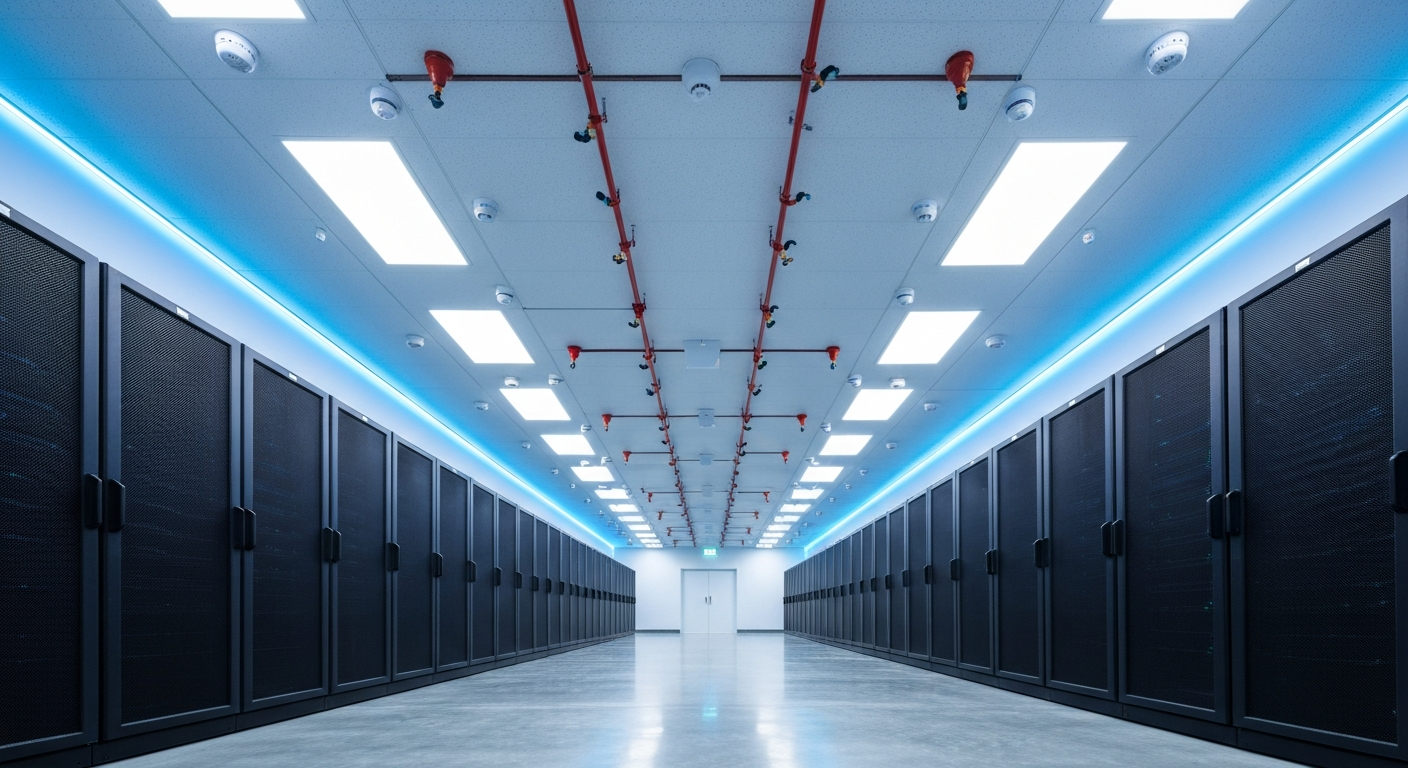
These detectors are connected to a centralized control panel that activates audible and visual alarms, and can automatically trigger suppression systems.
2. Effective Suppression: Controlling and Extinguishing the Threat
Once the fire is detected, the objective is to extinguish it quickly minimizing damage to assets and people. This is where “clean agents” shine:
- Clean Agent Systems (FM-200, Novec 1230): They are the preferred option for critical environments. They act by smothering the fire without leaving residues, are non-conductive of electricity, and are safe for people in adequate concentrations. They protect electronic equipment, documents, and works of art without causing collateral damage.
- Water Mist Systems: Use high-pressure water micro-droplets to extinguish the fire. They require much less water than traditional sprinklers, reducing water damage.
- CO2 Systems: Extremely effective for extinguishing fires, but dangerous for people in enclosed spaces due to oxygen deprivation. They are used in unstaffed areas or with very strict evacuation protocols.
- Condensed Aerosol Systems: A more recent technology that generates a solid extinguishing aerosol in fine particles, also without damaging equipment.
The choice of suppression system will depend on the type of risks, the assets to protect, and the occupancy of the space.
Key Considerations for Implementing your System
- Risk Assessment: A professional analysis is essential to identify the specific vulnerabilities of your facility.
- Custom Design: There is no “one size fits all” solution. The system must be designed tailored to your needs, complying with local and international regulations (NFPA, ISO).
- Regular Maintenance: A system is only as good as its maintenance. Periodic inspections, testing, and maintenance are essential to guarantee its operability.
- Integration: Consider integrating the fire system with other security and building management systems.
- Staff Training: Staff must be trained to react appropriately to a fire alarm and understand evacuation procedures.
Protect your Investment, Secure your Future
Investing in an advanced fire detection and suppression system is not an expense, it is a critical investment in the continuity of your business and the safety of your employees.
In a world where resilience is key, ensuring that your critical operations are protected against one of the most destructive threats is simply indispensable.
Do not wait until it is too late.
A well-designed and implemented system can mean the difference between a small interruption and a total disaster.