Edge data center for manufacturing: why Mexican plants in 2026 can no longer wait for corporate
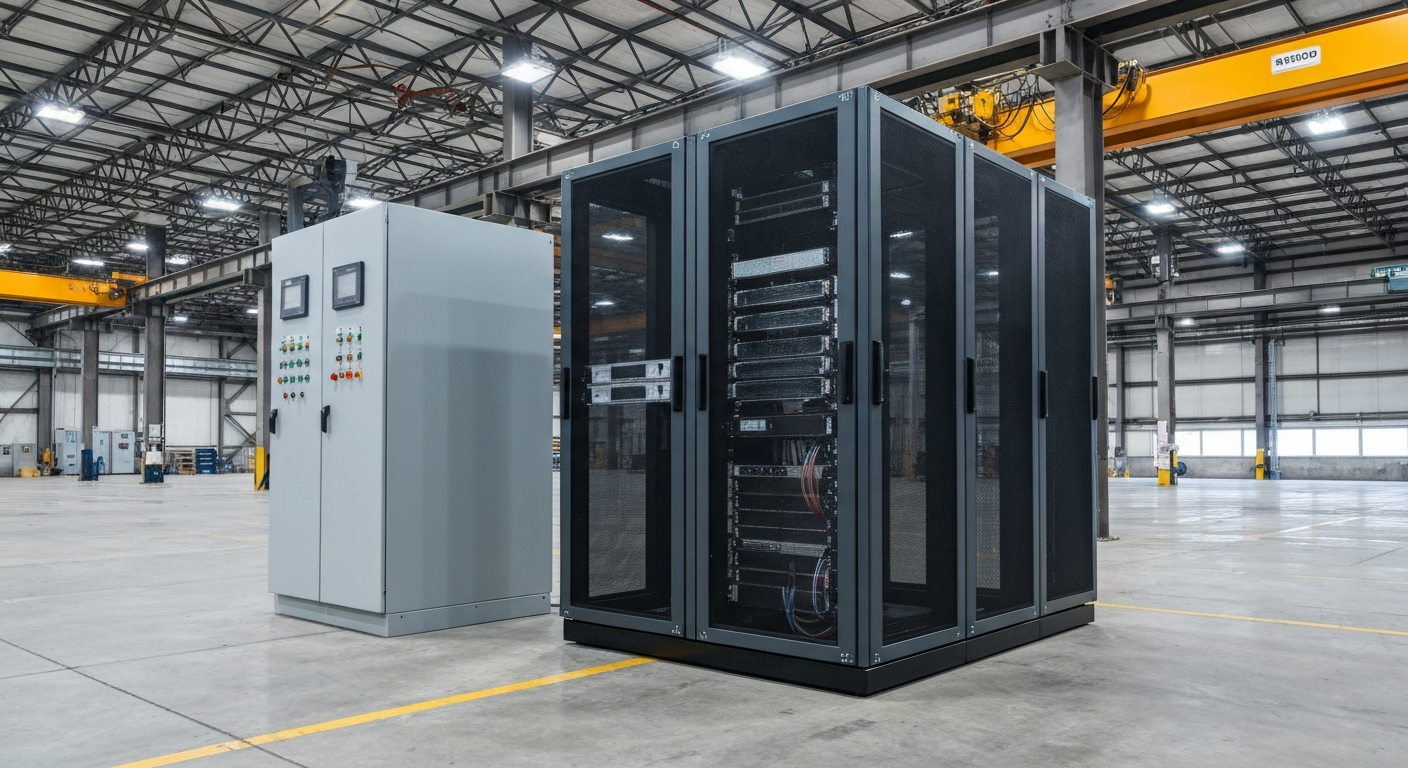
In manufacturing, waiting for data to travel to the corporate data center and come back already processed introduces a latency that, in many cases, makes the use case unviable. The edge data center (compute and storage infrastructure located at the site where data is generated, close to the production line) emerges as the answer to this need. This article describes what problem it specifically solves in Mexican manufacturing plants, what unique constraints the industrial environment imposes, and what technical decisions separate a successful implementation from an IT rack poorly integrated to the plant floor.
What problem does the edge data center solve on the plant floor
Three categories of problem justify investment in local compute at a manufacturing plant:
- Processing latency: computer-vision quality-control applications, real-time anomaly detection systems, and predictive-control algorithms require response times lower than what a link to the corporate data center offers.
- Availability against connectivity loss: the plant cannot stop production because the WAN (Wide Area Network) link to corporate goes down. Local compute ensures operational continuity.
- Regulatory compliance and data residency: some processes generate data that must not leave the plant’s physical perimeter due to internal, contractual, or sector regulation.
Use cases that actually justify edge in manufacturing
Not every application on the plant floor needs local compute. Three cases where the edge data center is justified by technical and economic value:
- Computer-vision quality inspection on high-speed lines, where every millisecond of latency impacts throughput (the volume of parts processed per unit of time).
- Industrial safety systems and machinery protection, where the time between detecting an unsafe condition and acting on the equipment must be deterministic.
- Predictive-maintenance analytics on critical machinery, where the inference model runs continuously with data that must not leave the plant.
For other cases — batch analytics, executive dashboards, long-term storage — sending data to the corporate data center remains the most cost-efficient option.
The unique constraints of the industrial environment
A traditional data center assumes controlled conditions of temperature, humidity, dust, and vibration. A manufacturing plant offers the opposite, and the edge data center design must compensate:
- Constant vibration from heavy machinery (presses, motors, conveyors): equipment must be mounted on racks that absorb it, and storage drives must be selected for vibration resistance, not only capacity.
- Dust and contaminants: the cabinet requires filtration appropriate to the environment (metallic dust in metal-mechanic plants, particles in food plants) and a more aggressive preventive filter-maintenance plan than in a traditional data center.
- Temperature variation: areas near furnaces, welding, or thermal processes generate ambient temperature peaks that the cabinet cooling must handle.
- Electromagnetic interference: large motors, variable-frequency drives, and welding equipment can generate EMI that affects sensitive electronics. Shielding and physical separation are part of the design.
Reduced Tier and acceptable uptime on the plant floor
An edge data center in a manufacturing plant does not need to meet the same Tier (redundancy and availability classification per Uptime Institute) as a corporate data center. Three considerations:
- The cost of one hour of downtime on the plant floor is different from the cost in a data center that serves financial transactions. Redundancy architecture must be sized to the real operational impact, not copied from corporate.
- Simplified Tier II or Tier III options are usually sufficient for most manufacturing use cases. The CAPEX (capital expenditure) difference between Tier II and Tier III can be significant and not always justified.
- The edge data center can operate as local backup infrastructure for critical applications and as a compute accelerator for latency-sensitive cases, without trying to replace the central data center.
Integration with the central data center
The edge data center does not operate in isolation. Its integration with the corporate data center determines the real value of the deployment:
- Model and data synchronization: when the edge runs inference, the model trained in corporate must reach the edge securely and consistently. The reverse happens with data generated at the edge that feeds retraining.
- Centralized monitoring: corporate must have operational visibility of the edge (equipment status, temperature, consumed capacity) without requiring specialized local staff.
- Identity and access management: security policies must be consistent between corporate and edge, ideally with a unified identity system.
- Operating procedures: maintenance, patching, and incident-response tasks must be coordinated between both teams to avoid inconsistencies.
When edge is NOT the answer
The edge data center on the plant floor is the right answer for cases with latency sensitivity, continuity against link loss, or mandatory data residency. It is not the right answer for:
- Reducing processing costs without a clear technical case: the edge has its own CAPEX and OPEX that are only justified if there is demonstrable operational value.
- Satisfying regulatory requirements that are actually met with logical access controls and encryption, without needing local compute.
- Operating as a mini corporate data center replicated on the plant floor: the edge must be designed for specific use cases, not as a copy of the central one.
The decision between edge and central must be based on measurable operational requirements and the value each option brings to the productive process. A poorly justified edge becomes underutilized infrastructure with operating costs that no one can defend.
Sources
[1] Uptime Institute — Tier Classification System and Research: https://uptimeinstitute.com/
[2] TIA — TIA-942 Telecommunications Infrastructure Standard for Data Centers: https://tiaonline.org/products/tia-942/
[3] BICSI — Telecommunications Standards and Methods: https://www.bicsi.org/standards
[4] ASHRAE — Technical Resources for Industrial and Data Center Environments: https://www.ashrae.org/technical-resources
[5] Wikipedia — Edge computing (background reference): https://en.wikipedia.org/wiki/Edge_computing
[6] Wikipedia — Data center (background reference): https://en.wikipedia.org/wiki/Data_center
Want to master this?
Noxtel Academy →