
Compact Precision Air for Edge and Cabinets: Liebert DataMate, Stulz Wall-Air, and Liebert Mini-Mate2
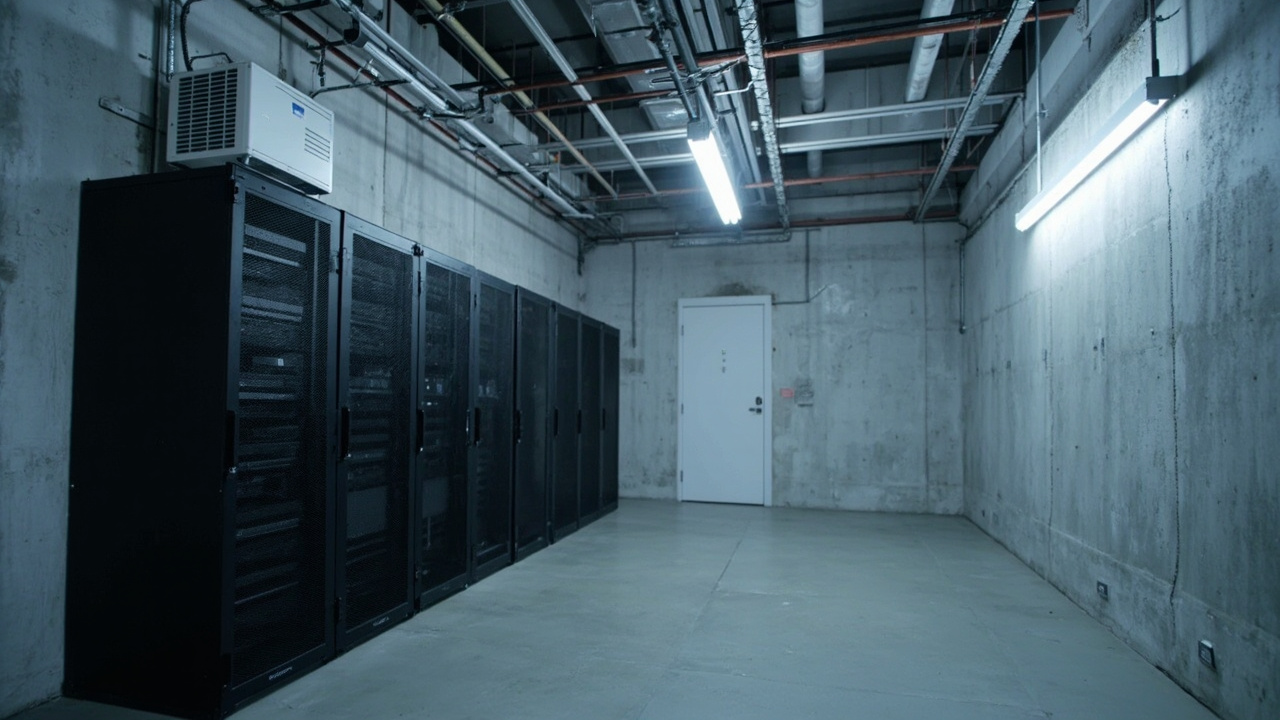
Precision air for edge is not a split disguised as a data center
When a company needs to air-condition an electrical room of 4-12 m² with one or two communications racks, or an edge site (remote site where information is processed close to the end user) in a bank branch, a hospital, or an industrial plant, the typical pattern is to buy a residential mini-split because that is what the local provider offers. And it works for the first six months.
Then the problems come: relative humidity goes out of range during the rainy season, the compressor seizes during a heat wave, the condenser freezes in winter, and nobody has a maintenance contract because "it is a household air conditioner". For IT equipment in production, this means tickets, downtime, and, in the worst case, data loss.
When a company needs to air-condition an electrical room of 4-12 m² with one or two communications racks, or an edge site (remote site where information is processed close to the end user) in a bank branch, a hospital, or an industrial plant, the typical pattern is to buy a residential mini-split because that is what the local provider offers. And it works for the first six months. Then the problems come: relative humidity goes out of range during the rainy season, the compressor seizes during a heat wave, the condenser freezes in winter, and nobody has a maintenance contract because it is a household air conditioner.
For IT equipment in production, this means tickets, downtime, and, in the worst case, data loss. To close that gap, there are three lines of compact precision air depending on the available space: the Liebert DataMate from Vertiv and the Stulz Wall-Air, both wall-mount (de pared); the Stulz CyberAir Mini, also wall-mount; and the Liebert Mini-Mate2 from Vertiv, ceiling-mounted (de plafón, suspended from the slab with threaded rods) — ideal when neither floor nor walls have free space because the walls are saturated with cable trays and electrical panels.
Variants and part numbers
The compact precision air offering is concentrated in capacities of 2 to 12 kW, sufficient for communications cabinets, micro data centers, and low-density edge sites. The part numbers follow the manufacturer’s nomenclature: the Liebert DataMate is identified with DMA or DME codes depending on the variant; the Stulz Wall-Air and CyberAir Mini use STULZ’s own prefixes; the Liebert Mini-Mate2 uses MMA2 prefixes followed by the capacity in kW.
| Family | Available capacities | Rejection type | Typical application |
|---|---|---|---|
| Liebert Mini-Mate2 | 2-12 kW | DX air, DX water, CW | Electrical room, micro-DC, 1-3-rack edge |
| Stulz CyberAir Mini | 3-10 kW | DX air, DX water, CW | Dedicated edge, industrial site, telecom site |
| Schneider/APC equivalent | 3-12 kW | DX air, DX water | IDF/MDF room (Intermediate/Main Distribution Frame, wiring distribution cabinets), micro data center in retail site |
DX air variants (direct expansion with air-cooled condenser, meaning the heat is rejected to the outside via a heat exchanger) are the most common in Mexico for edge sites due to their installation simplicity. DX water and CW (chilled water) variants require external piping and are reserved for new installations or sites with a nearby chiller.
Technical specifications of the DataMate, Wall-Air, CyberAir Mini, and Mini-Mate2
Electrical
- Power supply: 208-230 V single-phase (models up to 6 kW); 380-415 V three-phase available above 6 kW.
- Steady-state consumption: 0.30-0.40 kW per kW of thermal output in normal mode.
- Control: local display with thermometer and hygrostat (sensor that measures relative humidity); remote monitoring options via Modbus or SNMP on models with a communications card.
Cooling
- Refrigerant: R-410A in DX variants; CW units do not use refrigerant on the unit side.
- Operating setpoint: 18-27 °C configurable; relative humidity 40-55 % controllable with optional integrated humidifier.
- Operating modes: continuous, economy (turns off the compressor when the room is within range), and emergency (free ventilation if the compressor fails).
Mechanical
- Dimensions: 600-900 mm wide by 300-400 mm deep by 1500-1800 mm high. Fits in a standard electrical room without civil works.
- Weight: 60-90 kg in wall-mount (DataMate, Wall-Air, CyberAir Mini); 100-160 kg in ceiling-mount (Mini-Mate2 suspended from the slab). In both cases, two technicians can handle it without a forklift.
- Noise level: 48-58 dB(A) at one meter; the quietest of the two brands is the Stulz CyberAir Mini in silent mode (52 dB(A) in nominal operation).
- Filters: G3 standard; washable, no monthly replacement in normal environments.
Pros of the DataMate, Wall-Air, CyberAir Mini, and Mini-Mate2
- Installation in existing room without civil works. The DataMate, Wall-Air, and CyberAir Mini are wall-mounted with a bracket and connected to the electrical service entrance and condensate drain. The Mini-Mate2 is suspended from the slab with threaded rods, freeing up the floor and walls — a key option in communications rooms where the walls are already occupied by cable trays or electrical panels. In any case, the equipment is up and running within one workday.
- Contained initial cost. Between 30-50 % cheaper than an equivalent in-row unit in capacity. For edge sites with tight budgets, the difference is decisive.
- Integrated humidity control. Unlike a residential split, these units maintain relative humidity at 40-55 % even during the rainy season, eliminating the risk of electrostatic discharge (a spark that damages components when the air is too dry) and corrosion.
- Simple maintenance. Washable filters, no complex internal components, accessible from the front without moving the unit. A general HVAC (Heating, Ventilation and Air Conditioning, i.e., climate control) technician can service it with basic training.
- Suitable for unmanned sites. With a communications card, the unit reports status, alarms, and temperature to a remote NOC (Network Operations Center, network monitoring center). This is critical for edge in branch offices, where nobody visits the site more than once a month.
- National service coverage. Both Vertiv and STULZ have certified service networks in CDMX, Monterrey, Querétaro, Guadalajara, and Tijuana, which eliminates the excuse of "no technician nearby".
Cons of the DataMate, Wall-Air, CyberAir Mini, and Mini-Mate2
- Capacity limited to 12 kW. If the site grows beyond three racks with densities of 8-10 kW per rack, the unit falls short. There is no in-situ upgrade; replacement is required.
- Single cooling zone. The unit cools the air in the entire room; it does not cool per rack like in-row cooling. If your critical rack is 15 meters from the unit, the air arrives already mixed with ambient air and loses precision.
- Mechanical requirement per form factor. Wall-mount models (DataMate, Wall-Air, CyberAir Mini) require a structural wall with a load capacity of ≥ 100 kg — unreinforced drywall is not suitable. The ceiling-mounted Mini-Mate2 requires a structural upper slab capable of supporting the anchorage with threaded rods of (100-160 kg per point at 4 points). Verify with the building’s maintenance area before quoting.
- Noticeable noise in offices. 48-58 dB(A) is tolerable in a dedicated electrical room, but audible in an open office. If the edge site is on an office floor, evaluate acoustic cabinets or location in a closed room.
- No internal redundancy. Single compressor, single fan. For critical sites you need a second unit in N+1 configuration (one active unit plus one backup) or a backup split that engages when the main one fails.
- Limited free cooling capacity. Air DX versions do not take advantage of outside cooling. For sites in cold climates (Toluca, Puebla in winter), evaluate CW variants or models with an economizer for actual savings.
Comparison: DataMate vs Wall-Air vs CyberAir Mini vs Mini-Mate2 vs conventional split
| Equipment | Capacity | Humidity control | Noise level | Relative cost | Service network |
|---|---|---|---|---|---|
| Liebert Mini-Mate2 | 2-12 kW | Yes (40-55 % RH) | 50-58 dB(A) | Medium-high | National, certified |
| Stulz CyberAir Mini | 3-10 kW | Yes (40-55 % RH) | 48-55 dB(A) | Medium-high | National, certified |
| APC/Schneider equivalent | 3-12 kW | Yes (40-55 % RH) | 52-60 dB(A) | Medium | National, certified |
| Residential mini-split | 2-7 kW | Not controllable | 38-50 dB(A) | Low | Any HVAC technician |
The difference between a precision unit and a residential split is not marketing: it is the control range, component redundancy, and support. When the edge site supports a critical application (payment processing, digital signage, industrial monitoring), the cost of failure is far greater than the savings from the split’s CAPEX (initial capital expenditure).
Practical tips before installation
Sizing
Calculate the load with an actual equipment inventory, not with the rack label. A 42U rack with 10 servers and two switches consumes between 3-6 kW in normal operation; under peaks it can reach 8 kW. Add 30 % margin and review the "all equipment at maximum" scenario to size the correct unit.
Installation
Verify the structure before installing. For wall-mount (DataMate, Wall-Air, CyberAir Mini): confirm with the building’s maintenance department that the wall supports 60-100 kg without reinforcement; if not, install a metal bracket on the back or structural support. For ceiling-mount (Mini-Mate2): confirm that the upper slab has anchoring capacity for 100-160 kg at 4 points and that the threaded rods can be fastened to the slab (concrete or metal, not to electrical installations or ducts). Leave 30 cm clear around the unit for maintenance access and airflow.
Operation
Set the setpoint to 22 °C and relative humidity to 45 % as a baseline; review temperature logs monthly to detect drift. If the site is unattended, configure remote alerts for out-of-range temperature or compressor failure. A unit without monitoring can be failing for weeks before anyone notices.
Common field errors
- Buying the unit by price and not by service. The mini-split is 40 % cheaper on day one and 300 % more expensive when it fails in production and no technician can service it in less than 48 hours. For edge sites in production, after-sales service is more important than the technical specification.
- Not calculating the load correctly. An undersized unit operates at 100 % capacity for 12 months of the year, ages twice as fast, and fails sooner. Better to pay 15 % more for a correctly sized unit than to replace it at three years.
- Ignoring humidity. IT equipment is more sensitive to humidity than to temperature. A split without humidity control generates static in the dry season and condensation in the rainy season; either one costs you a hard drive or a network card.
- Not documenting the electrical room. Without an electrical service plan, without records of changed filters, without annual thermography, the edge site becomes an operational blind spot. Lack of documentation is the root cause of 70% of the failures we see in site surveys.
- Forgetting redundancy. For sites supporting 24/7 operation, a single unit is a single point of failure (single point of failure). Installing two small units in N+1 is better than one large unit; if one fails, the other holds while service arrives.
- Mixing brands unknowingly. On a site where there is already a Vertiv UPS, installing a STULZ air conditioner may not be a problem; but on a site with a Schneider UPS and Vertiv air conditioner, alarm and monitoring integration requires development. Better to keep a single brand if possible.
When compact precision air is the right decision
The Liebert DataMate, Stulz Wall-Air, and Stulz CyberAir Mini are the right answer for the 1-12 kW range at edge sites, electrical rooms, and micro data centers where you have structural wall available to mount the unit. If your edge site has walls saturated by cabling or electrical panels, the ceiling-mount Liebert Mini-Mate2 is the alternative: it frees up floor and walls, only requiring a capable overhead slab. Neither is the answer for dense rooms or for critical edge that requires extreme redundancy without local personnel.
If your site is in this range and you have access to certified technical service in your city, either unit will give you years of reliable operation. The decision between Vertiv and STULZ usually comes down to local service availability and compatibility with your existing UPS or BMS; the technical specifications are very close.
An informed decision starts with a site survey. Measure the actual load, identify hot spots, evaluate humidity by season, and review wall space before choosing. It is the only way to know whether a compact precision air unit is enough or if you need to jump to in-row from day one.
? The figures in this article (capacities, dimensions, noise levels, rejection types) come from public Vertiv and STULZ datasheets, and are verified against the official catalog before publishing. The ranges indicated correspond to the offering available at the close of 2026; confirm the specific SKU in your quote.
Sources
[1] Vertiv — Thermal Management / Cooling catalog. https://www.vertiv.com/en-us/products/thermal-management/cooling/
[2] Vertiv — Liebert Mini-Mate product search. https://www.vertiv.com/en-us/search?q=liebert+mini-mate
[3] STULZ — official site and precision air catalog. https://www.stulz.com/en-us/
[4] STULZ Deutschland — precision air product catalog. https://www.stulz.de/en/products/
[5] ASHRAE — data center technical resources (TC 9.9 Mission Critical Technologies). https://www.ashrae.org/
[6] TIA — TIA-942-C standard for telecommunications in data centers. https://tiaonline.org/
[7] Uptime Institute — research reports on efficiency and resilience. https://uptimeinstitute.com/resources/research-and-reports/
Want to master this?
Noxtel Academy →
