Diesel vs natural gas vs hybrid generators for data centers
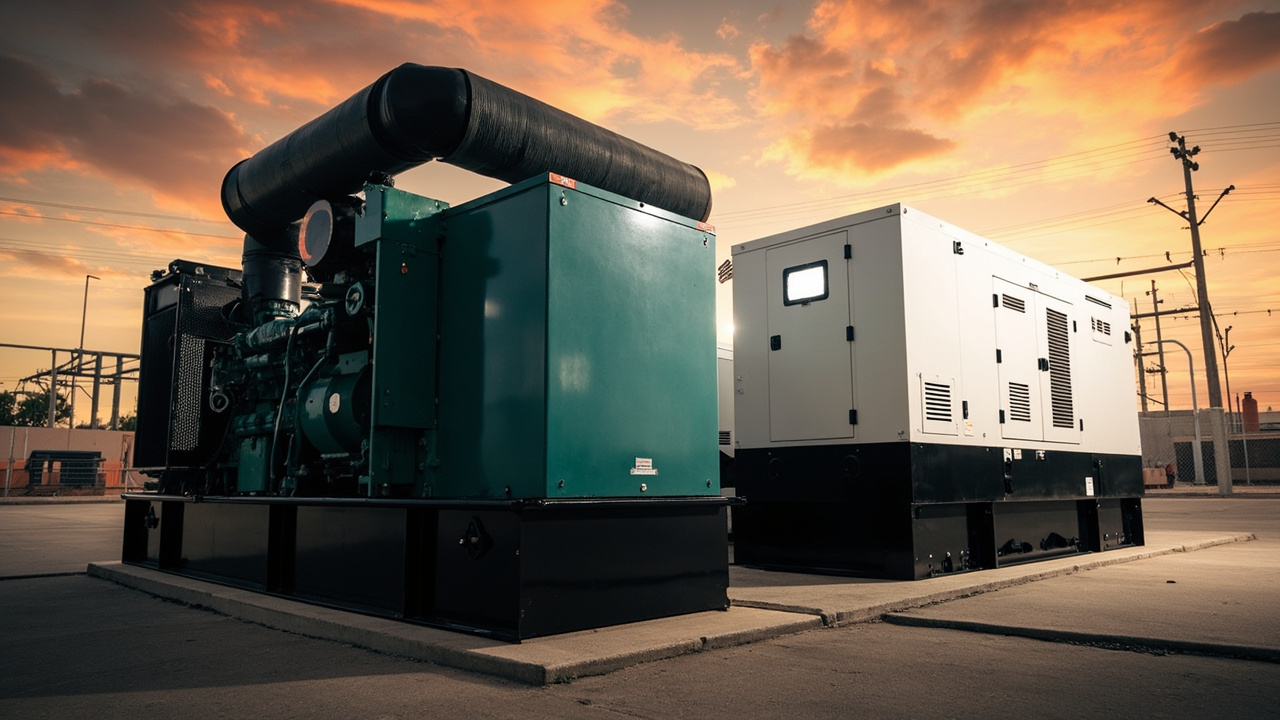
The choice of fuel for the emergency generator defines the data center’s reliability during a power outage (blackout), the annual operating cost (OPEX), and the overall carbon footprint of the site. Diesel, natural gas, and hybrid systems represent three distinct technological paths, each with radically different risk profiles, regulatory requirements, and maintenance schemes.
Why this decision is made at the start of the project
The backup generator is not a secondary accessory chosen at the end of the build. Its selection defines the physical dimensions of the electrical room, the load capacity of the structural foundation, the size and containment of the fuel storage tanks, the mandatory permits required by Civil Protection and fire departments, and the logistics of the associated supply chain. Attempting to modify this architecture in advanced project phases dramatically increases costs and delays delivery timelines.
1. Diesel: The historical industry standard
The diesel generator remains the most widespread option in data centers across Latin America. Its main strategic advantage is immediate physical autonomy: by relying on local storage tanks designed to support between 8 and 24 hours of continuous operation, the site can weather prolonged blackouts without depending on external public services or on the stability of third-party gas distribution networks.
- Efficiency: Modern diesel gensets deliver an electrical efficiency of between 0.35 and 0.45 liters per kWh produced (0.35 – 0.45 L/kWh) in continuous operation scenarios.
- Environmental Regulation: Their emissions of nitrogen oxides (NOx) and particulate matter are the highest of the three options. In markets like Mexico, strict environmental regulations (such as NOM-085-SEMARNAT-2011 and its state-level equivalents) limit their installation in areas with environmental contingencies or poor air quality.
- Logistics Risk: The main operational challenge of diesel is the supply chain during prolonged emergencies. If the data center operator does not have priority supply contracts with authorized carriers guaranteeing 24/7 response, a prolonged utility outage endangers the site’s continuity. Its preventive maintenance is strict: it requires monthly load tests, filtration, and constant fuel stabilization to prevent internal degradation.
2. Natural gas: The continuous fuel
Generators powered by natural gas offer continuous, extended operation without the need for ground-based logistical resupply, since the underground distribution network maintains constant supply as long as duct pressure is preserved. From an environmental standpoint, their pollutant emissions sit between 30% and 40% below diesel, and they also operate at notably lower noise levels.
- The major reliability limitation: The primary obstacle is their absolute dependence on the gas network infrastructure. In a major natural disaster (such as a high-intensity earthquake, hurricane, or critical flooding), underground gas distribution lines can be interrupted simultaneously with the collapse of the general electrical grid.
- Mission-Critical Risk: For a high-availability data center, depending on a single external vector is unacceptable. For this reason, natural gas is rarely deployed in isolation; it is usually implemented in dual-fuel configurations that start on diesel and switch over to gas once the engine stabilizes.
- Regional Availability: In regions like Mexico, mid-pressure natural gas infrastructure is not uniformly distributed. In remote industrial zones or cities without pipeline coverage, liquefied natural gas (LNG) must be transported via tanker trucks and stored in dedicated cryogenic tanks on site, which notably increases CAPEX and the complexity of the basic design.
3. Hybrid systems: Dual-fuel and trigeneration
Dual-fuel systems represent a highly efficient hybrid solution: the engine starts using 100% diesel to meet the critical response times required by the load, and once frequency and voltage are stabilized, it performs a gradual transition to replace most of the consumption with natural gas. This architecture combines the immediate, safe autonomy of diesel with the economic and environmental benefits of natural gas. It is currently one of the preferred schemes in new projects under N+1 or higher redundancy configurations.
Decision table
| Scenario / Site Risk | Recommended System | Key Reason |
|---|---|---|
| Robust natural gas network, critical loads, and unlikely blackout. | Natural gas or dual-fuel | Continuous fuel without resupply and lower NOx (nitrogen oxide) emissions than diesel. |
| Isolated site or one at risk of natural disaster (earthquake, hurricane, flooding). | Diesel with a 24-hour tank and proven resupply contract. | Operational autonomy independent of the gas network, which may fail alongside the electrical grid. |
| 24/7 operation in a climate requiring year-round chiller use. | Trigeneration (cogeneration + absorption chiller) | Waste heat recovery from exhaust to feed the chiller reduces total electrical consumption. |
| Site with a strong ESG (environmental, social, and governance) commitment. | Natural gas or hybrid system | Avoid diesel as the only source: -30% NOx emissions and a better carbon profile for auditors. |
Technical sizing and backup architectures
The basic engineering design rule for backup electrical supply requires minimum N+1 redundancy configurations. For example, to safely back up a critical load of 2 MW supported by UPS systems, the standard design calls for the installation of three 1 MW gensets (where two units cover the nominal demand and one is held in active reserve). For high-availability environments operating under strict Tier IV design level requirements, the configuration evolves toward 2N or 2(N+1) architectures, completely duplicating distribution paths and generation plants.
A generator should never be sized to operate continuously at 100% of the nominal UPS load. Unified recommendations from leading manufacturers (such as Caterpillar, Cummins, MTU, or Mitsubishi) call for operating the engines at load ranges between 60% and 80% of their nominal capacity. Within this operating window, the engine blocks deliver the best specific fuel consumption, optimize internal combustion, and prevent serious mechanical issues associated with chronic low load (such as cylinder glazing or wet stacking).
Total Cost of Ownership (TCO) analysis at 10 years
- Diesel Infrastructure: Direct fuel cost represents between 60% and 70% of the projected Total Cost of Ownership (TCO) over a decade. The main financial risk in this model lies in the international and local price volatility of diesel.
- Natural Gas Infrastructure: Operating fuel costs are substantially lower and demonstrate greater long-term stability. In geographic locations with mature mid-pressure distribution networks, the 10-year TCO can sit between 15% and 25% below the traditional diesel scheme.
- Hybrid Infrastructure (Dual-Fuel): Requires considerably higher initial capital cost (CAPEX) due to the duplication of components and instrumentation for controlling both fuels. However, it pays back the investment by allowing operators to dynamically optimize fuel mixes based on real-time market (spot) prices for each energy source. In the 10-year projection, its TCO consistently outperforms pure diesel in medium and high-utilization applications.
Conclusion
The choice of backup power generation system for a data center should not be limited solely to analyzing the current price per liter or cubic meter of fuel. Higher-weight factors such as the resilience of the local supply chain, environmental emission constraints, and the geographic risk profile dictate the final architecture. A sizing error or omission of environmental regulations at this stage will inevitably translate into costly hours of operational downtime that could have been avoided at the conceptual design stage.
Sources
[1] MTU/Rolls-Royce Power Systems — Data Center Solutions — https://www.rolls-royce.com/products-and-services/power-systems.aspx
[2] Cummins — Data Center Generators (overview) — https://en.wikipedia.org/wiki/Cummins
[3] Uptime Institute — Tier Standard — https://uptimeinstitute.com/tiers
[4] IEEE — Standards Association — https://standards.ieee.org/
[5] Wikipedia — Diesel generator — https://en.wikipedia.org/wiki/Diesel_generator
Want to master this?
Noxtel Academy →