Diesel generator vs BESS in data center: the real ROI in Mexico 2026
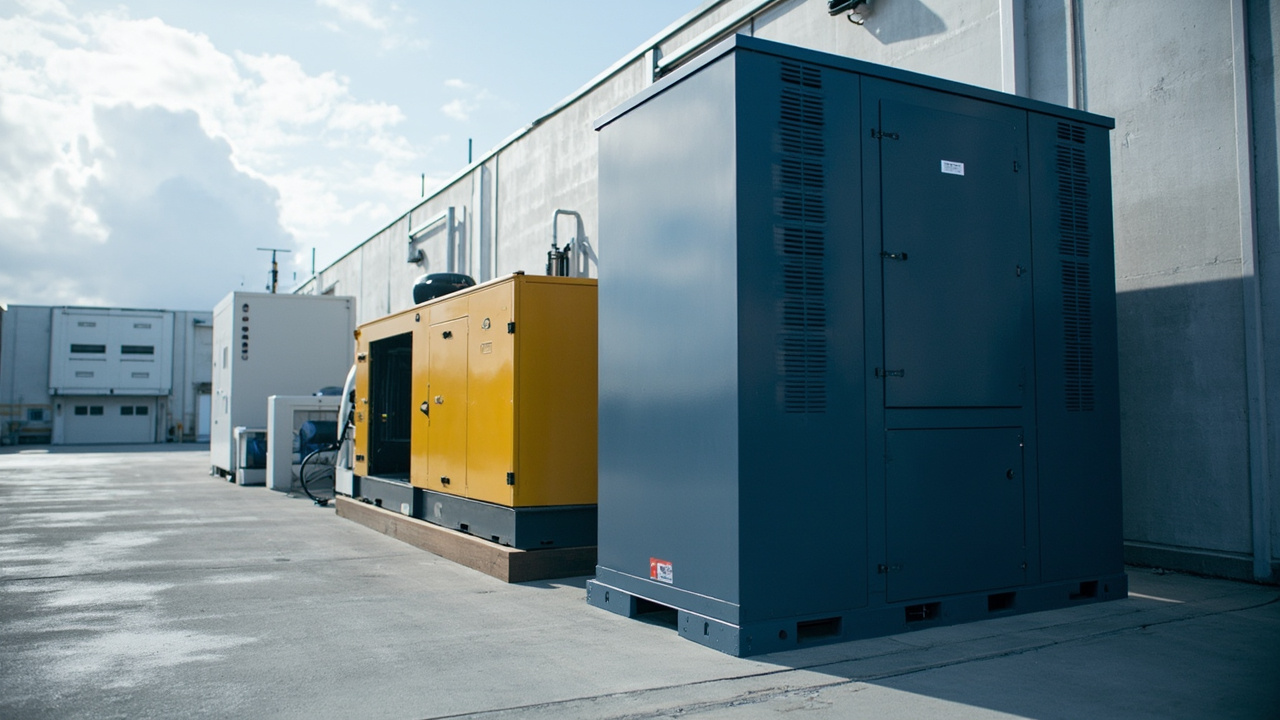
Data centers in Mexico combine two energy backup systems: diesel generators for long-duration backup (5 to 72 hours) and batteries (BESS — Battery Energy Storage System) for fast-transition backup (5 to 60 minutes). The choice between them is no longer binary: AI loads, higher fuel costs, SEMARNAT environmental restrictions, and the technological advance of LiFePO4 batteries make BESS a serious complement to diesel, not a replacement in all cases. This article breaks down CAPEX, OPEX, lifecycle, Mexican regulation, and when each one wins over the other.
Different functions (they do not compete, they complement each other)
The diesel generator and BESS play distinct roles in backup. Diesel starts in 5 to 15 seconds, reaches full capacity in 30 to 60 seconds, and can deliver 100% of its rated capacity for 12 to 72 hours (depending on the fuel tank). BESS starts instantaneously (milliseconds), delivers full power for 5 to 60 minutes (depending on sizing), and is typically combined with a diesel generator to deliver extended autonomy. Together, they cover operational continuity and long-duration backup. Comparing them as mutually exclusive is a common conceptual error.
The common error in the Mexican market is sizing BESS as if it would replace diesel. The correct approach is to size BESS to cover the transient until the diesel generator takes the load (5 to 15 seconds), plus 5 to 30 minutes of autonomy to protect against diesel start failures. With that definition, BESS covers between 8% and 25% of the total backup system CAPEX. Compared with schemes where BESS tries to replace diesel (2 to 8 hours of autonomy), the correct sizing is 4 to 8 times cheaper.
The 6 comparison dimensions
Six dimensions where the two technologies diverge for data centers in Mexico 2026:
- CAPEX per kVA of backup: diesel generator USD $250 to $500/kVA (excluding tank and civil works). LiFePO4 BESS USD $800 to $1,400/kVA installed (includes BMS, cabinet, integration). Diesel is 1.6 to 5 times cheaper in initial CAPEX per kVA.
- Annual OPEX: diesel consumes fuel, requires maintenance, and emits emissions. For 2 MW of diesel backup running 8 hours/month of testing plus 12 hours/year of real operation: fuel USD $18,000 to $30,000/year, maintenance USD $8,000 to $12,000/year. BESS does not consume fuel, only capacity degradation. For 2 MWh installed, typical degradation is 2 to 3% per year (5 years the module is replaced), with maintenance cost USD $6,000 to $10,000/year.
- Lifecycle: diesel generator 20 to 30 years with overhaul at 12 to 15 years (cost 35% to 50% of a new unit). LiFePO4 BESS 8 to 15 years depending on cycles (80% capacity degradation is typically end of useful life). For a 24/7 data center with frequent micro-outages, BESS accumulates daily cycles.
- Response speed: diesel starts in 5 to 15 seconds, reaches full power in 30 to 60 seconds. BESS delivers power in milliseconds. The time difference matters for AI loads (H100 with UVP triggers protection if frequency drops between 58.5 and 59.5 Hz for more than 30 seconds).
- Mexican regulation: Diesel generators require SEMARNAT permit for emissions (NOM-085-SEMARNAT-2011 on stationary sources, plus local Air Quality Management plans / contingencies for metropolitan areas such as CDMX, Guadalajara, and Monterrey). BESS operates without requiring atmospheric emissions permits, requiring only compliance with the electrical code NOM-001-SEDE.
- Footprint and location: diesel takes less physical space (1.5 to 2 m² per MW). BESS requires 1.5 to 2.5 times more area (battery cabinets with fire suppression + air conditioning). In space-constrained Tier IV sites, footprint matters.
When BESS wins
Three cases where BESS has clear ROI:
- Site with densely concentrated AI/HPC loads (over 30 kW per rack) where the H100 UVP regulation requires backup in milliseconds. Diesel starts too slowly; only BESS delivers transient response compatible with AI.
- Site in a metropolitan area with SEMARNAT restrictions on diesel generators (CDMX, Guadalajara, Monterrey new regulations 2024-2026) where operating diesel generators is constrained or requires additional permits. BESS avoids the regulation associated with diesel.
- Operator with CFE GDMTO tariffs that can participate in the backup market (controlled demand program) and earn revenue by making the battery available to the grid. In Mexico 2026 this is still in pilot but CENACE regulation opens opportunities for 2027-2030.
When diesel wins
Three cases where diesel remains the right choice:
- Tier IV site with target autonomy of 24 to 72 hours, required by contractual SLA. BESS with that autonomy is prohibitively expensive in CAPEX (USD $1,200/kWh × 4 hours × MW = USD $4.8 million per MW vs USD $350k per MW diesel). Diesel with a 24-hour tank remains dramatically more economical.
- Site in an industrial or rural area with flexible environmental regulation and accessible fuel. Without strict SEMARNAT restrictions, diesel is unbeatable in CAPEX and autonomy. For sites in industrial parks in Querétaro, San Luis Potosí, Aguascalientes.
- Site with a useful life expectancy of over 20 years. Diesel is proven at 30 years of service with overhaul. LiFePO4 BESS has degradation that requires full replacement at 10 to 15 years and does not allow continuous operation without upgrading the bank.
The Mexican data point 2026
Main operators in Mexico 2026 retain the classic architecture: diesel generator for long-duration backup + UPS with VRLA batteries for the transient (5 to 15 min). The UPS with VRLA serves a function similar to a small BESS, with cycling limitations. Migration to dedicated BESS is starting in new sites from KIO and Ascenty. For enterprise on-prem data centers, the decision depends on the CFE tariff mix, local environmental regulation, and AI load expectations. The diesel + BESS combination (30 to 60 min autonomy) is the dominant choice for new AI sites 2026-2027; diesel alone is reasonable for traditional CPU sites with autonomy over 12 hours.
Sources
- EPRI (Electric Power Research Institute): studies on BESS in data centers and use cases — https://www.epri.com/
- Uptime Institute: data center certifications and energy backup practices — https://www.uptimeinstitute.com/
- CFE: GDMTO and GMD tariffs applicable to energy backup — https://www.cfe.gob.mx/
- SEMARNAT: Mexican regulation on emissions and operation of backup equipment — https://www.gob.mx/semarnat
- EIA (U.S. Energy Information Administration): benchmarks for diesel generator consumption in data centers — https://www.eia.gov/
Want to master this?
Noxtel Academy →