Cooling towers vs adiabatic in a data center: when water stops being your bottleneck
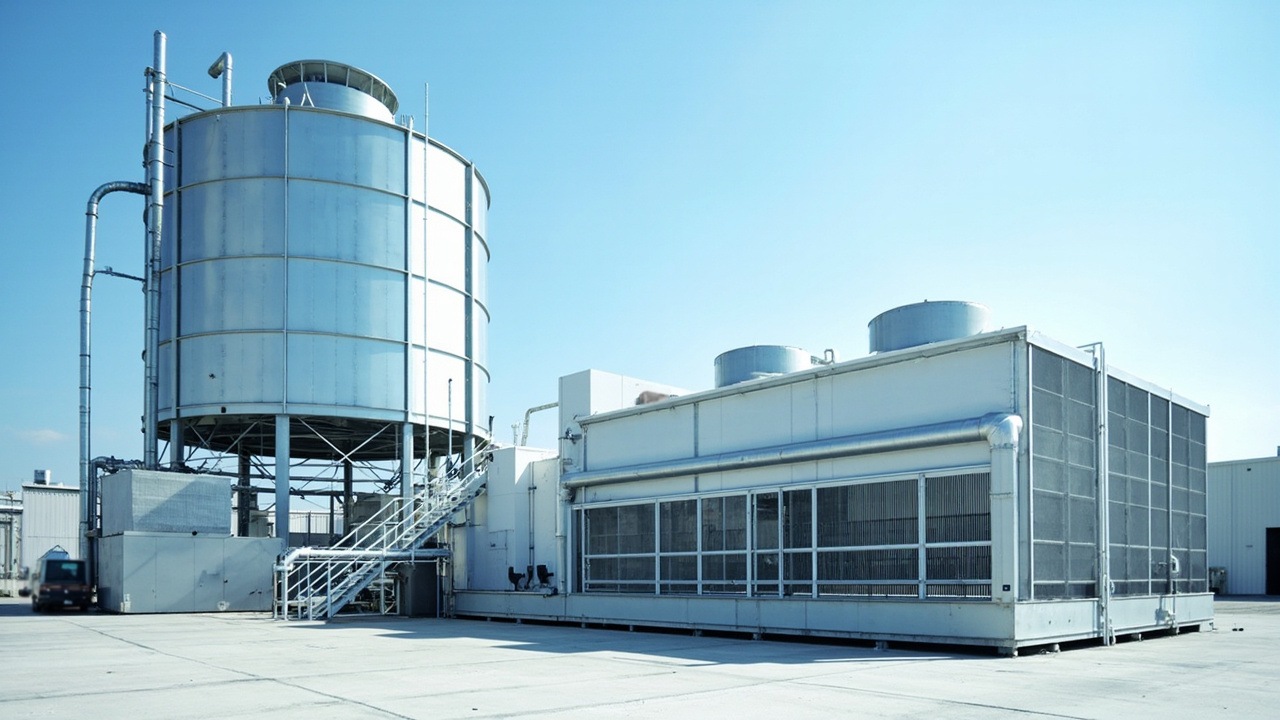
In the open tower the process water meets the air and the heat leaves by evaporation: it has to be replenished. In the adiabatic one the circuit is closed and the air is cooled by evaporation before the coil: water only appears when the environment demands it.
Trane publishes the tower’s make-up rule per ton: 0.0224 of evaporation, 0.0004 of drift, 0.0108 of blowdown, 0.0336 gpm in total. One MW of rejected heat is 284.35 tons: the math gives 1.45 m³/h of evaporation and 2.17 m³/h of make-up.
The energy balance confirms it: 1.45 m³/h evaporated carries close to 1 MW of heat; a larger figure is impossible. The 3.2 m³/h per MW that circulates in reports is total consumption, not evaporation.
On the adiabatic side, Vertiv publishes one million gallons evaporated per year per MW of cooling, 0.43 m³/h; Trane measures the other extreme: the adiabatic assist reduces water consumption by 70% to 80% versus the open tower, with a range of 0.43 to 0.65 m³/h per MW. If the environment does not demand it, no water runs.
| Variable | Open tower | Adiabatic |
|---|---|---|
| Circuit | Open: the water meets the air | Closed: no mixing with the sprayed water |
| Water per MW | 2.17 m³/h of make-up; 1.45 evaporated | 0.43 to 0.65 m³/h; zero without spraying |
| WUE (Trane) | 2.35 / 2.85 / 3.75 L/kWh | 0.15 / 0.22 / 0.28 L/kWh |
| Threshold | Wet bulb, 3.9 °C approach | 23.9 °C wet bulb: full load |
| Energy | With chiller: site PUE of 1.3 to 1.5 | 30% less electricity than the dry cooler |
WUE: the metric that unifies water and energy
WUE (liters of water per kWh of IT) unifies the comparison. Trane publishes three scenarios: for the tower, 2.35 L/kWh in the best case, 2.85 in the most likely and 3.75 in the worst; for the adiabatic, 0.15, 0.22 and 0.28. Between the most likely cases there is a gap of about 13 times less water per kWh.
EPRI confirms it with a 150 MW center: with a water-cooled chiller, 970 million gallons a year and a WUE of 2.8 L/kWh; with liquid cooling and a dry cooler, 69 million and 0.2 L/kWh. That is 901 million gallons less per year.
Warning: the adiabatic’s 0.22 L/kWh is an annual average for equipment that operates between 5% and 20% of the year; in continuous operation it rises to 0.43 m³/h per MW, and Xylem and GWI report 0.75 L/kWh.
Climate sets the threshold: wet bulb or dry bulb
Two variables that must not be confused: the wet bulb marks how far evaporation reaches; the design dry bulb is the thermal limit of the coil. With a wet bulb of 23.9 °C or less, the adiabatic cooler covers 100% of the IT load. Above a design dry bulb of 41.7 °C (0.4% point), dry cooling stops being viable.
Between both thresholds the balance between water and electricity weighs more than the climate. The adiabatic uses less energy than the dry cooler, with a median of 30% less in heat rejection, but it consumes between 8 and 56 gallons of on-site water for every kWh saved: that ratio is compared against the local tariff.
In Mexico the basin decides
CONAGUA measures the degree of water stress by hydrological-administrative region. In 2023 RHA XIII, Aguas del Valle de México, reached 128.7%, Very High; RHA VI Río Bravo, where Monterrey is, 73.9%, High; RHA IX Golfo Norte, which includes Querétaro, 21.4%, Medium. The country is unequal: 653 aquifers, 114 overexploited, and 77% of the population and 84% of GDP in the north and center, with only 31.7% of renewable water.
Blowdown and condensate discharge is governed by NOM-001-SEMARNAT-2021, in force, and sludge by NOM-004-SEMARNAT-2002; NOM-052 only covers the identification and classification of hazardous waste. Almost nobody accounts for the fact that what evaporates does not return through the drain: the water damage of a tower is evaporation plus blowdown plus drift.
And since there is no verified Mexican industrial tariff, a formula serves: break-even water tariff = (electricity price × kWh saved) ÷ (gallons of water used per kWh saved). With 8 to 56 gallons per kWh saved and a median saving of 30% in cooling electricity, that tariff falls below any realistic tariff.
Querétaro: outside air does the work
The clearest documented case is Microsoft’s, with three data centers in Querétaro. It says it uses direct outside air about 95% of the year, without water, and resorts to evaporative cooling only when the ambient temperature exceeds 29.4 °C. In fiscal year 2025 its sites consumed 40 million liters. The note does not document that Microsoft eliminated the tower: it describes a design that leaves evaporation for the hottest 5% of the year, with evaporative backup as a safety net.
Water stops being the bottleneck when the design has a path that consumes no water most of the year, and the evaporative system remains as backup for a handful of hours.
Sources
Want to master this?
Noxtel Academy →